




Journaling after a breakup can help you process emotions, reduce stress, and rebuild your sense of self. Writing allows you to organize thoughts, release tension, and reflect on personal growth. Studies show that consistent journaling improves emotional well-being and even physical health, like lowering heart rates. Here’s how to get started:
- Choose your tools: Use a notebook, app, or voice memos – whatever feels comfortable and private.
- Set a routine: Dedicate 10–15 minutes daily, either in the morning or before bed, to write without distractions.
- Create a soothing space: Find a quiet, calming spot to help you focus.
- Use prompts: Reflect on emotions, lessons from the relationship, and goals for the future.
- Release emotions: Write letters to your ex (not to send) or use the “write-and-release” method to let go of anger or guilt.
Your journal becomes a safe space to explore feelings, track progress, and shift focus from pain to healing. Start small, stay consistent, and let this practice guide you toward clarity and growth.
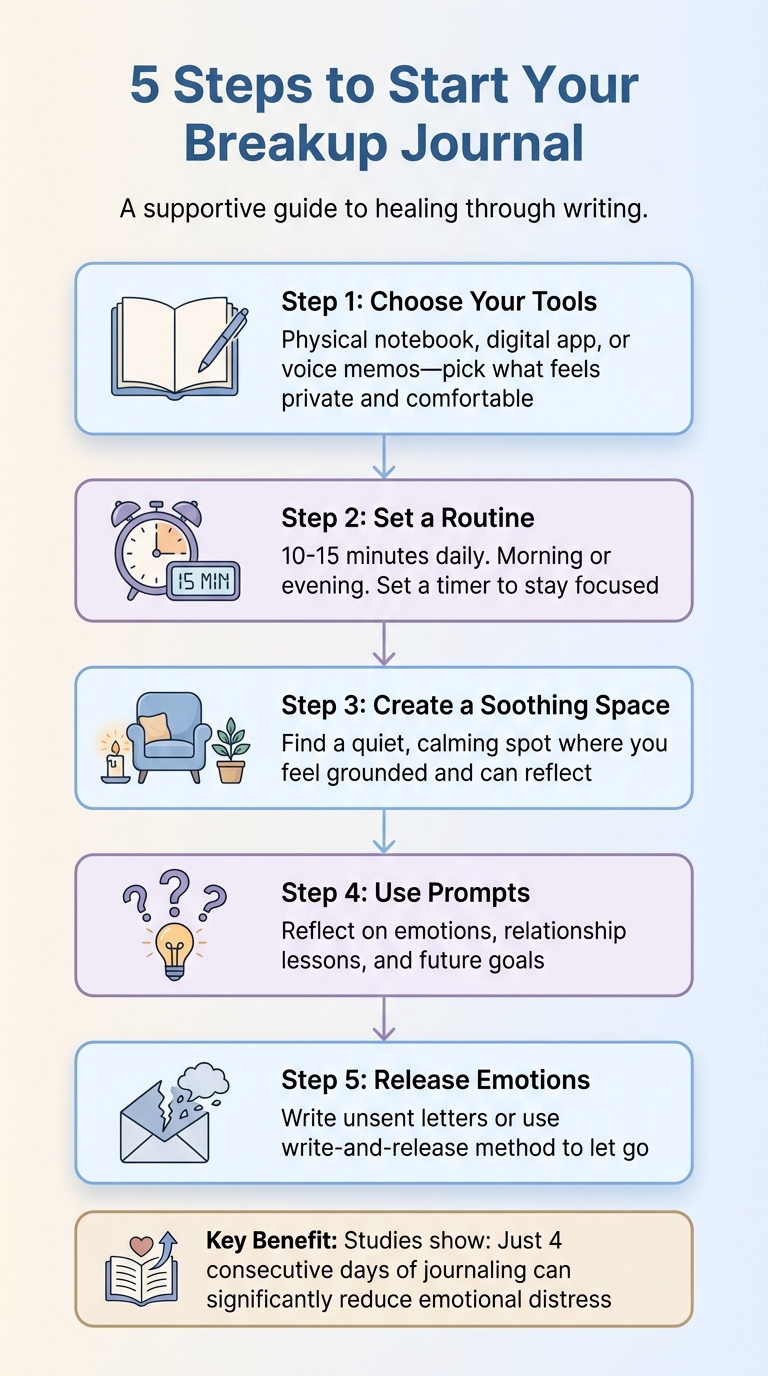
5-Step Guide to Starting a Breakup Journaling Practice
How Journaling Supports Emotional Healing
The Science Behind Journaling
Writing down your emotions can transform a jumble of feelings into clear, structured thoughts. Studies reveal that bottling up emotions after traumatic events can raise your heart rate and even weaken your immune system. Putting those emotions on paper helps release built-up tension, offering both mental and physical relief.
The physical benefits are real. Research shows that people who journal regularly after a breakup tend to have a steadier heart rate and greater heart rate variability – both signs of lower stress levels. This process not only soothes your body but also gives your mind the clarity it needs to untangle emotional knots.
Turning Emotional Chaos Into Clear Thoughts
Journaling doesn’t just calm your body – it helps you organize your emotions. When you find yourself replaying painful conversations over and over, your thoughts can spiral out of control. Writing slows that process down, giving you space to process emotions in a healthier way.
Putting your thoughts on paper turns overwhelming feelings into something tangible and easier to understand. Therapist Susan Borkin captures this perfectly:
"Journaling is an intimate form of writing, one that is able to touch deeply into places that are difficult to speak about".
This isn’t just venting – it’s about clearing mental clutter. By breaking down complex emotions into smaller, digestible pieces, you create room for reflection and growth.
Journaling can also shift your perspective. A study in the Annals of Behavioral Medicine found that people who explored both their thoughts and emotions while journaling gained a deeper understanding of the positive outcomes from stressful experiences. Over time, you might start to see lessons in situations that once felt painful or even notice opportunities where you previously felt stuck. This combination of physical relaxation and mental clarity is a powerful way to reclaim your story after a breakup.
sbb-itb-ee19e1f
How to Start and Maintain a Breakup Journal
Choosing Your Journaling Tools
When it comes to journaling through a breakup, the first step is picking tools that make the process feel personal and supportive. A physical notebook and pen can be a great choice – they encourage creative expression and give you a much-needed break from screens. Opt for a notebook you genuinely like and a pen that feels smooth to write with; these small details can make the habit feel more intentional.
If writing by hand isn’t your thing, digital tools like Notes apps or Google Docs are practical alternatives. There are even apps specifically designed for emotional healing. And if writing feels too overwhelming, consider recording voice memos instead. The key is to choose a format that feels secure and private. As breakup coach Paige Wilhide explains:
"Journaling is a way of pruning, allowing you to gently release that burden, one layer at a time."
Once you’ve got your tools, the next step is to establish a routine that turns journaling into a consistent part of your day.
Setting Up a Journaling Routine
Keep your sessions manageable – 10 to 15 minutes is all you need. Setting a timer can help you maintain focus and avoid overthinking. In fact, research suggests that just four consecutive days of structured journaling can significantly reduce emotional distress.
Timing matters, too. Choose a moment in your day when you won’t feel rushed or distracted. Morning journaling can help clear your head before the day starts, while writing in the evening may help you process emotions before bed. As Elle Huerta, founder of Mend, advises:
"Writing about your breakup brings up emotions, so find the best time of day that doesn’t interfere with your school or work schedule."
Pair your journaling with a soothing ritual to ease into the practice. Whether it’s sipping tea, taking a few deep breaths, or lighting a candle, these small acts can signal it’s time to reflect.
Creating a Comfortable Writing Space
A calming environment can make all the difference when it comes to journaling. Find a quiet, comfortable spot where you feel grounded – this could be a cozy chair at home, a peaceful park bench, or even a quiet corner of a coffee shop.
As Hannah Eastham, Content Manager, explains:
"When you set the scene, you’re making a commitment to slow down, be present, and allow yourself the freedom to reflect and reconnect with your inner self."
Adding small comforts, like soft lighting or journaling outdoors, can help create a soothing atmosphere. And when you finish a tough journaling session, closing your journal can feel like a symbolic way of setting aside those emotions for the rest of your day.
the ultimate breakup journal guide (how i healed)
Journaling Prompts for Processing Your Emotions
Now that you’ve built a journaling habit, it’s time to dive deeper. The right prompts can help you move from feeling overwhelmed to finding clarity. They’ll guide you through the layers of heartbreak, helping you reflect without getting stuck in endless loops of rumination. These questions are designed to help you acknowledge your emotions, understand the relationship, and begin letting go of resentment and self-blame.
Acknowledging and Accepting Your Emotions
The first step is to recognize what you’re feeling. Breakups often bring a mix of emotions – sadness, anger, relief, and confusion might all hit you in a single day. The goal here isn’t to fix or change these feelings, but simply to name them.
- What emotion am I feeling right now, and where do I feel it in my body?
- If this emotion could speak, what would it say to me?
- How has this feeling shifted over the past week?
Reflecting on the Relationship
Once you’ve identified your emotions, take a step back and reflect on the relationship itself. Look at it honestly – both the good and the bad. As Julia Heming from Her Campus puts it:
"It’s easy to miss red flags when you are wearing rose-colored glasses, so acknowledge them now to show that this was not the relationship for you."
- What are three things I miss about the relationship, and three things I don’t?
- What red flags did I overlook in the beginning?
- How did this relationship limit my personal growth or my life in general?
- Were we truly compatible, or was I just trying to make it work?
Letting Go of Resentment and Self-Blame
After exploring your emotions and the relationship, it’s time to start releasing the weight of resentment and guilt. Letting go doesn’t mean forgetting – it means freeing yourself from the hold these emotions have over you.
Write a letter to your ex where you express your anger and resentment. Once you’ve written it, destroy the letter.
- What have I forgiven myself for since the breakup?
- What role did I play in the relationship ending, and how can I accept that with kindness toward myself?
- Do I feel guilty about entering the relationship? If so, what advice would I give to a friend feeling the same way?
These prompts can help you turn the chaos of your emotions into a story of healing, keeping your focus on moving forward.
Prompts for Personal Growth and Moving Forward
Once you’ve worked through the heavier emotions of a breakup, it’s time to guide your journaling toward personal growth. The goal is to shift your focus from the pain of the past to the possibilities of the future. Sarah Thompson from Ahead captures this perfectly:
"The most powerful breakup journal evolves with you, shifting from processing grief to celebrating new beginnings."
Studies reveal that reflecting on the positive aspects of a breakup can boost emotions like confidence, happiness, gratitude, and even wisdom. Balancing entries about pain with entries about hope can naturally move you from loss to growth.
Finding Gratitude in the Experience
Gratitude doesn’t erase the pain, but it allows you to see the lessons hidden within it. This is about spotting the silver linings – the strengths, opportunities, and insights that emerged from the end of the relationship.
Think about how your life has changed since the breakup. Maybe you’ve discovered new freedoms, like more time to focus on your career, hobbies, or friendships. Or perhaps you’ve uncovered a resilience you didn’t know you had. Consider writing a thank-you note to your ex – not to send, but as a way to acknowledge the growth their presence (and absence) sparked in you.
Here are a few prompts to explore:
- What are three things I learned about my needs and boundaries from this relationship?
- What parts of myself did I set aside that I’m excited to reclaim?
- How is this breakup happening for me instead of to me?
- What strengths have I discovered in myself during this challenging time?
Setting Goals and Planning Your Future
Now it’s time to turn those lessons into a roadmap for the future. Use this stage to get specific about what you want – not just in relationships, but in your life as a whole. Imagine your ideal relationship a year from now. What would it feel like? What qualities would you prioritize in a partner based on what you’ve learned?
Break your vision into actionable steps. For example, instead of saying, “I want to be happy,” ask yourself, “What’s one small step I can take today to move toward my ideal life?”. Explore new hobbies or experiences you’ve been curious about. Picture a life where you prioritize yourself – what would your daily routine look like?
Here are some prompts to help you plan:
- What are three qualities I will prioritize in my next partner?
- What new experiences or hobbies am I curious about exploring?
- Which relationship patterns will I leave behind?
These exercises are designed to help you move from simply surviving the breakup to thriving in its aftermath. Keep your journaling sessions short – 10 to 20 minutes is enough to avoid overthinking – and always end by jotting down one thing you’re looking forward to. This process bridges the gap between processing the past and stepping into a brighter future.
Techniques to Improve Your Journaling Practice
Tailor your journaling to match your healing journey. Pay attention to how writing affects you – whether it soothes your emotions or keeps you stuck in the past.
The Write-and-Release Method
Try the write-and-release method: when strong emotions surface, pour them onto the page without holding back. Once you’re done, close your journal as a symbolic way of letting those feelings go.
Another approach is to write an uncensored letter to your ex – one you’ll never send. Afterward, destroy the pages. This act of physically discarding the letter can help you release pent-up emotions without causing real-world fallout. It’s a small but powerful ritual that combines emotional expression with a tangible sense of closure.
Beyond words, creative additions can deepen your healing process.
Adding Visual Elements
When words alone don’t capture the depth of your emotions, try incorporating sketches, photos, or meaningful quotes. These visual elements can complement your writing, offering a richer way to process your feelings and shift your focus toward the future.
As you explore different ways to express yourself, it’s equally important to recognize when your journaling may be working against you.
Identifying Unhelpful Patterns
Keep an eye on your journaling habits. If you find yourself stuck in repetitive thoughts, feeling worse after writing, or obsessing over your ex, it’s time to make some changes. Sarah Thompson, a breakup recovery expert, highlights the importance of mindful journaling:
"A breakup journal offers a powerful way to process these feelings without getting stuck in a cycle of pain. Unlike traditional journaling that might lead to rumination, a healing-focused breakup journal helps transform raw emotions into meaningful growth."
To avoid falling into unproductive patterns, set a timer for 10 to 20 minutes. When the timer ends, close your journal – no exceptions. Create guidelines for yourself, such as avoiding lengthy analyses of your ex or rehashing old arguments. If these patterns persist, try cutting back to journaling every three days and limit entries to around 500 words. These adjustments ensure your journaling remains a tool for progress rather than a trap for rumination.
Conclusion
Journaling can transform the chaos of a breakup into something more manageable. By putting your feelings into words, you take what feels like an overwhelming storm and turn it into something you can understand and work through. It’s a way to organize your emotions, rebuild your sense of self, and keep track of your healing process.
Think of your journal as a personal roadmap. Even when the days feel tough, it serves as proof of how far you’ve come. Studies show that regular journaling helps reduce emotional distress and supports both mental and physical recovery.
With this in mind, set aside just 10–15 minutes a day to write in a quiet, private space. Use the prompts and techniques discussed earlier to dive deep into your emotions, let go of lingering resentment, and reconnect with the parts of you that may have felt lost. Balance writing about your pain with reflecting on your strengths and the things you’re excited about in the future. Each session can help you take another step toward reclaiming your life.
"It’s the process of externalizing big emotions that can bring perspective and relief. When you put your feelings into words, it shifts them from something undefined and chaotic into something you can start to understand and manage." – Dr. Miriam Greenspan, Trauma Specialist
Your healing journey is yours alone, and your journal is a safe space to navigate it. By making journaling a regular habit, you’ll uncover the clarity, perspective, and strength you need to move forward – one page at a time.
FAQs
How can journaling help me heal emotionally and physically after a breakup?
Journaling provides a comforting outlet to navigate the whirlwind of emotions that often follow a breakup. By putting pen to paper regularly, you can untangle your thoughts, uncover recurring themes, and find lessons hidden in the chaos. It’s a great way to quiet the mental noise – like replaying old conversations or stewing in frustration – allowing you to gain clarity and treat yourself with more kindness.
But the benefits of journaling go beyond emotional relief. The stress of heartbreak can take a serious toll on your body, and journaling has been shown to help reduce stress. This, in turn, can lead to better sleep, a stronger immune system, and even improved heart health. Establishing a journaling routine can be a simple yet meaningful way to care for both your emotional and physical well-being during a tough period.
What are some helpful journaling prompts to work through my emotions after a breakup?
Journaling can be an incredibly helpful tool for working through emotions and finding clarity after a breakup. If you’re not sure where to begin, here are some prompts to guide your thoughts:
- What do I miss about the relationship, and what don’t I miss? Take a moment to reflect on both the positive memories and the challenges. This can help you see the relationship more clearly.
- What lessons did I learn about myself during this relationship? Think about how you’ve grown and what you’ve discovered about your own needs and values.
- What do I need to let go of to move forward? Consider any lingering feelings – like guilt, anger, or regret – that might be keeping you stuck.
- What do I deserve in a healthy relationship? Use this prompt to affirm your worth and outline the qualities you’ll prioritize in future relationships.
Spend just a few minutes a day writing without judgment. This simple practice can help you release pent-up emotions, quiet your mind, and support your emotional recovery.
How can I make sure my journaling helps me heal without becoming repetitive?
To make journaling a more effective and enriching habit, consider these strategies:
- Define a goal for each session: Before you start writing, decide what you want to achieve. Are you working through emotions, analyzing lessons learned, or acknowledging recent successes? Having a clear purpose can help keep your thoughts organized and productive.
- Incorporate diverse prompts: Keep your entries engaging by rotating prompts. For instance, write about lessons you’ve learned, things you miss (or don’t miss), or your aspirations for the future. This variety can prevent your journaling from feeling repetitive.
- Reflect on your entries weekly: Set aside time each week to review what you’ve written. Look for patterns, highlight key takeaways, and reassess your focus to ensure you’re moving forward in your personal journey.
By setting clear intentions, using varied prompts, and revisiting your thoughts regularly, journaling can become a powerful tool for self-discovery and growth.
Tagged with :