



THE REAL PROBLEM
You Don’t Need Another Diary — You Need a Private Journal App for Breakup Pain You’ll Actually Use
Here’s something nobody talks about: most people don’t journal honestly. They self-censor. They soften the ugly parts. They write “I’m sad” when what they actually mean is “I checked their location 14 times today and I’m disgusted with myself.”
That filter exists because, somewhere in the back of your mind, you’re worried someone might find it. A roommate. A future partner scrolling through your Notes app. Your own future self, judging you for how much you cared.
So you write the edited version. The version that sounds reasonable. And the real stuff — the rage, the obsessive thoughts, the bargaining with a universe that isn’t listening — stays trapped inside you, festering. That’s the problem Stumble solves. Not with productivity templates or habit streaks, but with complete, bone-deep anonymity and a community going through the same thing. If you’re working through a breakup recovery process, the ability to write without a mask changes everything.
THE SCIENCE
Why Expressive Writing Actually Heals — and Why Anonymity Makes It Work Better
In the 1980s, psychologist James Pennebaker ran an experiment that changed how we understand grief. He asked one group to write about their deepest emotional experiences for just 15–20 minutes a day. The control group wrote about mundane topics. The results were startling: the emotional writing group showed measurable drops in cortisol, stronger immune function, and fewer doctor visits in the months that followed.
Here’s the part that matters for you: the effect was strongest when people wrote with total honesty. Not when they crafted polished reflections. Not when they tried to find a silver lining. When they dumped the rawest, messiest version of their pain onto the page. Research from UC Berkeley’s Greater Good Science Center confirms that writing about negative experiences helps the brain process and organize traumatic memories, reducing their emotional charge over time.
That’s exactly what an anonymous diary app for mental health enables. When there’s zero chance anyone connects your words to your name, face, or social media profile, you stop performing for an audience. You stop protecting your own ego. You just… write. And that’s when the healing actually starts. It’s the difference between telling your therapist “I’m processing some anger” and finally admitting “I want to key their car and I’m not even sorry about it.” One of those is honest. Only one helps.
HOW IT WORKS
Journaling for Grief and Loss in Four Simple Steps
1. Create Your Anonymous Identity
No real name, no photo, no email linked to your profile. You pick a random alias. Nobody — not even us — knows who you are.
2. Pick a Prompt (Or Don’t)
Choose from prompts designed for heartbreak, grief, loneliness, and life transitions — or freewrite. Your entry. Your rules.
3. Share or Keep Private
Every entry can stay in your private journal — or you can share it with Stumble’s anonymous community to receive support from people who get it.
4. Track Your Emotional Arc
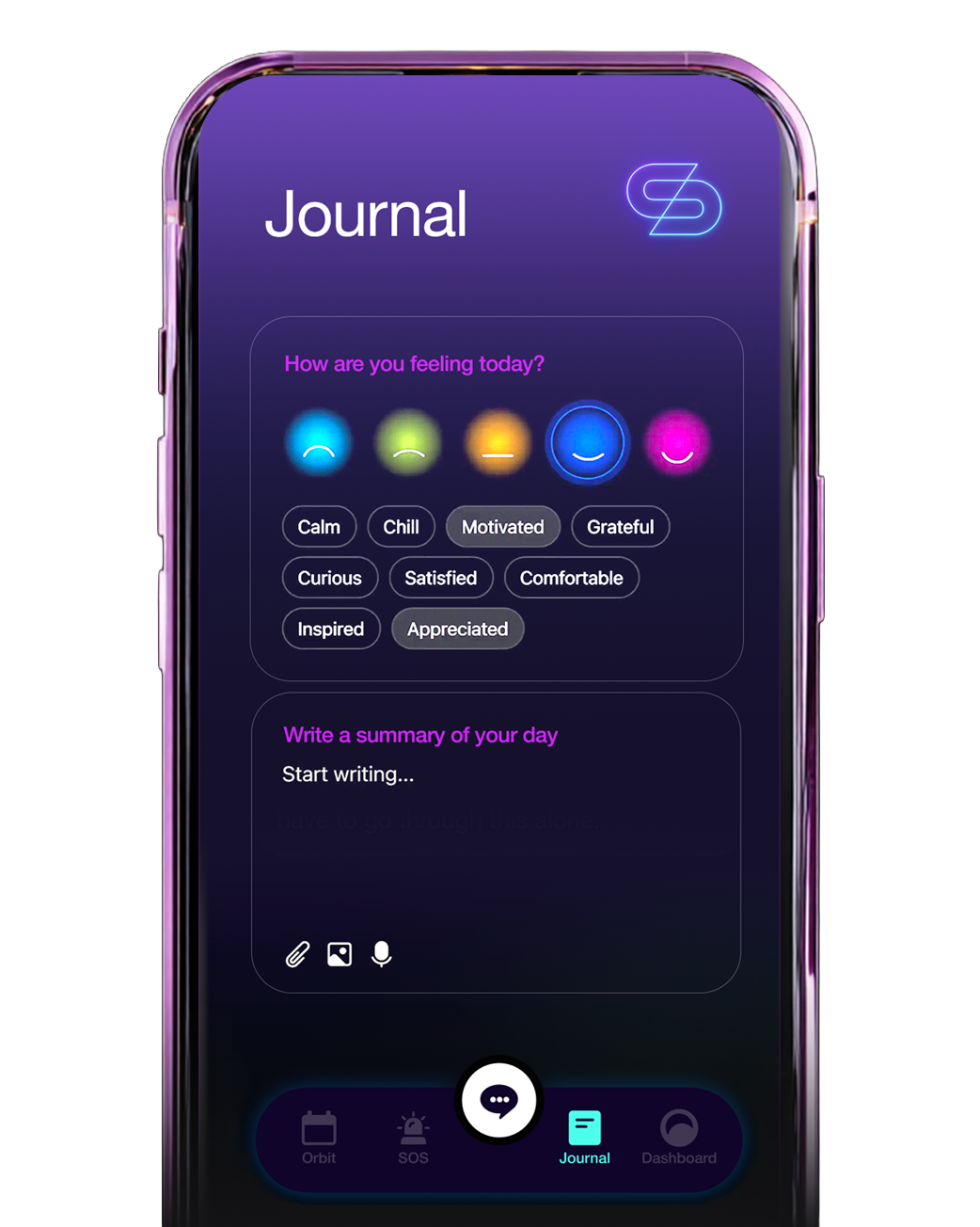
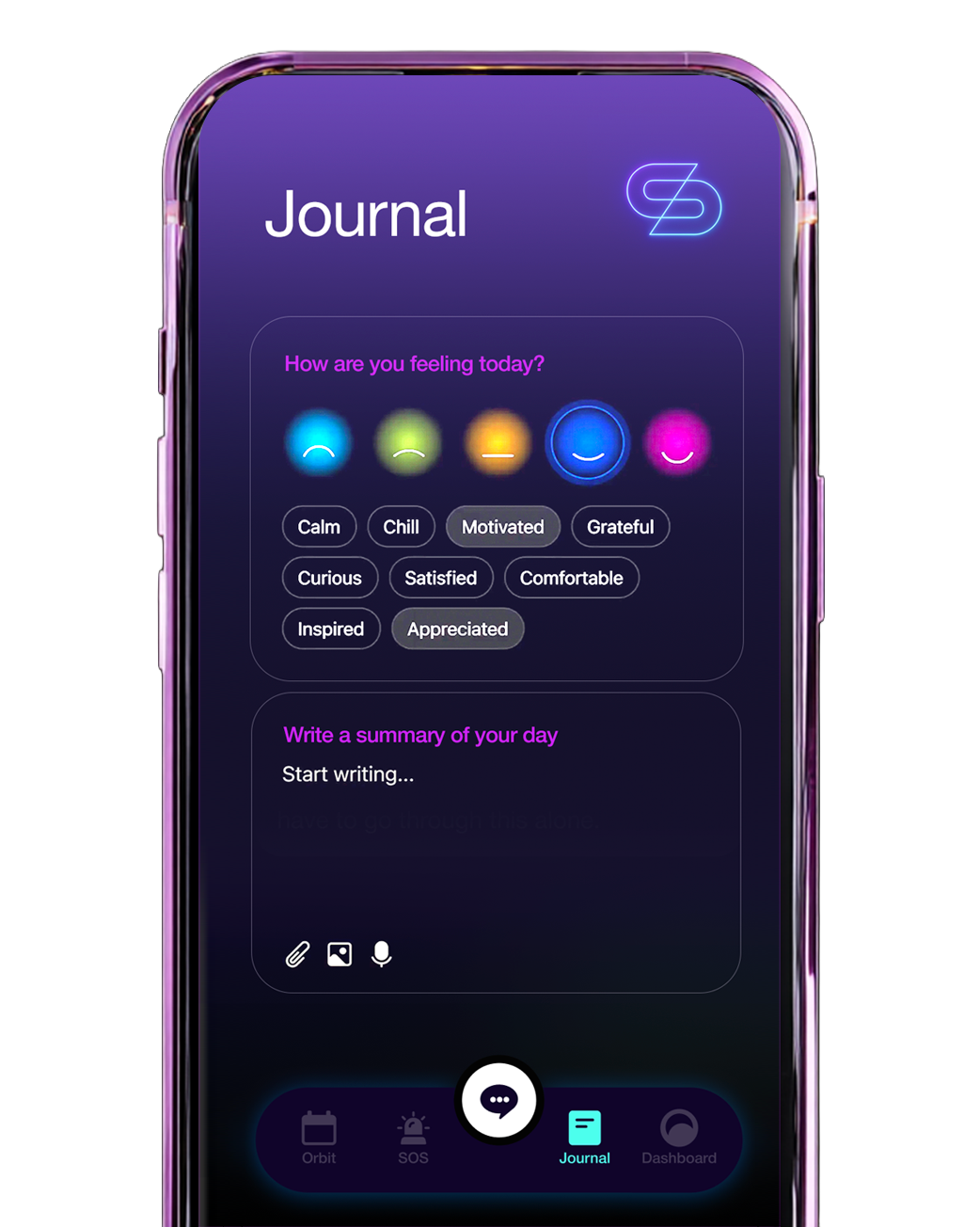
Stumble’s mood tracking pairs with your journal entries so you can see — with real data — that you’re getting better, even on the days it doesn’t feel like it.
THE STUMBLE DIFFERENCE
An Emotional Processing Journal App Where You’re Not Writing Into the Void
Most journal apps treat your entries like a vault. You write, you close the app, you stare at the ceiling. The words sit there, unread and unreceived, and you’re still alone with all of it.
Stumble gives you a choice. Keep your entry completely private — absolutely fine, it’s still yours. But if you want to, you can share it with the community. And here’s what happens: real people who’ve been where you are respond. Not with toxic positivity. Not with “just get over it.” With the kind of honest, compassionate understanding that only comes from someone who also couldn’t eat for a week after their person left.
It turns journaling from a monologue into a dialogue. And according to the APA’s guidance on grief recovery, social support is one of the strongest predictors of how quickly someone heals from a loss. Stumble combines expressive writing with anonymous peer support — two evidence-based approaches in one place.
HONEST COMPARISON
Stumble vs. Generic Journaling Apps
Day One, Notion, Apple Notes — they’re fine tools. They’re just not designed for what you’re going through. Here’s the difference when an app is built specifically for emotional healing.
📓 Generic Journal Apps
- Linked to your real name and Apple ID
- Prompts about goals, habits, and productivity
- No community — write alone, read alone
- No emotional tracking or progress insights
- Your ex could find it on your shared iPad
💜 Stumble
- Fully anonymous — no name, photo, or ID
- Prompts crafted for breakup, grief, and loss
- Anonymous community support on shared entries
- Mood tracking paired with journal history
- Nobody can connect your entries to you — ever
This isn’t about which app has better fonts or syncs to more devices. It’s about whether you can sit down at 3am, unable to sleep because you keep replaying the last conversation, and actually write what’s destroying you without worrying about consequences. That requires a fundamentally different kind of tool.
Real Words from Real People Healing Through Anonymous Journaling

“I’d been staring at our old texts for three weeks straight when I downloaded Stumble. The first night I wrote about how I missed the way he smelled and I didn’t have to feel stupid about it. Someone replied ‘I still have his hoodie and I can’t wash it.’ I cried for an hour and then I slept through the night for the first time in weeks.”
— Anonymous, 27, post-breakup
“My dad died in October and everyone kept telling me to ‘stay strong.’ I didn’t want to be strong. I wanted to scream. On Stumble I wrote about how angry I was that he never apologized for missing my graduation. Nobody told me to forgive him. They just said ‘yeah, that’s fair.’ That one sentence helped more than two months of people tiptoeing around me.”
— Anonymous, 34, grieving a parent
“I tried regular journaling apps but I kept self-censoring because my girlfriend has the passcode to my phone. On Stumble, nobody knows who I am. I finally wrote about the loneliness I feel even inside my relationship. Seeing other people admit the same thing made me realize I wasn’t broken — I just needed to be honest somewhere safe.”
— Anonymous, 31, dealing with lonelinessPRACTICAL ADVICE
Tips for Getting the Most from Your Anonymous Emotional Journal
You don’t need perfect grammar or deep insights. You need honesty. Here’s how to make your journaling practice actually work for emotional processing, based on Pennebaker’s research and what we’ve seen help thousands of Stumble users.
Write for 15 Minutes, Not 15 Pages
Pennebaker’s studies used 15–20 minute sessions. You don’t need to write a novel. Set a timer, dump everything out, stop. Shorter and raw beats long and polished every time.
Don’t Edit While You Write
The second you start fixing a sentence, you’re performing. Leave the typos. Leave the run-on sentences. Leave the part that doesn’t make sense. That’s the point. You’re anonymous. Nobody’s grading this.
Write About the Same Thing Multiple Times
It’s not repetitive — it’s processing. You’ll notice your perspective shifts a little each time. The thing that made you furious on Monday might make you sad by Thursday. That’s progress, even when it doesn’t feel like it.
Share One Entry This Week
You don’t have to share everything. But try sharing one entry with Stumble’s community. There’s something that shifts inside you when someone reads your worst moment and responds with kindness instead of running.
Frequently Asked Questions About Anonymous Journaling for Healing
Is Stumble really anonymous? Can anyone trace my entries back to me?
Completely anonymous. We don’t collect your real name, email address, or photo. Your journal entries aren’t linked to your Apple ID or any identifying information. Even our team can’t connect an entry to a real person. We built it this way on purpose — because we know honest writing requires safety, not just privacy settings buried in a menu somewhere.
How is Stumble’s journaling different from writing in Apple Notes or a regular diary app?
Three big differences. First, the anonymity isn’t just a toggle — it’s the entire architecture. There’s no profile to connect anything to. Second, our prompts aren’t about productivity or gratitude lists. They’re designed specifically for heartbreak, grief, loneliness, and emotional processing — the stuff you’re actually going through. Third, if you choose to share an entry, real people respond with support. Apple Notes won’t hug you back. We will — anonymously.
Does journaling actually help with breakup grief, or is that just something people say?
It’s backed by decades of research. Dr. James Pennebaker’s studies at the University of Texas found that writing about emotional upheavals for just 15 minutes a day led to measurable improvements in physical and mental health — lower cortisol, improved immune function, fewer anxiety symptoms. The key is expressive writing, not surface-level reflection. You have to write what you actually feel, not what sounds acceptable. That’s why anonymity matters so much. It removes the last barrier between you and honesty.
The Things You Can’t Say Out Loud Still Deserve to Be Heard
You’ve been carrying these words for long enough. Stumble gives you a place to put them down — privately, anonymously, and surrounded by people who won’t flinch at any
KEEP READINGRelated Articles to Support Your Journey