
Breaking up is tough, but overthinking makes it even harder. If you’re stuck replaying the breakup, questioning every detail, or imagining endless "what-ifs", you’re not alone. Overthinking can disrupt your sleep, drain your energy, and keep you from moving forward. Here’s how to break the cycle and find clarity:
- Journaling: Write down your thoughts to spot patterns and challenge negative ones. Try writing in the third person for a fresh perspective.
- Reframing: Replace "why" questions with actionable "how" questions. Challenge cognitive distortions like "I’ll be alone forever" with facts.
- Mindfulness: Use breathing exercises or grounding techniques like the 5-4-3-2-1 method to focus on the present.
- Blame Pie Chart: Visualize shared responsibility for the breakup to avoid blaming yourself entirely.
- New Habits: Build a routine with self-care, hobbies, and gratitude practices to redirect your energy.
Recovery takes time, but small, intentional steps can help you heal. Focus on what you can control, and remember: it’s okay to grieve, but it’s also okay to grow.
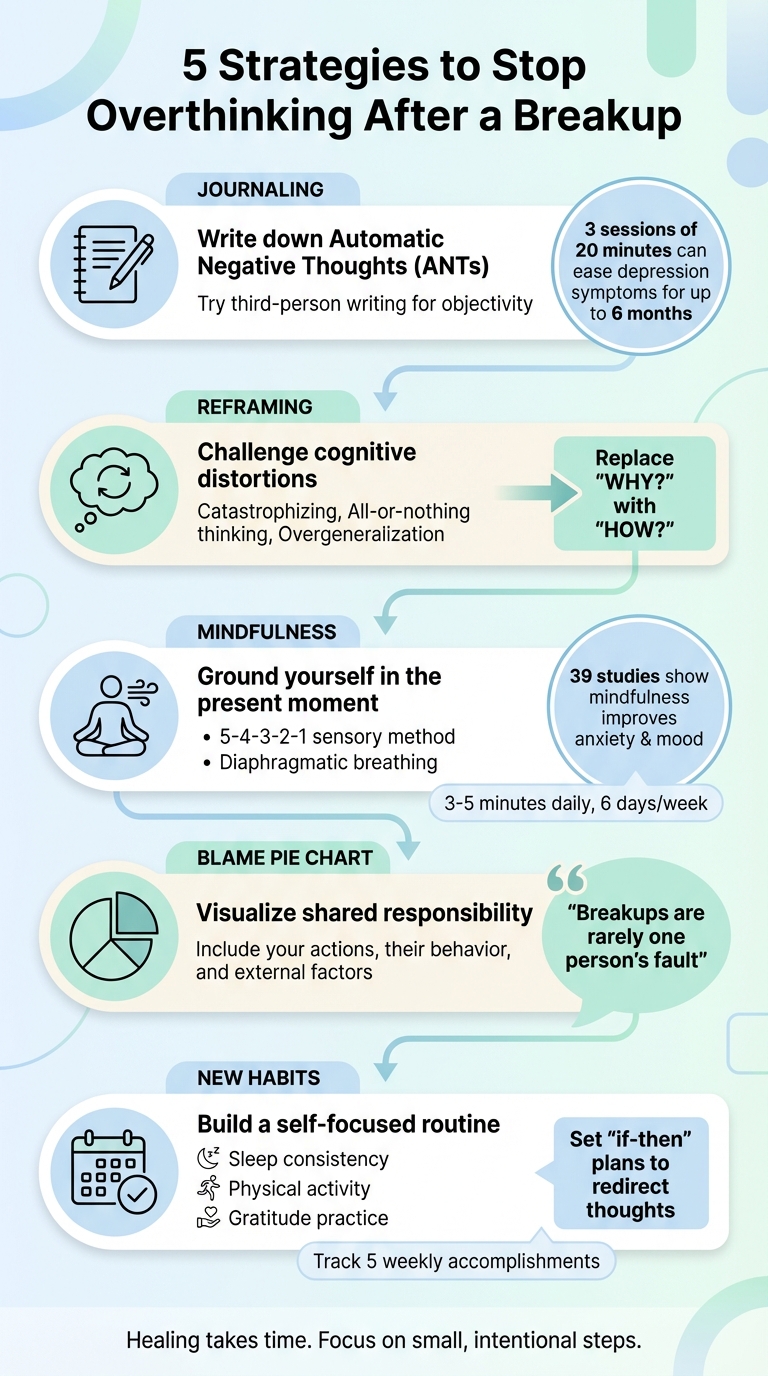
5 Evidence-Based Strategies to Stop Overthinking After a Breakup
Psychologist Explains Proven Ways You Can Stop Thinking / Ruminating About / Obsessing Over Your Ex
Strategies to Stop Overthinking
Overthinking can take a heavy toll on your mental health, but there are ways to break the cycle. The techniques below can help you shift from endless rumination to a healthier, more productive mindset.
Journaling to Understand Thought Patterns
Journaling is a powerful tool for uncovering the triggers behind your negative thoughts. For example, you might notice that feelings of loneliness creep in during late-night hours or when a certain song plays. Writing down these Automatic Negative Thoughts (ANTs) allows you to step back and ask yourself: Are these fears based on facts, or are they just emotional reactions disguised as truths?
To take it a step further, try writing in the third person. This approach, known as "self-distancing", helps you create space between your emotions and your perspective. By doing so, you can view your situation more objectively. Research supports this practice: just three 20-minute sessions of expressive writing about a stressful event can significantly ease symptoms of depression, with benefits lasting up to six months.
Reframing Negative Thoughts
Once you’ve identified your negative thought patterns, it’s time to challenge them. Overthinking often feeds on cognitive distortions, which are mental habits that skew your perception of reality. After a breakup, for instance, you might fall into traps like catastrophizing ("I’ll be alone forever"), all-or-nothing thinking ("I’m terrible at relationships"), or overgeneralization ("This always happens to me"). As registered psychotherapist Natacha Duke from Cleveland Clinic explains:
"Reframing helps one learn to first identify the errors, then to reframe the thinking in more logical and balanced ways".
Start by shifting your "why" questions into actionable "how" questions. Instead of asking, "Why does this always happen to me?" try, "How can I approach relationships differently in the future?" Clinical psychologist Jennifer L. Taitz highlights the importance of this shift:
"Notice the difference – ‘why’ is a dead end, but ‘how’ leads to action".
For example, if you find yourself thinking, "I’m unlovable", counter it with evidence: "I have friends who care deeply about me, and I’ve had meaningful relationships before." Another technique is labeling your thoughts – for instance, saying, "I am having the thought that I’m a failure", instead of accepting the idea as fact. This subtle shift in language creates distance and makes it easier to loosen the thought’s grip on your mind.
Mindfulness and Breathing Exercises
Mindfulness is about grounding yourself in the present moment, which helps interrupt overthinking about the past or worrying about the future. It also reframes thoughts as temporary events, not permanent truths. A meta-analysis of 39 studies found that mindfulness exercises significantly improved anxiety and mood symptoms, with measurable results.
To get started, try breath awareness: sit in a comfortable position and focus on the sensation of air moving in and out of your nose. When intrusive thoughts arise, gently label them as "thinking" and return your attention to your breath. For a more structured method, practice diaphragmatic breathing: place one hand on your chest and the other on your belly, and breathe slowly through your nose. Pay attention to how your body moves with each breath – this activates your parasympathetic nervous system, promoting calmness and reducing anxious thoughts.
If you’re stuck in a particularly intense cycle of overthinking, use the 5-4-3-2-1 technique: identify five things you can see, four textures you can feel, three sounds you can hear, two scents you can smell, and one taste you can notice. This sensory exercise pulls your mind back into the present moment. Even just 3–5 minutes of focused breathing can make a difference. For the best results, aim to practice mindfulness exercises at least six days a week. Combined with journaling and reframing, these practices can help you build a more resilient mindset and move forward with greater clarity.
Tools for Gaining Perspective
After a breakup, it’s easy to fall into the trap of black-and-white thinking, where blame is placed entirely on yourself or your ex. Licensed Marriage and Family Therapist Emilea Richardson sheds light on this:
"It’s very common after a bad breakup to feel like [either] it’s all your fault or all the other person’s fault. Neither are true – CBT classifies this as black-and-white thinking, which is unhelpful".
To break free from this distorted perspective, there are specific exercises designed to help you see the situation more clearly.
The Blame Pie Chart
The Blame Pie Chart is a practical way to distribute responsibility more realistically. Start by drawing a circle to represent all the factors that contributed to the breakup – this can include your actions, your ex’s behavior, and external influences like work stress, long-distance challenges, or family dynamics. Then, divide the circle into segments that reflect how much each factor contributed to the relationship’s end.
This visual exercise can help challenge the tendency to take on all the blame yourself. It’s a reminder that breakups are rarely the result of one person’s actions alone and are often shaped by a combination of interconnected factors.
Another helpful tool for shifting your mindset is the Thoughts-Feelings-Behavior Triangle.
Using the Thoughts-Feelings-Behavior Triangle
The Thoughts-Feelings-Behavior Triangle highlights how your thoughts, emotions, and actions influence one another. Therapist Victoria Smith explains that this tool can guide you toward healthier patterns.
Here’s how it works: Draw two triangles, labeling the corners of each as "Thoughts", "Feelings", and "Behaviors." In the first triangle, map out your current state. For instance, you might write down thoughts like "I’ll never find love again", feelings of hopelessness, and behaviors such as isolating yourself from others. In the second triangle, outline the state you want to move toward. This could include thoughts like "I’m learning and growing from this", a sense of hope, and actions like reconnecting with friends or pursuing hobbies.
By comparing the two triangles, you can pinpoint what’s holding you back and identify small, actionable steps to move forward. Licensed Clinical Social Worker Gayle Weill emphasizes the power of this approach:
"If you change the way that you think, then that [can] change the way that you feel, and then your behaviors [may] also change".
Even small actions, like sending a text to a friend, can set the stage for a gradual shift in your emotional and behavioral patterns, helping you regain a sense of balance and perspective.
sbb-itb-ee19e1f
Using the Stumble App for Healing

After a breakup, overthinking can feel like an endless loop. Having the right tools at hand can help you process emotions and regain clarity. That’s where Stumble comes in, offering a private space to work through your thoughts and find balance.
Private Journaling and Daily Check-Ins
Stumble’s private journaling feature uses a technique called illeism – writing about yourself in the third person. This method helps you take a step back from your emotions and see things more objectively. For instance, instead of writing, "I can’t stop thinking about what went wrong", you might write, "Sarah is struggling with thoughts about the breakup." This subtle shift creates distance, making it easier to process your feelings.
The app’s daily check-ins are another powerful tool. They help you notice when overthinking hits hardest – maybe mornings feel particularly tough – or identify triggers that spark intrusive thoughts. These check-ins also help you recognize Automatic Negative Thoughts (ANTs): those knee-jerk reactions filled with fear or anger that often seem valid but don’t hold up under scrutiny. By tracking these patterns, you can start challenging and reframing them.
But Stumble doesn’t stop there. Its guided exercises take healing a step further.
Guided Healing Content
Stumble provides guided exercises inspired by Cognitive Behavioral Therapy (CBT) to help shift your mindset. Instead of spiraling into unhelpful "why" questions, these exercises encourage more constructive thinking. One effective strategy is the "dedicated worry period." Set aside 15 minutes each day to focus exclusively on breakup-related concerns using the app’s journaling tools. Once the time’s up, you move on to other activities. This method keeps worries from dominating your entire day while giving them a structured space.
24/7 Grounding Support
Life doesn’t follow a schedule, and neither do emotions. That’s why Stumble offers 24/7 grounding support for those moments when distress feels overwhelming – whether it’s mid-afternoon or the middle of the night. The app includes grounding techniques like the 5-4-3-2-1 method, which helps you focus on the present by engaging your senses. This can quiet racing thoughts and bring a sense of calm. As Baltimore Therapy Group explains:
"Distraction isn’t avoidance – it’s a skill"
With these grounding tools available anytime, you’ll never have to face overthinking alone.
Building New Habits and a Self-Focused Routine
After a breakup, shifting your focus from negative thoughts to positive actions can be a game-changer. Creating a self-focused routine not only gives your day structure but also helps you achieve small, meaningful victories. As Dr. Adam Borland from Cleveland Clinic puts it:
"That structure gives you a sense of accomplishment and purpose, and it allows you to build off of small wins."
This approach lays the groundwork for channeling your energy into self-care and personal growth.
Redirecting Thoughts to Self-Care
When memories of your ex creep in, having a clear plan to redirect those thoughts can make all the difference. This is where "implementation intentions" come into play. For example, you might decide: "If I start thinking about my ex, I’ll spend ten minutes practicing my hobby instead." This simple if-then framework shifts your focus from unproductive rumination to constructive action.
Start with the essentials: get consistent sleep, eat nourishing meals, stay active, and maintain grooming habits. These aren’t just feel-good tips – they’re backed by science. Research from the University of Michigan shows that chronic overthinking raises cortisol levels, which can harm your immune system and disrupt your sleep. Taking care of your body helps calm your mind. For extra support, try sensory grounding techniques like focusing on a soothing scent, texture, or flavor to break the cycle of spiraling thoughts.
Once you’ve got these redirection strategies down, adding new rituals can help solidify your progress.
Creating New Rituals
New rituals can help you frame this time as an opportunity for growth. Start small – try jotting down three things you’re grateful for each morning. This simple gratitude practice can boost your mood and shift your mindset toward optimism.
Another idea is to schedule a "worry window": set aside 30 minutes a day to write down and process your concerns. Outside of this window, gently remind yourself to save those thoughts for later. This technique keeps worries from dominating your day while still giving them space to be acknowledged. Similarly, limit conversations about your ex to short, focused periods. This ensures healthy venting doesn’t spiral into repetitive overthinking.
With these rituals in place, you’ll find it easier to dive into activities that bring you joy and distraction.
Engaging in Enjoyable Activities
Breaking free from overthinking often involves immersing yourself in activities that fully capture your attention. Look for tasks that create a "flow state" – those moments when you’re so engaged, you lose track of time. Revisit old hobbies or try something completely new. Physical activities, like running or yoga, release feel-good chemicals that naturally ease anxiety. Creative outlets, such as painting or writing, activate different parts of your brain, pulling you out of repetitive thought patterns.
Don’t underestimate the importance of social connection, either. Volunteer with a local group, explore an art gallery with friends, or reclaim spaces that hold memories of your ex. As clinical psychologist Sarah Gundle explains, visiting a favorite spot with new people can help you create fresh, positive associations:
"Taking back and reclaiming a place or experience can invoke a sense of control."
Even simple sensory activities can ground you in the present. Petting a dog, listening to music while focusing on the lyrics, or dancing around your living room can shift your focus from abstract worries to immediate, uplifting experiences.
Moving Forward with Emotional Clarity
Now that you’ve got practical tools and strategies in your corner, it’s time to focus on shifting your mindset to foster lasting emotional clarity.
Breaking the cycle of overthinking doesn’t mean you’ll never have bad days again. Healing isn’t a straight road – there will be ups and downs, and cloudy moments are part of the process. What truly matters is equipping yourself with habits and tools to navigate those moments without feeling stuck.
The real turning point comes when you shift your focus from asking, “Why did this happen?” to “How can I move forward?” This mental pivot is where transformation begins. When you notice yourself spiraling, try grounding techniques like the 5-sense method or redirect your energy using "if-then" plans. These small but intentional actions can help you build resilience over time.
As you continue using grounding and reframing strategies, start weaving in habits that reinforce your emotional growth. One powerful approach is radical acceptance. Therapist Kristin Money explains it beautifully:
"Acceptance means that we choose to allow ourselves to feel what we need to feel without judgment".
By acknowledging your reality without criticizing yourself, you create space to process emotions fully. It’s important to remember that losing a romantic partner activates the same brain regions as physical pain. Be patient with yourself – your brain is working hard to form new neural pathways.
A simple yet effective practice is tracking five accomplishments each week. These can be anything from sticking to a morning routine, trying out a new hobby, or simply getting through a tough day without reaching out to your ex. These small wins help rebuild self-esteem and remind you of the progress you’re making. Replace negative self-talk with affirmations like “This feeling is only temporary” or “I can handle whatever comes my way.” These affirmations can shift your mindset when doubt starts to creep in.
Recovering from a breakup is about more than just moving on – it’s about rediscovering who you are and building a stronger foundation for the future. With self-compassion, consistent effort, and the courage to feel your emotions fully, you’re paving the way for emotional clarity and resilience. Each step forward, no matter how small, is a victory worth celebrating.
FAQs
How can journaling help me stop overthinking after a breakup?
Journaling can be an incredibly effective tool to process emotions and calm an overactive mind, especially after a breakup. Putting your thoughts on paper helps you untangle feelings, spot patterns in your thinking, and release emotions in a healthy, constructive way.
If you’re not sure where to begin, try starting with prompts like: What am I feeling right now?, What do I need to let go of?, or What lessons can I learn from this experience? Even dedicating just a few minutes a day to writing can shift your focus from dwelling on the past to prioritizing your growth and healing. Over time, this simple habit can ease overthinking and bring a greater sense of emotional stability.
What are the best mindfulness techniques to stop overthinking after a breakup?
Mindfulness can be an effective way to calm an overactive mind and regain emotional balance after a breakup. Here are a few approachable techniques you can try:
- Focused breathing: Find a comfortable seat, close your eyes, and take slow, deep breaths. Try this rhythm: inhale for 4 seconds, hold for 2 seconds, and exhale for 6 seconds. Repeat for 5–10 minutes. If your thoughts start to wander, gently guide your attention back to your breath.
- Body scan: Tune into your body by focusing on physical sensations. Start at your toes and slowly move upward, noticing how each part feels. This exercise helps anchor you in the present moment and interrupts repetitive, intrusive thoughts.
- Self-compassion: When negative thoughts pop up, pause and remind yourself, "It’s okay to feel this way." Placing a hand over your heart can add a comforting, physical element to this practice. By acknowledging your emotions without judgment, you can ease self-criticism and quiet overthinking.
Even adding just one of these practices to your daily routine can leave you feeling more centered, focused, and ready to take on what’s next.
What is the Blame Pie Chart, and how can it help you move on after a breakup?
The Blame Pie Chart is a straightforward tool designed to help you gain clarity after a breakup. It works by visualizing all the factors that led to the end of the relationship and dividing them into "slices" of a pie, with each slice representing its share of responsibility. These slices can include your actions, your ex-partner’s choices, external circumstances, or even moments of miscommunication.
This approach helps you step away from the trap of assigning all the blame to yourself or your ex, a mindset that often leads to overthinking. Instead, it promotes a balanced perspective, allowing you to process the breakup with more understanding and self-kindness. Using this method can be an effective step toward emotional recovery and moving on.
Related Blog Posts
- Breakup Recovery Checklist: 15 Steps to Heal
- No Contact vs Low Contact: Which Helps You Heal?
- Therapy vs Support Groups: Finding the Right Help
- Top 7 Creative Outlets For Emotional Healing
STUMBLE APP
Ready to start healing?
Stumble gives you the community, tools, and support to move forward — free on iOS.
Download the app free →
Tagged with :