
Breaking up is tough, but this 15-step checklist offers practical ways to help you heal, rebuild, and move forward. Here’s a quick overview of the steps covered:
- Accept Your Feelings: Acknowledge emotions like sadness, anger, or confusion instead of suppressing them.
- Build a Self-Care Routine: Focus on daily habits like eating well, staying hydrated, and creating bedtime rituals.
- Set Digital Boundaries: Limit or eliminate contact with your ex on social media to reduce emotional triggers.
- Journal Your Emotions: Write down your thoughts to calm your mind and gain clarity.
- Add Gentle Physical Activity: Engage in light exercise, like walking or yoga, to boost mood and reduce stress.
- Reach Out to Your Support System: Lean on trusted friends, family, or professionals for emotional support.
- Try Mindfulness Practices: Use grounding techniques like the 5-4-3-2-1 method or breathing exercises to stay present.
- Remove Relationship Reminders: Box up items tied to your ex and refresh your space to create a healing environment.
- Treat Yourself: Prioritize activities or comforts that bring you joy and relaxation.
- Rediscover Your Interests: Reconnect with hobbies or passions you might have set aside during the relationship.
- Use Tools Like Private Journaling: Explore apps or tools designed for emotional recovery.
- Practice Daily Affirmations: Replace negative self-talk with positive, empowering statements.
- Rebuild Social Connections: Gradually expand your social circle and engage in meaningful interactions.
- Reflect on Your Progress: Celebrate milestones and lessons learned as you heal.
Each step focuses on small, actionable changes to help you regain control, process emotions, and rebuild confidence. Healing takes time, but these steps can guide you toward a brighter future.
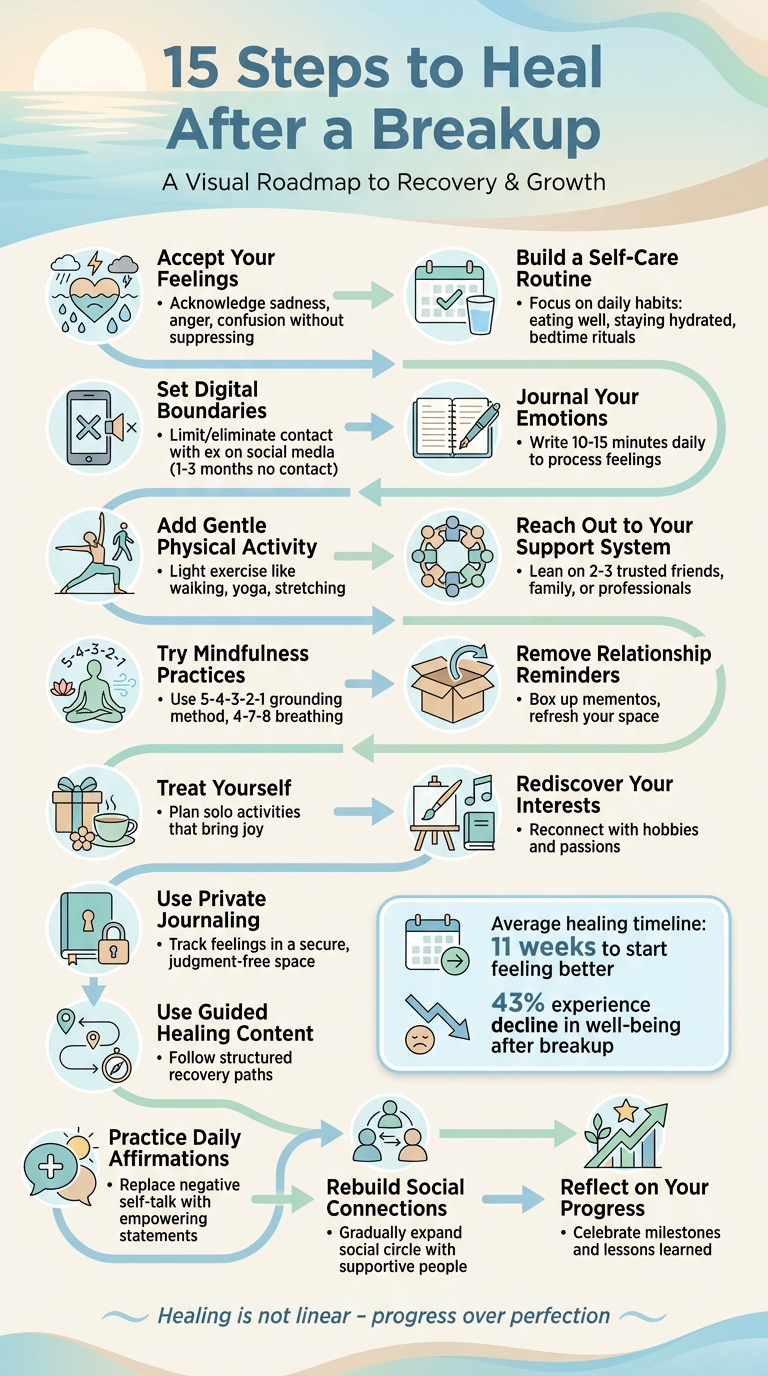
15 Steps to Heal After a Breakup: Complete Recovery Checklist
To Anyone Going Through a Breakup: How to Heal a Broken Heart & Move On
Step 1: Accept Your Feelings
Breaking up triggers a natural, biological reaction in your body. When a relationship ends, your brain experiences withdrawal, leading to a drop in dopamine and serotonin levels. This can leave you feeling emotionally and physically drained. It’s not about lacking strength or willpower – your body is simply dealing with what experts call "ambiguous loss", a type of loss that feels unresolved because it lacks the finality of death.
During this time, you might find yourself cycling through a mix of emotions: sadness, anger, confusion, relief, shock, denial, betrayal, fear, and loneliness. And yes, all of these are completely normal. Dr. Evita Limon-Rocha, a psychiatrist with Kaiser Permanente, highlights the importance of facing these feelings head-on:
Acknowledging your feelings and normalizing the variety of emotions experienced in this process is key in allowing yourself to heal.
Your body often gives you clues about what you’re experiencing emotionally. If you notice a racing heart, restless thoughts, sleepless nights, or find yourself scrolling through old messages at odd hours, these could be signs of denial or bargaining. That deep exhaustion you feel? It’s your body working through the loss of what some researchers describe as a "romantic addiction".
Trying to suppress these emotions won’t make them disappear. Instead, they may linger and show up in future relationships. Dr. Adam Borland from Cleveland Clinic explains:
Not addressing grief robs you of an opportunity to grow. The end of a relationship is a time to reflect, clarify your values and decide what kind of life you want moving forward.
Recognizing and understanding these emotional and physical responses is the essential first step in navigating your healing journey.
Start with Small Wins
When everything feels overwhelming, small victories can help you regain a sense of control. Start with simple, achievable tasks: make your bed, take a shower, eat a healthy meal, or drink a glass of water. These small actions might seem minor, but they create a foundation for recovery.
If your body is showing signs of distress – like a racing heart or sleepless nights – focusing on manageable tasks can anchor you. A helpful strategy is the "Two-Task" Rule: commit to just two goals each day when you’re feeling low. Choose one for your body, like a 10-minute walk, and one for your mind, like reading a few pages of a book. These small successes can build momentum, offering a sense of accomplishment when life feels chaotic.
Step 2: Build a Self-Care Routine
After a breakup, your body often experiences a rush of cortisol and adrenaline, which can lead to physical symptoms like chest tightness, trouble sleeping, and even a lack of appetite. In some cases, it may even result in Broken Heart Syndrome.
Establishing a daily routine can provide much-needed stability when life feels unpredictable. Dr. Adam Borland from Cleveland Clinic highlights the importance of structure during times of loss:
Whenever you experience a loss, this [routine] is the first place to start. That structure gives you a sense of accomplishment and purpose, and it allows you to build off of small wins.
Statistics reveal that over 43% of breakups lead to a noticeable decline in personal well-being. A consistent self-care routine can help address both mental and physical health. The World Health Organization defines self-care as the ability to maintain health, prevent illness, and manage challenges independently or with professional help. By incorporating daily habits and bedtime rituals, you can create a structure that supports recovery.
Daily Self-Care Practices
A solid routine starts with the basics: shower regularly, stay hydrated, and eat balanced meals. These simple actions form the foundation for maintaining stability. Life coach Stephanie Lyn emphasizes the connection between nutrition and emotional well-being:
Good food equals a good mood. Skip those late-night snacks or too much to drink – they might feel good for a moment, but it’s a bummer later.
If cooking feels like too much to handle, try meal prepping on Sundays or consider healthy food delivery options to avoid relying on takeout. On particularly hard days, focus on the essentials: take a shower, eat one nutritious meal, and make your bed. These small steps can help you regain a sense of control and build momentum.
Create Bedtime Rituals
Pair your daily routine with calming bedtime habits to improve sleep, which is often disrupted after a breakup. Aim for 7 to 9 hours of sleep each night to help regulate your emotions and support recovery. Establishing soothing bedtime rituals can signal to your body that it’s time to relax.
For instance, taking a warm bath about 90 minutes before bed can help. Use water between 104°F and 109°F – this triggers a cooling process in your body that promotes sleep. A cup of chamomile tea can also help you fall asleep faster.
Psychotherapist Natalie Capano suggests incorporating gentle stretches into your evening routine:
We carry our emotions in our [bodies], and we may become aware of this when trying to unwind and get comfortable at night.
For mental relaxation, try reading light fiction (steer clear of intense genres), listening to soft classical or ambient music with a sleep timer, or practicing a short guided meditation. To avoid distractions, keep your phone in another room. These rituals not only encourage better sleep but also create a comforting and predictable space where your body and mind can truly rest.
Step 3: Set Digital Boundaries
Dealing with a breakup is tough, and social media often makes it even harder. Licensed Mental Health Counselor Katherine Ibis points out that platforms like Instagram and Facebook can encourage obsessive behaviors and even passive-aggressive actions. Studies back this up, showing that staying in touch – whether online or in person – with an ex can delay emotional recovery. That’s why setting clear digital boundaries is key to moving forward. It helps you focus on healing instead of getting stuck in endless cycles of profile-checking and painful memories.
One effective strategy? Commit to a no-contact period of 1–3 months. This could involve removing your ex from your social media feeds – or, if the breakup was especially rough, blocking them entirely. For less messy splits, muting is a softer option. It keeps their posts and stories out of sight without the drama of unfollowing. As author Allison Raskin wisely puts it:
The mute function is a beautiful thing!
Taking this digital detox seriously can help you reclaim your emotional space.
Mute or Unfollow on Social Media
Each platform requires its own approach. On Facebook, consider setting your relationship status to "Only Me" before switching it to "Single" to avoid public notifications. Move shared photos into a private album to avoid stumbling upon them unexpectedly. On Instagram, unfollow your ex and their close friends to reduce chances of seeing their updates in others’ posts. And on LinkedIn? Resist the urge to check the "Who’s viewed your profile?" feature.
If cutting ties completely feels overwhelming, try scaling back gradually. For instance, reduce contact from once a day to once a week. You can also lean on the "sponsor" method: ask a trusted friend to be your go-to person whenever you’re tempted to peek at your ex’s social media.
Another tip? Temporarily unfollow accounts that bring back painful memories, like wedding planners or artists known for romantic content. And steer clear of posting anything overly dramatic or attention-seeking – it only keeps you tied to the past.
Step 4: Journal Your Emotions
Once you’ve set digital boundaries, give yourself a safe outlet for processing emotions – journaling. Writing things down has a calming effect on your nervous system, especially during emotionally intense periods. Psychologist Amelia Kelley, Ph.D., highlights the benefits:
Journaling is helpful not only for calming your nervous system, but it also increases self-awareness and the connection with your inner voice that may have been ignored while in the ending phase of the past relationship.
Journaling can break the cycle of overthinking. Instead of replaying conversations or endlessly analyzing what went wrong, putting those thoughts on paper creates a sense of clarity. Interestingly, research suggests that writing by hand fosters more creative processing than typing. So, grab a notebook and pen – it might just help you untangle your thoughts in a way digital tools can’t.
As you continue journaling, you’ll notice your entries evolve from raw emotions to moments of self-discovery. This practice not only helps you track your growth but also clarifies your values as you move forward.
To make journaling a habit, try the "15-minute rule." Dedicate 10–15 minutes each day to confront and process your feelings. Pair it with a calming ritual, like sipping tea in the morning or reflecting quietly before bed, to make it a consistent part of your routine.
Daily Reflection Prompts
If you’re not sure where to start, prompts can guide your thoughts and help you track your emotional progress. Here are some ideas:
- What emotions am I feeling right now, and where do I feel them in my body?
- What are three things I learned from this relationship?
- What boundaries and needs do I now recognize as essential for my future relationships?
- Which feelings or memories will I release today?
- What are five things I love about myself that are independent of my relationship status?
- What would I say in a letter to my future self, six months from now?
These prompts can help you reflect, release, and rebuild as you navigate your emotions.
Step 5: Add Gentle Physical Activity
Reconnect with yourself through gentle movement. Engaging in light physical activity can play a big role in emotional healing. Research shows that light to moderate exercise helps manage symptoms of depression and boosts mood.
But gentle movement does more than just offer a distraction from heartbreak. Regular, low-intensity exercise can actually spark the release of proteins in the brain, improving its function and encouraging nerve cell growth in the hippocampus – the part of the brain that regulates mood. Professor Andrew Clegg from the University of Lancashire highlights this connection:
Our findings suggest that exercise appears to be a safe and accessible option for helping to manage symptoms of depression.
Studies back this up. For example, research involving nearly 5,000 adults found that consistent exercise – 13 to 36 sessions – produced the best improvements in symptoms. The secret? It’s not about how intense your workouts are but about staying consistent. Even starting with just five minutes of an activity you enjoy can make a difference. From there, you can gradually build up.
Logan Ury, Director of Relationship Science at Hinge, captures this idea perfectly:
Most people don’t feel like going to the gym, but once you get to the gym and start going, the endorphins kick in. And then you’re almost always happy that you went.
Adding movement into your daily routine can help counterbalance the emotional stress you’re working through. Spending at least two hours a week outdoors, for instance, has been strongly linked to better mental and physical health. When you find yourself stuck in negative thoughts, movement can act as a mental "reset." Whether it’s putting on your favorite music and taking a walk, doing some light stretching, or simply stepping outside, these small actions can calm your nervous system and give you a healthy break.
Examples of Gentle Exercise
Walking is one of the easiest and most effective options. Whether it’s a stroll through a park, a lap around your neighborhood, or even window shopping at your favorite stores, walking can do wonders. Yoga is another excellent choice, combining physical movement with mindfulness to help manage stress. If you’re ready to try something else, light jogging, dancing, or even strength training can help rebuild both your energy and confidence. Other great options include stretching, progressive muscle relaxation, or guided movement sessions.
The point isn’t to push yourself to exhaustion but to find activities that help you recharge and feel accomplished. As psychologist Adam Borland, PsyD, from the Cleveland Clinic, explains:
That structure gives you a sense of accomplishment and purpose, and it allows you to build off of small wins.
Step 6: Reach Out to Your Support System
Connecting with people you trust can ease feelings of depression and help you bounce back stronger. Studies show that staying socially active not only lowers the risk of depression but can also contribute to a longer life. After a breakup, though, nearly 40% of people experience some level of depression, and about 13% face severe clinical depression. These stats underline why leaning on your support system isn’t just helpful – it’s crucial.
Start by identifying your inner circle – those closest to you, like best friends, family members, or others you deeply trust. These are the people who can provide both emotional and practical support. Look for individuals who can listen without judgment and offer a safe space for you to share your feelings. Choose one person to be your go-to contact during tough moments. As Restorative Counseling advises:
Surround yourself with people who can listen without judgment, offer comfort, and provide a safe space for you to express your feelings.
It’s also important to be honest about how you’re feeling. Psychologist Adam Borland from the Cleveland Clinic highlights why this openness matters:
Having a strong support system is so important because you need people you can open up to – and who will be honest with you in return.
If your personal network feels limited or you need more specialized help, don’t hesitate to seek professional support. Therapists, counselors, or support groups can guide you in understanding your emotions, recognizing unhealthy patterns, and gaining clarity about your next steps. Madison Wise, LPC Associate at Just Mind, explains:
A therapist can help you to acknowledge and express your feelings, find understanding of your relationship and its end, identify both helpful and harmful relational behaviors, achieve clarity about the end of the relationship, and better define what you want and need in your future partnerships.
This professional insight can work hand-in-hand with the support of your personal network.
Ask for Emotional Support
Pick 2–3 trusted individuals to lean on during this time and designate one as your "sponsor" – a person you can call when you feel tempted to reach out to your ex.
Be clear about what you need from your support system. Whether it’s someone to simply listen, join you for a walk, or help with errands, let them know how they can best assist you. Dr. Kristen Carpenter from Ohio State University Wexner Medical Center advises:
Lead the way in letting people know what you need.
If asking for help feels awkward, try the "Notecard Method". Write down specific tasks or needs on individual cards (e.g., "listen for 10 minutes", "help with grocery shopping") and let your supporters pick one when they offer to help. This approach makes it easier to communicate your needs without hesitation.
Step 7: Try Mindfulness Practices
When your mind feels like it’s racing in overdrive, mindfulness can help you hit the brakes and refocus on the present moment. After a breakup, it’s common to experience a sharp drop in emotional well-being, especially during the first 72 hours, which can be the most intense neurologically. Mindfulness techniques offer practical ways to manage this emotional turbulence.
At the heart of mindfulness lies grounding – the practice of bringing your attention back to the present to counteract overwhelming thoughts. A simple first step is to observe your emotions without judgment. Psychiatrist Dr. Greg Sazima explains:
Meditation can be used to attend to the various effects of potent life events, like the end of a relationship.
This process helps you realize that not every thought you have is factual, which is a key step in reducing their emotional grip.
A great beginner technique is the 5-4-3-2-1 Grounding Method. When anxiety strikes, name:
- 5 things you see,
- 4 things you can touch,
- 3 things you hear,
- 2 things you can smell, and
- 1 thing you can taste.
This exercise keeps you connected to your immediate surroundings.
Another approach is breath-focused meditation. Sit comfortably, inhale for three seconds, then exhale for three seconds, paying close attention to the rhythm of your breath.
For deeper emotional work, try the "Sitting With It" Technique. When you feel overwhelmed, start by noticing physical sensations like a racing heart or tense muscles. Then, identify your emotional state – whether it’s sadness, anger, or relief – and let your thoughts pass by without engaging with them. Picture your thoughts as clouds drifting across the sky, and let them float away. This practice helps you build emotional resilience.
Visualization can also be powerful. Imagine the emotional ties to your ex as "hooks" in your mind, heart, or body. Visualize unhooking these connections and drawing that energy back into yourself. These grounding techniques serve as a stepping stone to more structured practices, like guided meditation.
Try Guided Meditation
Once you’ve gotten the hang of grounding, guided meditation can take your emotional healing to the next level. By focusing on your breath, you create an anchor that pulls you back to the present when your thoughts start spiraling. Breakups often trigger stress hormones like cortisol and adrenaline, and meditation may help reduce these while easing physical symptoms such as chest tightness or insomnia.
Start small – short sessions are more effective than forcing yourself into long, difficult practices. One calming technique is the 4-7-8 Reset: inhale for 4 counts, hold for 7, and exhale for 8. This pattern helps soothe your nervous system during moments of anxiety. You could also try Japa Meditation, where you use beads or a bracelet to repeat a calming mantra, like "I am going to be okay", to interrupt obsessive thoughts.
For extra support, apps like Insight Timer offer free guided meditations. If you’re open to a subscription, Headspace is available for $69.99 annually or $12.99 monthly.
Consider scheduling a 20-minute "cry time", followed immediately by a guided meditation. This allows you to process your emotions without letting sadness dominate your day. Psychologist Dr. Michele Leno emphasizes:
There is no need to pretend that everything is fine. Allow yourself to cry, as this is very healing and freeing, and acknowledging your feelings strengthens you rather than weakens you.
Step 8: Remove Relationship Reminders
Physical reminders of your ex can act as powerful emotional triggers, pulling you back into painful memories and making it harder to move forward. That coffee mug you always used together or the blanket you cuddled under – these items can keep your mind stuck in the past. Just like setting digital boundaries helps protect your emotional space, removing these physical reminders allows you to create a fresh environment for healing. This isn’t about erasing the relationship; it’s about giving yourself room to recover and focus on your own growth.
Start by gathering mementos – gifts, photos, shared items, or anything your ex left behind – and place them out of sight. Pack them into a box and store it somewhere like a closet, attic, or storage unit. This step doesn’t mean you have to decide right away whether to keep, donate, or toss these items. The goal is to remove them from your daily view while you work through the emotions. Research suggests it typically takes about three months to start feeling better after a breakup, so use this time to let the emotional intensity subside before deciding what to do with the items.
If you lived together, refreshing your space can help reclaim it as your own. Replace or donate things like bedding, throw pillows, and blankets – especially those tied to intimate moments. Even small changes, like swapping out mugs or kitchenware that remind you of shared meals, can make a big difference. Rearranging furniture is another simple way to change the flow of your home and signal a fresh start.
Box Up or Store Items
A "Box and Wait" strategy can help you temporarily remove painful reminders while keeping them for later reflection. Gather significant items – like gifts, photos, or shared purchases – and pack them away in a box. Store it somewhere out of sight, like the back of a closet or under the bed. This approach lets you revisit these items when you’re ready, without forcing you to make permanent decisions while emotions are still raw.
Focus on removing items that trigger sudden emotional setbacks – objects that instantly bring back painful memories. For example, a shared blanket might seem harmless at first, but if it stirs up feelings of intimacy, consider donating it and replacing it with something new in a different color or texture. Lifestyle journalist Nishad Thaivalappil puts it this way:
By removing the gifts from your ex, you take charge of your personal space, creating a more healing and growth-oriented environment.
For a fresh start, consider making small, affordable updates to your space. Add some greenery with a new plant, switch up your color scheme with fresh throw pillows or rugs, or rearrange your furniture to create a different vibe. These little changes can make your home feel more like your own, rather than a constant reminder of your past relationship.
sbb-itb-ee19e1f
Step 9: Treat Yourself
Now that you’ve cleared your space and created some stability, it’s time to turn inward and focus on nurturing yourself. Rewarding yourself isn’t just about indulgence – it’s a way to practice self-compassion and rebuild your sense of self-worth. Breakups can take a toll on well-being, with research showing that over 43% of people experience a noticeable decline after a split. Acts of kindness toward yourself can help counteract this.
One powerful idea is to start "dating yourself." This means shifting your energy from seeking validation from others to focusing on activities that bring you joy and replenish your emotional reserves. Plan solo outings to places you love. Whether it’s exploring a museum, attending a concert, or savoring a meal at your favorite restaurant, these experiences can boost those feel-good hormones and remind you that your happiness is within your control. As psychologist Adam Borland, PsyD, from Cleveland Clinic, advises:
I often encourage my patients to try to treat themselves the way they would treat a loved one experiencing a breakup.
Simple physical comforts can also work wonders. Take a relaxing bath, give yourself a soothing massage, or enjoy your favorite foods. These small but meaningful actions affirm that you’re prioritizing your own needs and comfort. These moments of self-care aren’t just indulgent – they’re a way of reminding yourself that you’re worth the effort. And they set the stage for celebrating the small wins, which we’ll dive into next.
Plan Activities for Yourself
Setting small daily goals can be a game-changer. Activities that immerse you in a state of flow – like painting, cooking, or going for a nature walk – can provide a sense of calm and accomplishment. Some therapists even suggest creating a simple reward system to celebrate completing tasks, like flossing, eating a balanced meal, or taking a short walk. These little victories can feel grounding when everything else feels uncertain.
If you’re looking for low-cost ways to lift your spirits, hobbies like photography, cooking, or painting can be deeply satisfying. Spending time outdoors, even if it’s just a stroll through a nearby park, can help calm your mind and ease your nervous system. And when painful memories resurface, try redirecting your focus with activities like Sudoku or mental math. These exercises not only engage your brain but also help reduce the emotional weight of heartbreak.
Step 10: Rediscover Your Interests
After taking time to care for yourself and explore new experiences, it’s time to reconnect with the parts of you that might have been set aside during your relationship. Breakups often blur the lines of identity because, naturally, your life and your partner’s become intertwined over time. Now is your opportunity to reclaim those parts of yourself and rebuild confidence by diving into activities that truly bring you joy. This step isn’t just about moving forward – it’s about rediscovering who you are and what makes you feel alive.
Think about the hobbies, foods, or activities you might have let go of while you were with your partner. Did you stop watching your favorite shows because they didn’t like them? Or maybe you gave up a hobby, like weightlifting or trying new cuisines? Now’s the time to revisit those things – not out of spite, but to remind yourself that your preferences and passions matter. Reclaiming these interests is a way of embracing your independence and honoring your individuality.
Engaging in hobbies can also help you find a "flow" state – that magical feeling where time seems to disappear because you’re so immersed in what you’re doing. Trauma-informed therapist Amelia Kelley, Ph.D., explains:
Spending time in flow through play can increase confidence, self-esteem, and your connection with yourself.
Creative outlets like painting, playing an instrument, or sketching can be powerful ways to process your emotions and reconnect with yourself. Physical activities such as yoga or jogging not only reduce stress but also boost your mood. And intellectual pursuits, like taking an online course or learning a new language, can help you feel sharper and more self-assured. As licensed therapist Imani Wilform puts it:
Learning new things can improve brain capacity and happiness, while mastering new skills builds confidence and self-respect.
You don’t have to feel motivated right away – it’s okay to start small. Even a little effort can trigger an endorphin boost and help you shift your focus from the past to the present. Whether you’re revisiting an old passion or trying something completely new, every step you take helps you reconnect with yourself.
Examples of Hobbies to Revisit
Consider exploring creative, physical, educational, or lifestyle activities to help re-establish your sense of self. Creative hobbies like pottery, photography, or sketching can provide a tangible way to express your emotions. Physical activities such as weightlifting, nature walks, or yoga can ease stress and improve your overall mood. Educational pursuits – whether it’s reading, listening to podcasts, or taking online workshops – can stimulate your mind and boost your confidence. Lifestyle activities like gardening, cooking, visiting cafes on your own, or exploring museums can help you rediscover your independence and personal interests. The most important thing? Choose something that feels right for you, not something someone else would have chosen for you.
Step 11: Use Stumble‘s Private Journaling

Now that you’ve reconnected with your interests, it’s time to create a safe space to process your emotions. Stumble’s private journaling feature offers a secure and judgment-free environment to help you track your feelings, organize your thoughts, and reflect on your healing journey. Unlike traditional paper journals or standard notes apps, this tool is specifically designed for breakup recovery, giving you the privacy and focus needed to be completely honest with yourself. It serves as a bridge between your daily recovery habits and deeper emotional understanding.
Journaling isn’t just about venting. Stumble’s private journaling is tailored to help you calm your mind and build self-awareness during this challenging time. Trauma-informed therapist Amelia Kelley, Ph.D., emphasizes its benefits:
Journaling is helpful not only for calming your nervous system, but it also increases self-awareness and the connection with your inner voice that may have been ignored while in the ending phase of the past relationship.
This is your opportunity to reconnect with that inner voice – the one that knows what you truly need and deserve.
Use Stumble’s journaling to uncover emotional triggers and clear mental clutter before the next wave of emotions arrives. Write unsent letters to release anger or resentment without the risk of escalating conflict. Document your progress – whether it’s small victories or personal milestones – to build confidence in this private, judgment-free space. The beauty of this feature lies in its privacy, allowing you to express yourself freely without fear of being read by others.
Consistency can make a big difference in your healing. Try establishing a daily journaling routine – whether it’s in the morning to set a calm tone for the day or at night to process your experiences. On particularly tough days, commit to just five minutes of writing to keep the momentum going without adding pressure. Use prompts that encourage growth, like reflecting on lessons from past relationships or defining boundaries for future ones. As life coach Stephanie Lyn explains:
When we write stuff down, it forces us to listen and read what we are saying. It’s almost like you get a third-person point of view on the situation.
This simple practice can help you gain clarity, process emotions, and take meaningful steps toward recovery.
Step 12: Use Stumble’s Guided Healing Content
In addition to your private journaling, Stumble’s guided healing content provides structured recovery paths to help you work through the emotional storm of a breakup. Instead of feeling lost or overwhelmed, you’ll have a clear roadmap to navigate each step of the healing process.
Breakup recovery often unfolds in stages – starting with shock and denial, moving toward acceptance, and eventually finding meaning. Stumble’s guided paths are designed to meet you exactly where you are, offering exercises and techniques tailored to your current emotional state. Paired with your personal journaling, this guidance helps you stay focused and makes the journey feel more manageable.
You’ll also have access to grounding techniques available anytime, like the 4-7-8 breathing method and the 5-4-3-2-1 grounding exercise. These tools are perfect for calming anxiety in the moment and fit seamlessly into Stumble’s structured recovery paths.
This guided approach helps you take control of your healing process, making it more productive and less overwhelming. It reinforces the idea that while the pain might still be there, it doesn’t have to control your life. As Milena J. Wisniewska wisely says:
The pain doesn’t vanish – it just stops controlling you.
Step 13: Practice Daily Affirmations
Daily affirmations can be a powerful addition to your self-care and mindfulness routines, especially after a breakup. These affirmations work to challenge the negative self-talk and self-criticism that often creep in during tough times. By practicing them regularly, you can strengthen your sense of self-worth and take active steps toward shaping a brighter future.
When you repeat positive affirmations, you’re not just saying nice words to yourself – you’re actually rewiring your brain. This practice reinforces neural pathways that boost your mood and lower stress by triggering the release of feel-good chemicals like endorphins and serotonin. As Radisha Brown, Ed.D., LCSW, puts it:
Your thoughts create your reality and affect the way you relate to the world, which will drive how you ultimately feel.
For these affirmations to truly make an impact, focus on present-tense statements. Instead of saying, "I will be happy", try "I am happy." This subtle shift can make your affirmations feel more immediate and achievable. Psychologist Adam Borland, PsyD, offers this helpful perspective:
I often encourage my patients to try to treat themselves the way they would treat a loved one experiencing a breakup.
Examples of Affirmations
Here are some affirmations to consider, tailored to different aspects of your healing process:
- Self-worth: "I am worthy of love and respect." "My value is not tied to my relationship status."
- Resilience: "I am strong and capable of overcoming challenges." "I have faced hard times before, and I can do it again."
- Empowerment and boundaries: "I am in control of my story." "I have the right to set boundaries that protect my peace." "Happiness comes from within me."
- Healing and growth: "I am healing at my own pace." "I release what no longer serves me and embrace growth."
To make these affirmations a regular part of your life, try writing them on sticky notes and placing them on your mirror, setting reminders on your phone, or weaving them into your journaling practice. You can even pair them with mindful breathing – inhale a positive quality like strength or trust, and exhale a burden like fear or doubt. The idea is to integrate these affirmations so seamlessly into your routine that they become second nature.
Step 14: Rebuild Social Connections
Once you’ve established a solid self-care routine and a dependable support system, it’s time to widen your social circle. After a breakup, the temptation to retreat into isolation can be strong. But staying socially active has been shown to reduce depression and even boost longevity. On the flip side, studies reveal that social isolation after a breakup can negatively impact your well-being. The goal here is to reconnect in ways that feel supportive and manageable, rather than overwhelming. Start small and focus on what psychotherapist Tonya Lester, LCSW, describes as your most powerful tools for healing:
Connection and love will be the greatest allies in your recovery.
Surround yourself with people who uplift you. Lean on the support system you’ve already built, spending time with friends and family who value and energize you. At the same time, limit interactions with individuals who are overly critical or emotionally draining.
Strike a balance in your conversations: share your feelings with trusted friends, but also make space for topics unrelated to your breakup. As Radisha Brown, Ed.D., LCSW, wisely points out:
It takes a village to help you put the pieces back together and find the light at the end of the tunnel.
Ask friends about their lives, plan activities that have nothing to do with your past relationship, or even enlist their help with practical tasks like organizing your space or brainstorming career ideas. This kind of shared engagement strengthens bonds without turning every interaction into a venting session.
When dealing with mutual friends, it’s essential to set boundaries. Be honest about where you’re at. For example, you might say, "I’m not ready to talk about the breakup yet, but I’d love to catch up over lunch and hear about what’s new with you." If the breakup led to losing shared friends, consider expanding your social circle by joining clubs, taking up hobbies, or volunteering. These environments offer a relaxed way to meet new people and build connections without added pressure.
Reconnect Gradually
Ease back into socializing by starting small. Instead of diving into large gatherings, plan low-key outings like grabbing coffee or taking a walk with a friend. These simpler interactions can help you regain your social footing without feeling overwhelmed. You might also create a list of trusted contacts you can call when you’re feeling vulnerable or tempted to reach out to your ex – having that safety net can make a big difference.
If face-to-face interactions still feel daunting, consider online communities like Stumble. It’s an anonymous platform where you can share your thoughts, read others’ experiences, and engage at your own pace. This can act as a stepping stone, helping you rebuild your confidence in social settings while offering a sense of connection without the pressure to appear "over it."
Gradually, these steps will help you feel more comfortable re-entering the broader social world on your own terms.
Step 15: Reflect on Your Progress
Healing is rarely a straight path – every small step forward matters. You’ve made it through some of the hardest moments, and now it’s time to take stock of how far you’ve come. According to research published in The Journal of Positive Psychology, it typically takes about 11 weeks to start feeling better after a breakup. But remember, your journey is entirely your own. This step is about honoring your progress and using what you’ve learned to shape a future that aligns with your values and dreams.
Reflection isn’t just about looking back – it’s also about realizing that you’re not merely a passenger in life. You’re the one steering the ship. Reflecting helps connect the structure you’ve built with the inner strength you’ve developed along the way. Psychologist Adam Borland, PsyD, puts it perfectly:
The end of a relationship is a time to reflect, clarify your values and decide what kind of life you want moving forward.
This step allows you to close one chapter with intention while opening another, filled with purpose and clarity. It’s time to solidify your achievements and map out the road ahead.
Celebrate Milestones
Progress often reveals itself in small, quiet ways. Celebrate those moments – whether it’s the day you no longer felt the urge to check your ex’s social media or the first time you laughed without forcing it. Writing an unsent letter can also be a powerful way to process lingering emotions and capture lessons learned.
Take a moment to identify three specific lessons this relationship taught you. Maybe you discovered more about your boundaries, your needs, or the kind of love you want to give and receive. Think of your healing process like kintsugi, the Japanese art of repairing broken pottery with gold. Each crack tells a story and becomes a source of strength.
Set Future Goals
With your progress as a foundation, it’s time to design the next chapter of your life. Start by setting clear, actionable goals. Break them into smaller, achievable steps, and celebrate each bit of progress along the way. Shift your focus from what you’ve lost to what you’re building. Create a "New Vision" list with specific goals – whether it’s exploring a new destination, pursuing a career change, or deepening connections with friends.
Professor Tracey Musarra Marchese from Syracuse University highlights the importance of small wins:
When you see successes along the way, it keeps you motivated. If you try to overhaul your life overnight, you’re setting yourself up for failure.
Avoid vague resolutions like “be happier.” Instead, aim for measurable milestones, such as going a week without checking your ex’s Instagram or feeling genuinely excited about spending a Saturday night solo. These small victories build momentum and remind you that you’re capable of creating the life you want.
Take it a step further by stepping outside your comfort zone in ways unrelated to romance. Sign up for that pottery class, join a hiking group, or try improv comedy. These new experiences will help you create memories unconnected to your past and reinforce the truth: you are whole and complete on your own. Your future isn’t about replacing what you’ve lost – it’s about discovering who you’re becoming.
Conclusion
You’ve explored 15 actionable steps to help navigate the path from heartbreak to healing. From embracing your emotions and creating digital boundaries to reigniting your passions and tracking your progress, each step builds upon the previous one, forming a solid base for recovery. Healing isn’t about achieving perfection or following a linear path – it’s about moving forward, even when the journey feels uneven. Some days will feel lighter, others heavier. That’s not failure; it’s simply the nature of grief.
Dr. Adam Borland from Cleveland Clinic offers this reminder:
The healing process takes time. Remind yourself that a relationship breakup doesn’t define who you are as a person and that you are capable of moving forward with your life.
Treat yourself with the same compassion you’d extend to a close friend in a similar situation. When self-doubt creeps in, ask yourself, "Would I say this to someone I care about?" If the answer is no, replace that inner criticism with kindness and understanding.
Progress doesn’t mean perfection. It’s about showing up for yourself, even in small ways – whether it’s getting out of bed, taking a walk, or reaching out to someone you trust. Every small step forward is a victory, a sign that you’re healing.
If you feel stuck or overwhelmed, see it as a signal, not a setback. Consider seeking support from a therapist, leaning on a trusted friend or sponsor, or exploring Stumble’s guided healing tools. Struggling is part of the process. What’s important is that you don’t face it alone.
FAQs
What are some effective ways to set digital boundaries after a breakup?
Setting firm digital boundaries after a breakup can make a big difference in reclaiming your emotional space and fostering a smoother healing process. Begin by securing your online privacy – update passwords for any shared accounts and enable two-factor authentication to keep things locked down.
On social media, take steps to limit your exposure to your ex. Mute or unfollow them, hide old photos, and adjust your settings to keep your feed free from reminders that might stir up emotions. If shared photos, videos, or messages feel like too much to handle, consider deleting or archiving them to create some breathing room.
Even subtle things, like streaming platforms suggesting shows or songs tied to your ex, can be tough. Reset algorithms by clearing your watch history or tweaking your preferences. And if it all feels overwhelming, taking a break from social media or cutting back on screen time can help you shift focus to offline activities and emotional recovery. These small but meaningful actions can help you build a healthier digital space as you navigate this new chapter.
What are some easy self-care habits to help you heal after a breakup?
Taking care of yourself after a breakup is crucial for emotional healing. Here are a few simple ways to practice self-care:
- Get enough sleep: Aim for 7–9 hours every night and establish a consistent bedtime routine. Rest is essential for recharging both your body and mind.
- Eat balanced meals: Choose wholesome foods like fruits, vegetables, lean proteins, and whole grains. These can help stabilize your energy levels and improve your mood.
- Maintain daily hygiene: Shower, brush your teeth, and wear clean, comfortable clothes. These small acts can help you feel more grounded and keep a sense of routine.
Taking these steps can support your physical health, laying the groundwork for emotional recovery.
How does journaling help with emotional healing after a breakup?
Journaling is an incredibly helpful tool when navigating the emotional aftermath of a breakup. By putting your thoughts and feelings onto paper, you create a space to process emotions, make sense of your experiences, and ease built-up stress. It’s like having a private outlet to explore your inner world without judgment.
To get started, consider using prompts such as "What lessons did I take away from this relationship?" or "What are three things I feel grateful for today?" These questions can guide your writing and encourage reflection. Over time, this practice can boost your self-confidence and help you envision a brighter future. Journaling is a simple yet meaningful way to nurture emotional healing and personal growth.
Related Blog Posts
- What to Do When You Miss Your Ex: 8 Healthy Steps
- The Complete Guide to Healing After a Breakup
- How Long Does It Take to Get Over a Breakup?
- Therapy vs Support Groups: Finding the Right Help
STUMBLE APP
Ready to start healing?
Stumble gives you the community, tools, and support to move forward — free on iOS.
Download the app free →
Tagged with :