
When relationships end, the emotional aftermath can feel overwhelming. Accountability – taking ownership of your actions and emotions – plays a key role in recovery. It’s not about blame or guilt, but about recognizing your role in the situation and using that awareness to move forward. Here’s why it’s important:
- Self-awareness: Accountability helps you reflect on your behavior and its impact on others, encouraging personal growth.
- Consistency: Committing to habits like journaling or therapy builds self-trust and keeps recovery on track.
- Support systems: Engaging with others ensures you don’t navigate healing alone, offering perspective and encouragement.
- Self-forgiveness: Accountability shifts focus from shame to constructive action, making setbacks part of the process, not failures.
The Power of Accountability During A Breakup!
Common Problems When Healing Without Accountability
Without a system to keep yourself accountable, emotional recovery can easily lose direction. Even with the best intentions, skipping regular check-ins can make it harder to stay on track. This lack of structure can delay healing and even reinforce unhelpful patterns that keep you stuck. Let’s dive into how isolation, slipping into old habits, and self-blame can disrupt recovery when accountability is missing.
Isolation and Stalled Progress
Healing on your own can sometimes lead to hiding your struggles. Fear of judgment or embarrassment over setbacks might push you to withdraw from loved ones, which can increase feelings of depression and anxiety. Without someone checking in on your progress, the active work of recovery can feel like you’re just going through the motions.
Dr. Michael DeShields, Medical Director at Discovery Institute, highlights this risk:
Lack of accountability can lead to a sense of complacency which can impede growth and progress in recovery.
When there’s no one to remind you to stick to habits like journaling or self-care, it’s all too easy for those commitments to fall by the wayside.
Falling Back into Old Patterns
Without accountability, it’s tempting to fall into what some call the "just once" mindset. You might think, “It’s been a hard week, so skipping this one check-in won’t hurt,” or find ways to justify minor lapses. But these small allowances can build up quickly, undoing a lot of the progress you’ve made. As Benjamin Franklin once said:
He that is good for making excuses is seldom good for anything else.
Without an outside perspective to catch these habits early, it becomes harder to spot warning signs. This can lead to rigid thinking, making it tough to break out of unhealthy emotional cycles.
Getting Stuck in Self-Blame and Guilt
A lack of accountability can also fuel guilt. When recovery lacks structure, setbacks can feel like personal failures rather than normal parts of the process. Without tools like journaling or support from others, it’s easy to fall into a pattern of self-blame. This can erode your self-trust, leaving you stuck in a cycle of shame. Instead of taking responsibility in a constructive way, you might start blaming outside circumstances while feeling powerless to make changes.
These challenges highlight why accountability is so important – it’s a key part of building momentum and making real emotional progress. Next, we’ll look at how accountability can actively support the healing process.
Why Accountability Drives Emotional Recovery
Accountability plays a key role in emotional healing. It’s not about striving for perfection or doling out punishment – it’s about setting up a system that helps you understand yourself, stay consistent, and grow through challenges instead of being derailed by them.
Building Self-Awareness and Taking Ownership
One of the biggest benefits of accountability is how it sharpens your ability to see your emotions and actions more clearly. Tools like journaling or connecting with supportive communities can uncover patterns you might not notice on your own. These regular check-ins bring hidden behaviors to light.
The way accountability frames setbacks is transformative. Instead of internalizing failure with thoughts like "I am bad", it shifts the focus to "I made a mistake". This subtle but powerful reframe encourages self-reflection without the crippling weight of shame. As Dr. Jaimie L. Lusk, Psy.D., ABPP, puts it:
Accountability focuses on behavior, while belittling attacks the person’s self-worth.
By taking this approach, you move from feeling powerless to reclaiming control over your actions. Accepting your reality as it is – without denial – helps you build self-trust, which is essential for long-term recovery. This clarity lays the foundation for consistent progress and resilience against future setbacks.
Preventing Setbacks and Maintaining Progress
Accountability is like a safety net, keeping you from slipping back into old habits. It pushes you to stick with your recovery plan, even on days when motivation feels out of reach. Instead of procrastinating or making excuses, accountability encourages you to tackle recovery tasks head-on.
Every time you honor your commitments, you strengthen your self-trust. This trust becomes the cornerstone of sustained progress. And when setbacks inevitably occur, accountability offers a structured way to address them: acknowledge the mistake, identify the cause, and take corrective action. This prevents a single misstep from snowballing into a complete derailment.
Using practical tools like schedules or tracking systems can make accountability more manageable. These tools remove the need to rely on fleeting motivation and ensure you stay on track. Over time, accountability not only helps you avoid regression but also fosters a sense of self-compassion, which naturally supports personal growth.
Encouraging Self-Forgiveness and Growth
When paired with self-compassion, accountability becomes a catalyst for growth. By focusing on specific behaviors instead of attacking your character, you allow yourself to repair mistakes without being consumed by shame. Following through on even small commitments helps rewrite your inner narrative – from "I always give up" to "I’m someone who sees things through".
This mindset shift empowers you to take responsibility for your healing, regardless of who caused the initial hurt. As the Dalai Lama wisely advises:
Follow the three R’s: Respect for self. Respect for others. Responsibility for all your actions.
When accountability is grounded in empathy, it fosters genuine remorse – a heartfelt desire to make things right – which significantly speeds up emotional recovery. Without self-compassion, accountability can lead to self-blame. But with it, responsibility transforms into a tool for constructive growth. This balance between owning your actions and treating yourself with kindness turns accountability into a powerful ally in the healing process.
sbb-itb-ee19e1f
Using Community Support for Accountability
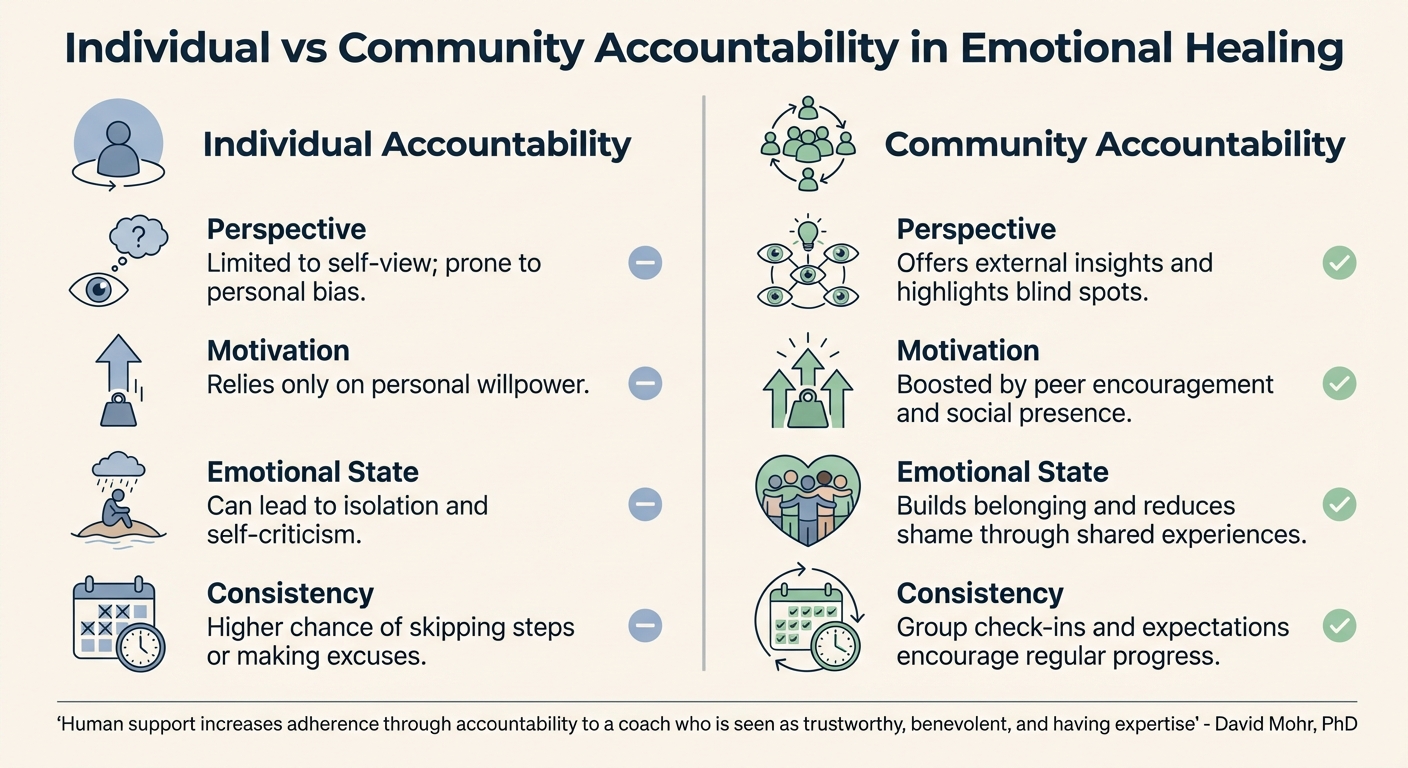
Individual vs Community Accountability in Emotional Healing
Building on personal accountability, involving a community adds an extra layer of support by offering outside perspectives and encouragement. While self-reflection helps you stay mindful of your progress, connecting with others ensures you’re not navigating the journey alone.
How Community Helps Emotional Healing
When you’re isolated, it’s easy to fall into patterns of rationalizing your actions, which can derail your progress. Community support interrupts this cycle by connecting you with people who genuinely understand what you’re experiencing.
Being part of a group with shared struggles fosters a sense of belonging and reminds you that recovery is possible [18, 13]. Hearing someone else’s story can be incredibly validating – it shows you’re not alone and makes it easier to open up about your own challenges without fear of judgment [18, 12].
Beyond emotional support, communities offer practical advice that you might not uncover on your own. Group members often point out warning signs you may overlook and share strategies that have worked for them in similar situations [18, 12]. A 2022 study even found that social support plays a key role in building resilience during tough times. Considering that 77% of Americans report significant stress about the future, having a strong support network is more important than ever.
These benefits highlight the unique value of collective insight, paving the way for a deeper dive into how individual and group accountability compare.
Individual vs. Community Accountability
| Feature | Individual Accountability | Community Accountability |
|---|---|---|
| Perspective | Limited to self-view; prone to personal bias | Offers external insights and highlights blind spots [21, 12] |
| Motivation | Relies only on personal willpower | Boosted by peer encouragement and social presence [12, 22] |
| Emotional State | Can lead to isolation and self-criticism | Builds belonging and reduces shame through shared experiences [18, 21] |
| Consistency | Higher chance of skipping steps or making excuses | Group check-ins and expectations encourage regular progress [18, 13] |
When you’re accountable solely to yourself, it’s easy to justify missed steps or slip-ups – a behavior researchers call "defensive bolstering." But when you check in with a group or trusted peer, those rationalizations don’t hold up as easily. David Mohr, PhD, from Northwestern University, explains:
Human support increases adherence through accountability to a coach who is seen as trustworthy, benevolent, and having expertise.
This comparison shows why integrating community accountability can make a huge difference in your healing process, as seen in tools like Stumble.
How Stumble Supports Community Accountability

Stumble provides a safe, anonymous space for shared healing. Its community feature lets you connect with others who are also working through breakups, offering support while protecting your privacy.
The app combines daily check-ins and reflective journaling with an anonymous peer network, helping you stay accountable both personally and within a group. Plus, its 24/7 grounding support ensures that no matter when you’re struggling, you’ll always have a lifeline to lean on.
How to Build Accountability in Your Healing Process
Now that you know how community support can strengthen accountability, it’s time to put that knowledge into action. Building accountability doesn’t require sweeping changes – just small, consistent steps.
Use Journaling and Daily Check-Ins
Journaling helps you document your progress while slowing down racing thoughts and breaking emotional spirals. It’s a simple yet effective way to stay grounded.
Using tools like bullet journaling, you can track your moods, habits, and goals. Keep your habit tracker somewhere you’ll see it daily – like on your refrigerator or bathroom mirror – for a constant reminder of your intentions. Apps like Stumble make this process even easier with daily check-ins and private journaling features, allowing you to reflect on your emotional state in a safe, private space.
But accountability doesn’t stop with personal reflection. Engaging with a supportive community takes it to the next level.
Join Supportive Communities
While self-reflection is essential, connecting with others who share your journey adds another layer of accountability. Sharing your goals with a supportive group creates a sense of responsibility and a standard to strive for. As Melissa Tihin, a therapist at Central Valley Family Therapy, explains:
Accountability is where change really takes root. It’s how we shift from insight to action, from awareness to growth.
Stumble offers an anonymous community where you can openly share your wins and struggles without fear of judgment. Whether you join a 12-step program, participate in an online forum, or use Stumble’s constellation-based support network, the key is consistency. Regularly showing up and being honest about your journey helps solidify your commitment.
While journaling and community involvement focus on tracking your growth, celebrating milestones reminds you of how far you’ve come.
Celebrate Your Milestones and Progress
Recognizing your achievements – big or small – keeps you motivated. Create a simple reward system to celebrate these moments. Rewards don’t have to be extravagant; they can be as simple as enjoying a quiet hour with a book, taking a relaxing bath, or watching a favorite movie.
Sharing these victories with your community makes them even more meaningful. When you post about reaching a milestone, you not only celebrate your success but also inspire others and strengthen your own commitment to keep moving forward. Stumble’s progress rewards feature helps you track these moments, offering reminders of how far you’ve come – even on the toughest days.
Conclusion
Healing emotionally often starts with connection. Accountability transforms self-awareness into actionable steps, helping to break cycles of isolation and harmful habits while fostering resilience. As Patrick Nagle, Co-Founder of MentalHealth.com, puts it:
Accountability offers a different path. Rather than assigning fault, accountability emphasizes responsibility, awareness, and response.
This perspective creates a foundation for meaningful, everyday recovery practices.
To begin, consider incorporating small, manageable habits into your daily routine – like journaling, regular self-check-ins, or engaging with others who truly understand your journey. Support from a community isn’t just beneficial – it’s a key part of the process. Studies show that accountability within a supportive group can significantly boost recovery efforts.
Celebrate your progress by tracking milestones, sharing achievements, and acknowledging personal growth. By blending accountability with the support of a community, you not only move forward but also create space for self-forgiveness. Platforms like Stumble provide a unique combination of private journaling and anonymous community connections, offering both the solitude to process your feelings and the accountability to stay on track.
FAQs
How does accountability support emotional healing and prevent setbacks?
Accountability plays a crucial role in emotional healing by helping individuals stay focused and dedicated to their recovery. When people take responsibility for their actions and progress, they’re more likely to identify emotional triggers, stick to their coping techniques, and take active steps to keep moving forward.
Having support from others, such as a community or accountability partners, can make this journey even more effective. This kind of support offers encouragement, a safe environment to share struggles, and an extra layer of reinforcement. It also helps people address challenges early, preventing negative patterns from spiraling out of control. By embracing accountability, individuals build emotional strength and lay the groundwork for lasting healing.
How does community support help with accountability in emotional healing?
Being part of a supportive community can make a big difference when it comes to emotional healing. It provides a space where people feel encouraged to reflect honestly on their experiences, stay motivated, and work toward healthier ways to cope. Sharing personal challenges in a safe and understanding group helps individuals stay committed to their healing process.
Beyond that, a supportive community fosters trust, a sense of belonging, and shared responsibility. When individuals feel accountable to others, they’re more likely to spot setbacks early, reach out for help, and feel reassured that they’re not navigating this journey alone. This kind of collective support not only boosts personal accountability but also helps build long-term emotional strength and resilience.
How can I incorporate accountability into my emotional healing journey?
Taking control of your emotional healing journey starts with owning your actions and progress. A good first step is to set clear, realistic goals and regularly assess how you’re doing. You can do this alone or with the help of someone you trust – whether that’s a close friend, a family member, or a group that values honesty and support without judgment.
Tools like journaling can be incredibly helpful for tracking your thoughts and emotions privately. If you prefer a more interactive approach, platforms like Stumble provide guided healing content, daily check-ins, and access to an anonymous community. These features make it easier to reflect and connect without feeling overwhelmed.
What’s key here is acknowledging setbacks, celebrating even small victories, and keeping your goals in mind. Building this sense of accountability can serve as a strong foundation for emotional growth and resilience over time.
Related Blog Posts
- How to Journal Your Feelings After a Breakup
- The Complete Guide to Healing After a Breakup
- 10 Self-Care Activities for Breakup Recovery
- How Long Does It Take to Get Over a Breakup?
STUMBLE APP
Ready to start healing?
Stumble gives you the community, tools, and support to move forward — free on iOS.
Download the app free →
Tagged with :