
Here’s the honest answer: most people feel meaningfully better around 11 weeks after a breakup — though that number will either reassure you or feel laughably optimistic depending on where you are right now. A 2017 study in the Journal of Positive Psychology found that people consistently overestimate how long their pain will last, which means you’re probably suffering more than you need to. Self-esteem can take closer to a year to fully stabilize, deep emotional attachments sometimes linger for years, and divorce recovery? That’s a whole different timeline — often 17 months or more.
Key Points to Know:
- 3 months: Depressive symptoms often improve.
- 1 year: Self-worth typically stabilizes.
- 4 years: Emotional attachments significantly fade.
- 17+ months: Divorce recovery takes longer.
Recovery isn’t one-size-fits-all. Strategies like the no-contact rule, journaling, and leaning on a support system can genuinely help. If the grief feels unmanageable or it’s bleeding into your daily life, therapy is worth considering. Healing takes time — but it does happen.
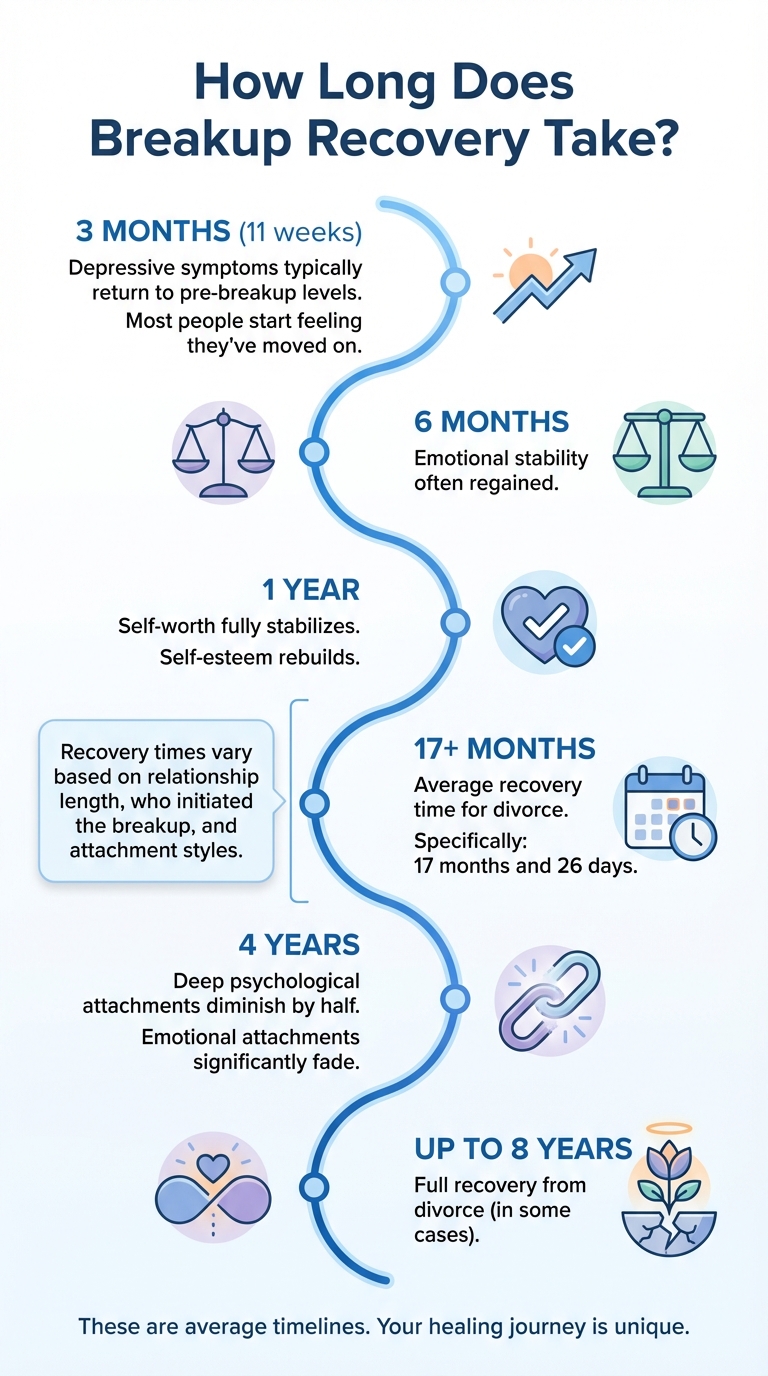
Breakup Recovery Timeline: How Long Does Healing Take
How Long Does Breakup Recovery Take?
Research on Average Recovery Times
How long does it take to get over a breakup? The honest answer is: it depends — but the research gives us some useful anchors. A 2023 study from the University of Washington found that depressive symptoms typically return to pre-breakup levels within about three months. A separate study of 155 undergraduates landed on a similar window — most participants felt they’d moved on within that same three-month stretch.
Data from Reddit suggests emotional stability often returns within six months. But research from the University of Bern tells a longer story — it can take about one year for self-worth to fully stabilize after a breakup. That’s not pessimism; it’s just how identity rebuilding works.
Divorce recovery is a different beast entirely. On average, divorcees need 17 months and 26 days to feel like themselves again. Deep psychological attachments tend to fade by half over roughly four years — and according to psychologist Mark Travers, Ph.D., fully moving on from a divorce can take up to eight years for some people.
These timelines aren’t meant to discourage you. They’re a reminder that where you are right now makes complete sense — and that healing, even when it’s slow, is still happening.
What Affects How Long Recovery Takes
The numbers give you a rough map, but your actual breakup recovery timeline is shaped by factors that are entirely your own. Relationship length, who ended things, attachment style, and the specific circumstances of the split all matter — a lot.
Longer relationships tend to involve deeply intertwined identities. When it ends, you’re not just losing a person — you’re losing a version of yourself. And the role you played in the breakup changes everything. If you were the one who left, you’ve likely been processing the grief for weeks or months already. If you were blindsided, that emotional impact hits differently and tends to extend the recovery period.
Attachment styles add another layer. People with anxious attachment — those who seek constant closeness and reassurance — often take significantly longer to let go than people with secure or avoidant styles. There’s no judgment in that. It’s just wiring.
The nature of the breakup itself shapes healing too. A mutual split over incompatibility might actually bring relief. A breakup involving infidelity or betrayal? That leaves wounds that take much longer to close. And if you share a dog, kids, or a lease — forced ongoing contact with your ex can slow everything down in ways that feel completely out of your control.
Strategies to Help You Heal Faster
The No-Contact Rule and How It Helps
The no-contact rule is simple in theory: cut off all communication with your ex — no texting, no calling, and definitely no late-night scrolling through their Instagram. Research backs this up strongly. Staying in contact with an ex after a breakup amplifies psychological distress. The brain science explains why.
Breakups cut off the neurochemical rewards — dopamine especially — that your relationship was providing. Every time you check their profile or send a “just checking in” text, you’re reigniting that craving. It feels like connection. It’s actually just prolonging withdrawal. Gregory Matos, PsyD, ABPP, is direct about it:
“In these situations, no contact for 30 or more days would be helpful.”
Behavioral scientist Clarissa Silva puts it even more plainly:
“This habit only slows your progress because it occupies your brain with thoughts of their activities and whereabouts.”
The 30-day no-contact window gives your brain the space it needs to rewire and stop idealizing memories of the relationship. A practical first step? Mute or unfollow your ex on every platform. It’s a small move — but it removes the temptation from your feed entirely.
And here’s the thing: a 2021 study in PLOS ONE found that limiting social media use to just 30 minutes daily reduced loneliness scores by 25% (PLOS ONE, 2021). Less scrolling means less pain — whether you’re stalking your ex or just doom-scrolling in general.
Using Journaling to Process Your Emotions
Journaling sounds almost too simple. But the evidence for it is surprisingly strong — a study in Frontiers in Psychology found that writing about emotional experiences reduces distress by up to 40% in acute grief (Frontiers in Psychology). That’s not a small effect. It slows down racing thoughts and gives overwhelming feelings somewhere to go other than back into your chest.
Therapist Alysson Thewes, LCSW, recommends starting with a “brain dump” — just write down every raw emotion without worrying about grammar, structure, or whether it makes sense. Sadness, anger, guilt, relief, confusion — put it all down. The point isn’t to write well. The point is to get it out of your head.
Once you’ve vented, try shifting to deeper questions. Something like: “Why do I keep looking for happiness in the same place I lost it?” That move — from venting to reflecting — is what turns journaling from a coping mechanism into actual processing.
Stumble’s private journaling feature was built for exactly this. It lets you track your mood and emotional patterns over time, and revisit past entries when you need a reminder of how far you’ve come. As Thewes puts it, rereading your entries gives you a “bird’s-eye view” of your emotions — and that perspective alone can be genuinely comforting.
Finding Support During Recovery
Let me be honest: you probably can’t do this alone — and you shouldn’t have to. The research is pretty clear on this. According to the American Psychological Association, social support is the single strongest predictor of resilience after a major loss. Not therapy. Not self-care routines. Other people.
Surround yourself with people who listen without judgment, validate what you’re feeling, and actually tell you the truth when you need to hear it. One practical move: find a “no-contact sponsor” — someone you can call in the 2am moments when you’re about to text your ex.
“Having a strong support system is so important because you need people you can open up to — and who will be honest with you in return.” — Adam Borland, PsyD, Psychologist
If your personal support network feels thin right now, anonymous communities can fill that gap. Data shows that engaging with science-backed resources and supportive groups can speed up recovery by as much as 58%. Stumble’s constellation-based community offers a judgment-free space to connect with people who are going through something similar — not just to vent, but to actually feel less alone in it.
Tracking Your Progress Over Time
How to Know You’re Healing
Healing rarely announces itself. It shows up quietly, in small moments. You think about your ex and the familiar chest-ache isn’t there. The coffee shop you used to go to together is just a coffee shop again. These are real signs — don’t dismiss them.
Another marker is feeling complete in yourself again. Not “healed” in some dramatic, final sense — just grounded. Like you’re a whole person who experienced a loss, rather than a person defined by what they lost. Dr. Sarah Bren, a psychologist, frames it well:
“Accepting that we can feel sad and also feel happiness is an important part of the healing process… because it reduces our chances of getting stuck in our sadness and becoming hopeless.”
You might also notice a genuine openness to meeting new people — not to fill the void, but because you actually want fresh connection. A 2017 study in the Journal of Positive Psychology found that most people start feeling significantly better around the 10 to 11-week mark (Journal of Positive Psychology, 2017). You may be closer to that turning point than you think.
That said, if your progress feels stalled, professional support is worth considering — not as a last resort, but as a legitimate tool.
When to Talk to a Therapist
Sometimes healing hits a wall. If basic daily tasks — work, self-care, making decisions — feel genuinely unmanageable, that’s a signal worth paying attention to. Therapist Jonathan Eddie advises that if grief persists beyond a year or is actively preventing you from moving forward, therapy isn’t just a good idea. It’s probably necessary.
There are also warning signs that call for immediate help: thoughts of self-harm, substance misuse, or significant struggles with daily functioning. If you’re there, please reach out — you can call or text the 988 Suicide & Crisis Lifeline right now.
A therapist offers something that friends and family — as well-meaning as they are — genuinely can’t: a neutral, expectation-free space to work through your emotions. Specialists in life transitions or relationship recovery can also help you identify patterns, like attachment styles, that might be making this particular breakup hit harder than it otherwise would.
sbb-itb-ee19e1f
How Much TIME Does It Take To HEAL FROM A BREAKUP? (Healing a broken heart timeline)
Conclusion
There’s no fixed timeline — and anyone who tells you there is probably hasn’t been through a bad one. Research points to the 11-week mark as a meaningful turning point for many people, but healing isn’t linear. Some people bounce back faster. Some need much more time. Both are valid.
What actually moves the needle is this: building healthy habits, leaning on people who genuinely care about you, and letting yourself feel what you feel instead of outrunning it. As Dr. Adam Borland from Cleveland Clinic wisely
STUMBLE APP
Ready to start healing?
Stumble gives you the community, tools, and support to move forward — free on iOS.
Download the app free →
Tagged with :