


THE GRIEF NO ONE PREPARES YOU FOR
Divorce Is Harder Than People Will Ever Admit to Your Face
Here’s the thing nobody tells you: a breakup ends a relationship. Divorce ends an entire infrastructure. Your tax filing changes. Your emergency contact changes. The person who knew your coffee order and your mother’s birthday and where you keep the spare house key — they become someone you communicate with through a lawyer.
The Holmes-Rahe Stress Inventory — a tool used by psychologists since 1967 — ranks divorce as the second most stressful life event a human can experience, right behind the death of a spouse. Research from the American Psychological Association confirms that divorce impacts mental health on nearly every measurable dimension: sleep, appetite, concentration, self-worth, even your immune system.
And yet. People expect you to “bounce back.” Your coworkers give you maybe two weeks of gentle treatment. Your family asks if you’re “seeing anyone yet” at Thanksgiving. Your kids need you to be steady when you can barely stand. This gap — between how devastating divorce actually is and how quickly the world expects you to recover — is where the real suffering lives.

EMOTIONAL SUPPORT AFTER SEPARATION
A Self-Care App During Divorce That Addresses the Four Layers Generic Apps Ignore
Most wellness apps treat emotional pain like it’s one thing. But divorce stacks at least four distinct kinds of grief on top of each other, and they all demand different tools:
Identity grief. Who are you when you’re no longer somebody’s husband or wife? You built a self around “we” — we like Italian food, we vacation in September, we’re saving for a house. When “we” dissolves, the “I” that’s left can feel like a stranger. Stumble’s guided journaling helps you rediscover that person through writing, not rumination.
Co-parenting stress. You have to keep showing up for tiny humans who don’t understand why Mommy or Daddy lives somewhere else now. You swallow your grief during pickup. You smile at birthday parties where your ex stands six feet away. It’s exhausting performance art, and our anonymous community gives you a place to drop the mask.
Social recalibration. Mutual friends vanish. Couple friends quietly stop inviting you. You realize your entire social life was scaffolded around a partnership that no longer exists. The University of Florida’s research on self-care after divorce highlights rebuilding social connections as critical — and Stumble provides that starting point.
Timeline pressure. “It’s been six months, aren’t you over this?” No. You’re not. And the shame of not being “over it” creates a second layer of pain on top of the original wound. Stumble’s mood tracking shows you the actual data: healing after divorce is nonlinear, and that’s completely normal.
HEALING AFTER DIVORCE APP — FEATURES
Four Tools Built for the Specific Pain of Divorce
Anonymous Community
Talk to people who’ve actually been through divorce — not friends who mean well but compare it to their two-month relationship ending. No names, no judgment, just people who get it.
Divorce Recovery Journaling
Process the emotional grief and the paperwork grief. Guided prompts for the day you sign the papers, the first holiday alone, the moment you remove your ring. The stuff therapy homework doesn’t cover.
AI Companion
Available at 2am when the kids are finally asleep and your chest is tight and you can’t call anyone. It won’t replace a therapist, but it’ll hold space until morning.
Mood Tracking
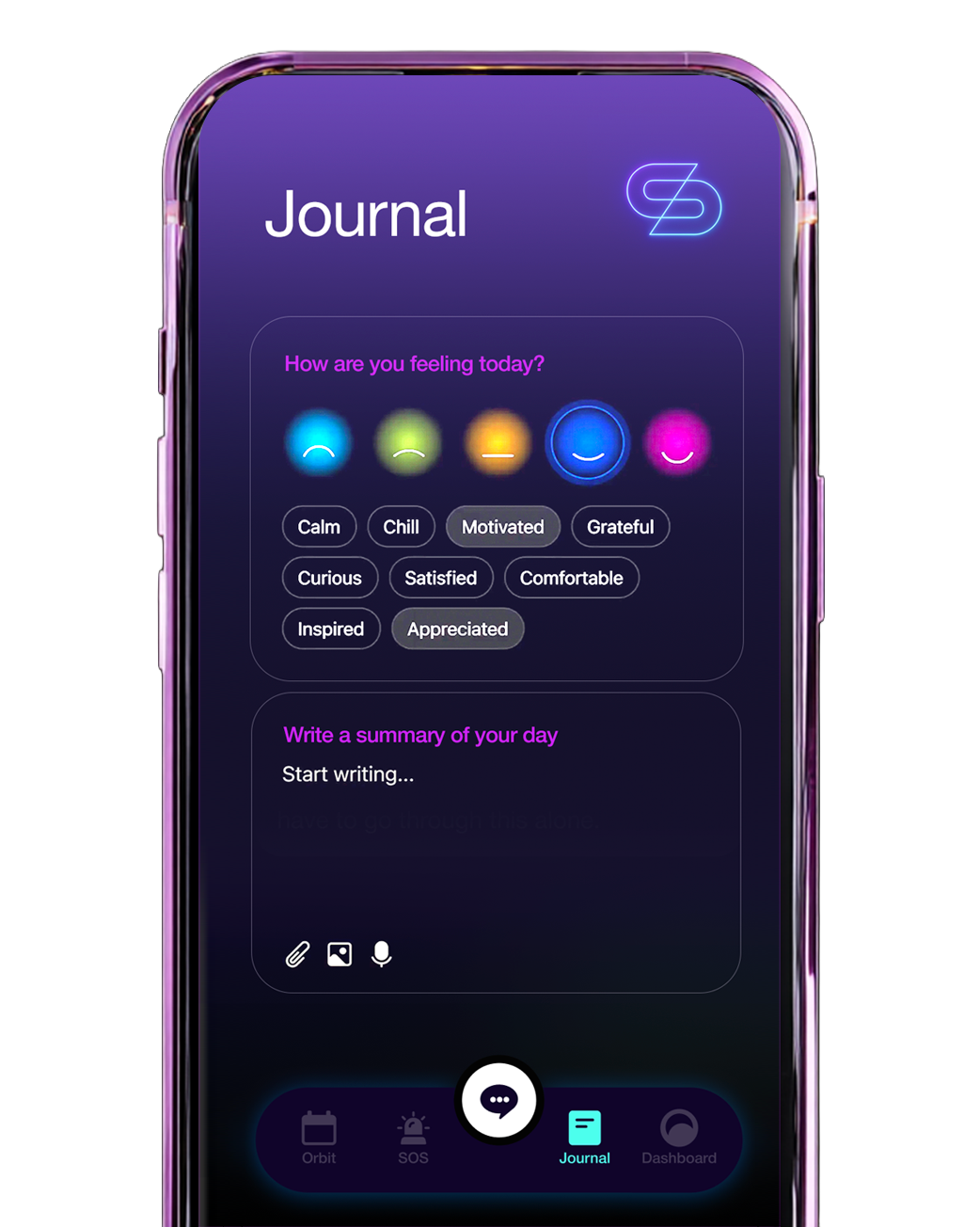
Divorce recovery doesn’t look like a straight line going up. It looks like chaos. Mood tracking gives you proof — actual visual proof — that the good days are slowly outnumbering the bad ones.
HOW STUMBLE WORKS
Getting Started Takes Less Time Than Making a Cup of Coffee
You don’t need to commit to anything big right now. You’ve already committed to — and lost — enough this year. Here’s how Stumble meets you where you are:
No lengthy intake forms. Tell Stumble what you’re going through — divorce, separation, co-parenting strain — and it customizes your experience.
Just a quick tap. Some days it’s “surviving.” Some days it’s “oddly okay.” Both are valid. Over time, these check-ins become your evidence that you’re moving forward.
Some nights you’ll journal. Some nights you’ll read someone’s anonymous post about co-parenting exchanges and cry because someone finally put it into words. Some nights you’ll just talk to the AI because you need to say it out loud without being judged. There’s no “right” way to use Stumble. Visit our divorce support hub for more guidance.

Real Stories from People Rebuilding After Divorce
Names changed. Feelings 100% real.

“I’d been sleeping on my sister’s couch for three weeks and doom-scrolling divorce forums at 1am when I found Stumble. The community here — I posted about feeling guilty for being relieved the marriage was over, and within an hour four people had shared the exact same feeling. I didn’t know guilt and relief could exist in the same breath until strangers validated it for me.”
— Rachel, 38, divorced after 11 years

“The hardest part wasn’t losing her. It was the Tuesday night I picked up my kids and my five-year-old asked ‘Why doesn’t Daddy live with us anymore?’ and I had to hold it together in a Walmart parking lot. I used the AI companion that night because I couldn’t burden my friends again. It didn’t fix anything, but it got me to morning.”
— Marcus, 41, co-parenting two kids

“Month four I was convinced I was getting worse, not better. Then I looked at my mood data in Stumble and realized I’d had 18 ‘okay’ days that month versus 7 in month one. My brain was lying to me. The data wasn’t. That single moment — seeing the chart — was the first time I believed I might actually survive this.”
— David, 34, separated 8 months
YOUR FIRST 30 DAYS
What Divorce Recovery Actually Looks Like on Stumble
This isn’t a rigid program. It’s a rough map for the kind of terrain you’re crossing. Some weeks you’ll sprint. Some weeks you’ll crawl. Both count as forward.
Landing Softly
Set up your mood check-ins. Browse the anonymous community. You don’t have to post yet — just read. Notice you’re not the only person awake at 3am wondering if they made the right call. That recognition alone is medicine.
Starting to Unpack
Try your first journal entry. Maybe it’s about the moment you knew. Maybe it’s about dividing the bookshelves and how absurd it felt to argue about a $12 cookbook. Let it be messy — that’s the point. The National Institute of Mental Health highlights expressive writing as a genuine buffer against depression.
Finding Your People
Post in the community. Share something small. You’ll realize that the shame you’ve been carrying — about the marriage failing, about not being enough, about the thing you said during the worst fight — has been weighing twice as much because you’ve been carrying it alone.
Seeing the Data
Look at your mood chart. Really look at it. You’ll probably notice something counterintuitive: the days you journaled or connected in the community consistently score better than the days you white-knuckled it alone. Your own data becomes the argument for showing up again tomorrow.
Questions People Ask About Using a Mental Health App for Divorce
Can an app really help with something as serious as divorce?
Honestly? An app won’t replace a therapist or a good lawyer. But here’s what it can do that neither of those can: it’s there at 2am on a Tuesday. It’s there during the custody exchange when you’re sitting in your car trying not to cry. It’s there when you don’t have the energy to explain the whole story to another friend. Stumble fills the gaps between the appointments — and those gaps are where most of the pain actually lives.
Is everything really anonymous? My divorce involves public people.
Completely anonymous. No real names, no photos, no linking to social accounts. You can share as much or as little detail as you want. Many of our members are going through high-profile or complicated divorces and the anonymity is exactly why they chose Stumble over Facebook support groups where screenshots travel fast.
I’m still in the middle of my divorce — is it too early to start?
There’s no such thing as too early. A lot of people join while they’re still in the thick of it — sleeping in separate bedrooms, waiting on paperwork, not even sure they’re actually going through with it. You don’t need to be “officially divorced” to need support. If you’re hurting, you qualify.
How is
KEEP READING
Related Articles to Support Your Journey
KEEP READING