
A breakup can feel like a setback, but it’s also an opportunity to focus on your career and personal growth. Research shows that while 44% of people experience a temporary decline in work performance, 71% report personal growth within just 11 weeks. This guide offers actionable steps to turn emotional challenges into professional momentum, including:
- Regaining focus: Set boundaries like no-contact to free your mental space for work.
- Building confidence: Identify emotions, practice mindfulness, and explore new skills to boost self-esteem.
- Setting career goals: Define clear objectives and break them into manageable steps.
- Creating routines: Replace old habits with productive ones, like networking or skill-building activities.
- Tracking progress: Use tools like journaling to measure achievements and align your career with your values.
The key is balancing emotional recovery with professional priorities. Tools like Stumble can help you process emotions while staying organized and focused on your career. Remember, this is your chance to redefine success on your terms.
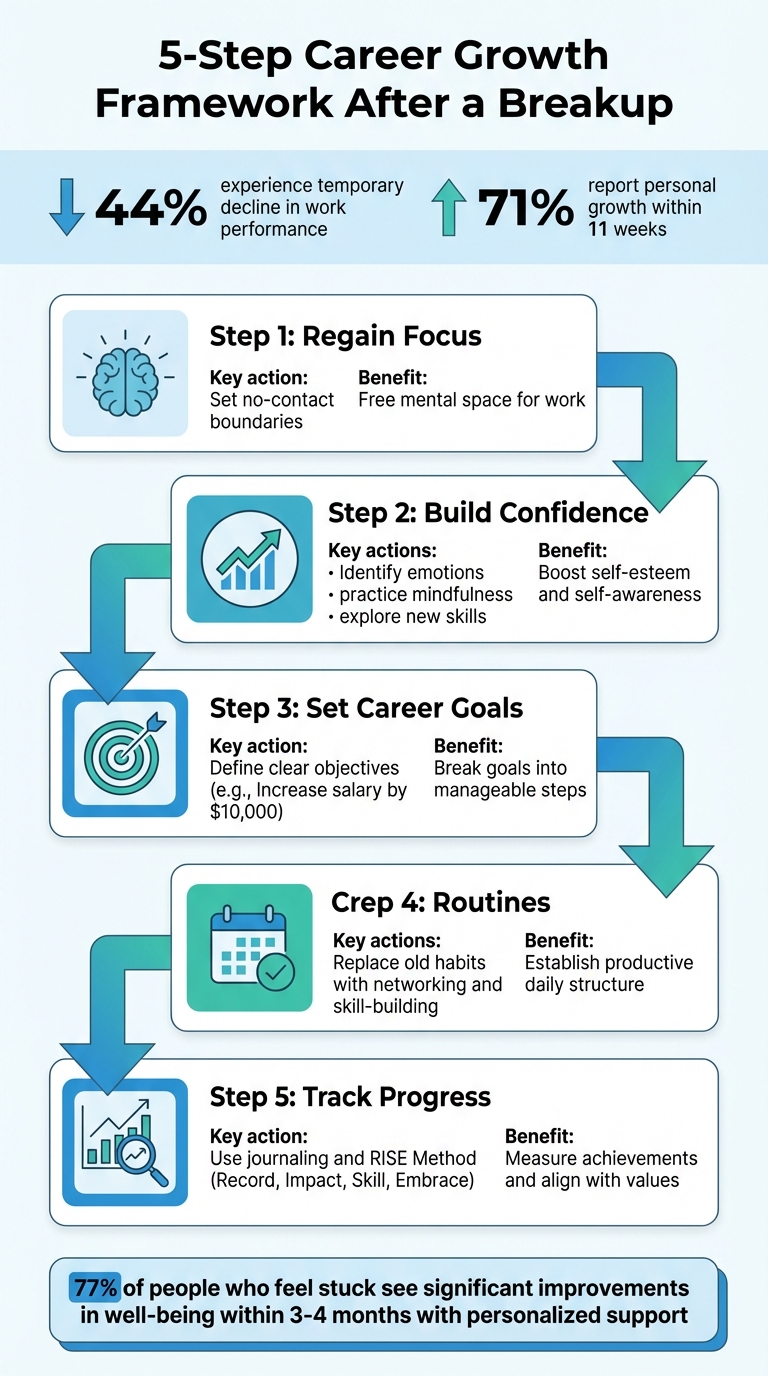
5-Step Career Growth Framework After a Breakup
Creating a Strong Foundation for Career Success
Gaining Mental Clarity Through No Contact
After a breakup, cutting off all non-essential communication is a powerful way to regain focus. This means no calls, texts, DMs, social media stalking, or even indirect check-ins through mutual friends. Think of it like quitting a bad habit – going "cold turkey" helps you take back control of your mental space.
"Minimizing any possible communication with your ex during work hours will ensure your mind is on work, and help you stay productive." – Kristin Wong, Editorial Author, Lifehacker
Blocking your ex’s contact channels is a simple but effective way to avoid emotional triggers that could derail your career focus. Instead of re-reading old messages or scrolling through their updates, use that time to focus on your professional growth. For example, swap out habits like calling your ex during your commute with listening to professional development podcasts or setting up networking meetings with colleagues.
If your ex is a coworker, it’s essential to shift the dynamic into a strictly professional one. As Chiara Atik, author of Modern Dating: A Field Guide, puts it:
"It’s not so much the end of a romantic relationship as it is a transition into a more distant, professional one"
Keep all interactions work-related and avoid discussing the breakup with colleagues. If you feel your productivity might take a hit, consider informing your manager. Career coach and attorney Wendi Weiner advises:
"The reason for [looping in your manager] is your output can be affected"
Once you’ve cleared your mind of these distractions, you can start focusing on rebuilding your confidence and professional identity.
Building Self-Awareness and Confidence
Confidence begins with identifying and naming your emotions as they happen. Instead of reacting impulsively, saying something like "I feel disappointed" creates a mental gap that allows for thoughtful responses. Physical cues, like tightness in your chest or sudden bursts of energy, can also signal stress before it spirals out of control.
To manage these moments, try the Pause Technique: take three slow, deep breaths to regain composure. For even more control during stressful situations, use box breathing – inhale, hold, exhale, and hold again, each for four counts. Therapist Imani Wilform highlights how learning new things can also be a game-changer:
"Learning new things can improve brain capacity and happiness, while mastering new skills builds confidence and self-respect"
Take stock of your marketable skills to reaffirm your professional value and pinpoint areas for improvement. Journaling can also help you process your thoughts and track your emotional progress over time. Research by Professor Richard H. Price at the University of Michigan found that losing a role you view as a "calling" can deeply impact your sense of identity. Reconnecting with your self-awareness is a key step in reclaiming that identity and moving forward with purpose.
Redirecting Your Energy Toward Career Goals
Setting Clear Career Objectives
Take the mental space freed up after a breakup and channel it into achieving specific career goals. Instead of settling for vague aspirations like "I want a better job", aim for something more defined, such as "Become a business intelligence analyst" or "Increase my annual salary by $10,000 within the next year".
Start with a self-assessment to understand your strengths and values. Look at skills you’ve gained from past jobs, hobbies, or volunteer work. Talking to mentors or professionals in your field can help you identify areas where you need to grow.
Rachel Cooke explains it well:
"Career development is simply a strategic set of actions you take to grow your career by building your knowledge, skills, and experience."
Once you know where you want to go, break your goals into smaller, actionable steps. If you’re considering a career shift, create a simple three-step plan. Write down everything you want to achieve, anticipate challenges and how to tackle them, and set deadlines for each step. For example, you might decide to send out five resumes weekly or schedule two informational interviews each month. Focusing on these smaller tasks helps you stay consistent and keeps emotional ups and downs from derailing your progress.
Define your goals clearly, then use daily habits to keep yourself moving forward.
Creating a Daily Routine for Consistency
With your objectives in place, the next step is to build routines that support your career growth. Start small – adopt one new habit every two weeks.
Each morning, set yourself up for success by identifying three "small wins." These could be as simple as responding to a key email, drinking water before your first coffee, or taking a few deep breaths before a stressful meeting. Sarah Thompson offers a helpful perspective:
"Think of rebuilding your routine after a breakup like updating your internal GPS. You’re not erasing the old routes – you’re simply programming new destinations that lead somewhere better."
Incorporate "anchor activities" into your week – things like a recurring fitness class or a regular volunteer shift. These scheduled commitments eliminate the stress of deciding how to spend your time and provide dependable structure.
Replace shared routines from your past relationship with solo activities that energize and motivate you. A quick morning stretch session or enrolling in an online certification course can set a positive tone for the day.
At night, spend just five minutes preparing for the next day. Lay out your clothes, set up your coffee maker, and unplug from screens. These small, consistent actions create a sense of progress and help prevent the stagnation that can hinder both your emotional recovery and career growth.
Building Professional Relationships and Managing Emotions
Managing Emotions at Work
After a breakup, managing your emotions at work is crucial for staying productive and focused. Break your work into smaller, concentrated tasks and schedule regular, short breaks – like a lunch period dedicated to reflection. This approach helps maintain productivity while giving you time to process emotions. Research published in Social Psychology and Personality Science found that individuals who took time to reflect on their breakup experienced a more significant decrease in self-concept disturbance, aiding in their recovery.
Set boundaries with technology to avoid emotional triggers during your workday. For instance, rename your ex’s contact with a neutral label like "Contact 1" to reduce emotional reactions. Also, resist the urge to check personal emails while at work to maintain a clear separation between personal challenges and professional responsibilities.
If you need support, confide in a trusted colleague rather than your manager. This allows you to share your feelings without risking your professional image.
By implementing these strategies, you can create a stable work environment, conserve your emotional energy, and redirect focus toward building professional connections.
Developing Professional Connections
Once you’ve gained control over your emotional landscape, turn your attention to cultivating meaningful professional relationships. Focus on building genuine connections with trusted advisors by setting up short informational meetings and practicing active listening. As Grow with Google emphasizes:
"Networking is, first and foremost, about building authentic relationships with people you respect and admire".
Replace routines tied to past emotions with activities that enhance your professional life. For example, join coworkers for lunch or head to the gym after work to boost your mood and stay focused .
If in-person networking feels overwhelming, explore online professional groups and participate in industry discussions. Sharing your thoughts on career topics or leaving encouraging comments on others’ posts can help you stay visible and engaged while conserving emotional energy.
Using Tools and Resources for Growth
How Stumble Supports Your Recovery and Career

Breakups can disrupt your emotional balance and shake your confidence, making it harder to focus and make decisions effectively. But here’s the thing: emotional intelligence isn’t gone – it’s a skill you can rebuild with time and the right tools. Stumble is designed to help you regain that balance while also advancing your career.
One of its standout features is private journaling, which provides a safe space to process your emotions. As Career Contessa puts it, "Journaling is a great way to keep your goals aligned, your thoughts organized". Think of it as emotional first aid – it helps you regain clarity and focus before diving into demanding work tasks. This can also help you separate genuine professional priorities from emotional reactions tied to past relationship dynamics.
Stumble also offers daily check-ins and guided healing content, which create structure in your day and encourage emotional processing. These small, consistent actions not only help you heal but also improve your ability to concentrate on work. By creating what’s called “time architecture,” you can protect your most productive hours for core tasks. For example, using these check-ins, you can carve out a 90–120 minute block during your peak productivity window to focus on critical work, free from distractions. This seamless integration of emotional recovery and career planning helps you move forward with intention.
The guided healing content is another essential tool for navigating breakups. April Davis, Founder of LUMA Luxury Matchmaking, explains:
"If you accept and release your emotions, you’ll pave the way for recovery and personal growth"
This emotional clarity not only aids in personal recovery but also equips you to handle professional challenges with a more thoughtful and grounded approach.
Stumble’s Plans and Features
Stumble doesn’t just stop at emotional recovery – it also supports your professional growth with tailored plans that adapt to your needs. Here’s a quick breakdown of what’s available:
| Plan | Price | Key Features |
|---|---|---|
| Free | $0/month | Basic journaling, daily check-ins, and guided healing content |
| Pro | $48/month | Unlimited tools and 10 TB of storage for both personal and professional use |
| Business | $140/month | Premium tools, unlimited storage, and advanced organizational features for your career |
The Pro and Business plans go beyond the basics, offering unlimited storage to help you manage complex projects and track your progress. This added capacity can be a game-changer for staying motivated and organized during your recovery journey.
sbb-itb-ee19e1f
Tracking Progress and Recognizing Wins
Measuring Your Career Progress
Seeing your progress in black and white can be a powerful motivator. After a breakup, it’s easy to lose sight of how far you’ve come professionally when emotional recovery clouds your perspective. The fix? Set up a system to track your growth with tangible proof.
Dedicate just 15 minutes each Friday to jot down your wins using the RISE Method: Record accomplishments, note Impact, capture Skill growth, and Embrace your story. This practice lays the groundwork for self-advocacy. As Cyndi Bennett, a Trauma-Informed Career Coach, puts it:
"Documenting your professional achievements isn’t about proving your worth – it’s about creating a practical foundation of self-advocacy that no one can take away from you".
And don’t forget the quieter victories – those moments that may seem small but matter just as much. Speaking up in a meeting, setting a boundary, or even prioritizing self-care like taking a mental health day are all achievements worth celebrating.
Every three months, take a step back with a quarterly review. Revisit your career roadmap to assess your progress, adjust timelines as needed, and ensure your goals still align with your evolving values. Pair this with SMART goals – Specific, Measurable, Achievable, Relevant, and Time-bound – to create clear milestones you can work toward and celebrate. These metrics not only highlight your achievements but also guide your next steps as you align your professional goals with what truly matters to you.
Aligning Career Growth With Personal Values
Once you’ve measured your progress, the next step is ensuring your career aligns with your personal values. This is especially critical after a breakup, which can often spark a period of self-reflection. In fact, 86% of millennials have reported experiencing a “quarter-life crisis,” often tied to stress about finances, careers, and relationships.
Your values act as a guiding light during these times of uncertainty. Careers today rarely follow a straight path – they’re more like “squiggly” journeys with unexpected turns. When you’re healing emotionally, your values can help you navigate the twists. Ask yourself: What energizes me in my work? What drains me? Does my career align with my values and vision?. These questions can help you sort meaningful priorities from choices made out of distraction or avoidance.
Conduct a quick “Lifestyle Check” to ensure your career supports your personal life. Focus on your non-negotiables, like flexibility, income, travel requirements, and work-life balance. This ensures that your professional growth contributes to your overall well-being instead of existing in a silo. As Positivity.org explains:
"A roadmap that works is one that evolves with you, supports your well-being, and aligns with your unique definition of success".
Feeling stuck? You’re not alone – and there’s hope. Research shows that 77% of people who feel stuck see significant improvements in their well-being within 3–4 months when they receive personalized support and coaching. By combining emotional recovery tools like those in Stumble with a clear system for tracking your career, you’re setting yourself up for success – one that’s defined by what genuinely brings you fulfillment, not by others’ expectations.
How To Level Up Your Life After A Break-Up With Sarah Ashcroft
Conclusion
A breakup can spark profound professional growth, but it starts with recognizing that emotional healing and career progress go hand in hand. As Sarah Thompson wisely says:
"Healing happens when you embrace both processes [grief and growth] simultaneously".
By addressing your grief, you build the mental clarity and resilience needed to fuel your career ambitions.
This guide outlines practical steps: set boundaries to regain focus, channel your energy into actionable goals, manage your emotions with care, and nurture professional relationships. A supportive network plays a crucial role in recovery. Tools like Stumble can help you balance emotional recovery with career priorities.
Remember, your professional identity is far more expansive than any single relationship or job title. This is your chance to rebuild your confidence, develop new skills, and align your career path with what truly matters to you – not what others might expect. Ultimately, you are in charge of defining your happiness and success.
Celebrate small victories, track your progress, and give yourself grace throughout the journey. Career growth after a breakup isn’t about proving anything to anyone – it’s about crafting a professional life that reflects your values, strengths, and vision for the future. The path forward is yours to create.
FAQs
How can I stay focused and productive at work after a breakup?
Staying focused at work after a breakup can feel like an uphill battle, but taking small, deliberate steps can make things more manageable. Start by breaking your workload into smaller, bite-sized tasks. Tackling one thing at a time not only reduces the feeling of being overwhelmed but also helps you build momentum as you go.
Pay attention to how you’re feeling emotionally and set realistic expectations for your productivity. Each morning, take a moment to check in with yourself – acknowledge your emotions and plan your day with them in mind. Establishing a simple routine with clear, attainable goals, such as completing one specific task within a certain timeframe, can help you regain a sense of control and accomplishment.
Finally, let work serve as a positive distraction, but don’t forget to take breaks when you need them. Whether it’s stepping outside for fresh air or engaging in hobbies that bring you joy, finding activities that provide structure or align with your interests can keep you grounded. Above all, be patient with yourself and practice self-compassion as you work through this tough time.
How can I rebuild my confidence after a breakup?
Rebuilding confidence after a breakup begins with giving yourself the space to feel and process emotions like sadness, frustration, or grief. Letting yourself experience these feelings is an important part of healing and reclaiming your self-esteem.
Take this time to reconnect with who you are. Dive back into hobbies you love, set personal goals, or try something completely new that sparks joy. Even small changes, like refreshing your wardrobe or starting a fitness routine, can have a big impact on your mood and confidence.
Lean on positive influences in your life – whether that’s supportive friends, family, or uplifting spaces. Work on silencing negative self-talk by practicing positive affirmations or reframing your thoughts in a kinder way. These steps can help you rebuild your confidence and rediscover your sense of self as you move forward.
How can I redefine my career goals to align with my values after a breakup?
After a breakup, it’s crucial to reconnect with what truly drives you to shape your career path. Relationships often shape our priorities, sometimes pushing personal values to the background. Now’s the time to reflect on what matters most – whether that’s achieving work-life balance, embracing creativity, or focusing on career advancement.
Take a moment for self-reflection. Activities like journaling or having honest conversations with trusted friends can help you uncover values that may have been sidetracked during the relationship. Use these insights to set fresh career goals that resonate with who you are now. This shift can transform a tough period into a chance to realign with your true self and build a fulfilling professional future.
Related Blog Posts
- The Complete Guide to Healing After a Breakup
- 10 Self-Care Activities for Breakup Recovery
- How Long Does It Take to Get Over a Breakup?
- Breakup Recovery Timeline Calculator
STUMBLE APP
Ready to start healing?
Stumble gives you the community, tools, and support to move forward — free on iOS.
Download the app free →
Tagged with :