
Struggling to stay present? Affirmations can help. These simple, positive statements redirect your thoughts, improve mindfulness, and reduce stress. By repeating affirmations, you can train your brain to focus on the here and now, break negative thought patterns, and cultivate self-compassion. Whether you’re managing anxiety, healing from a breakup, or building resilience, affirmations are a practical tool for emotional balance.
Here’s what you’ll learn:
- How affirmations work with your brain to encourage calm and focus.
- Tips for writing effective, realistic affirmations.
- When and how to practice affirmations for maximum impact.
- Examples of affirmations for stress, healing, and confidence.
Start small: Choose 3–5 affirmations, repeat them daily, and pair them with grounding practices like deep breathing or journaling. Over time, this habit can shift your mindset and improve your well-being.
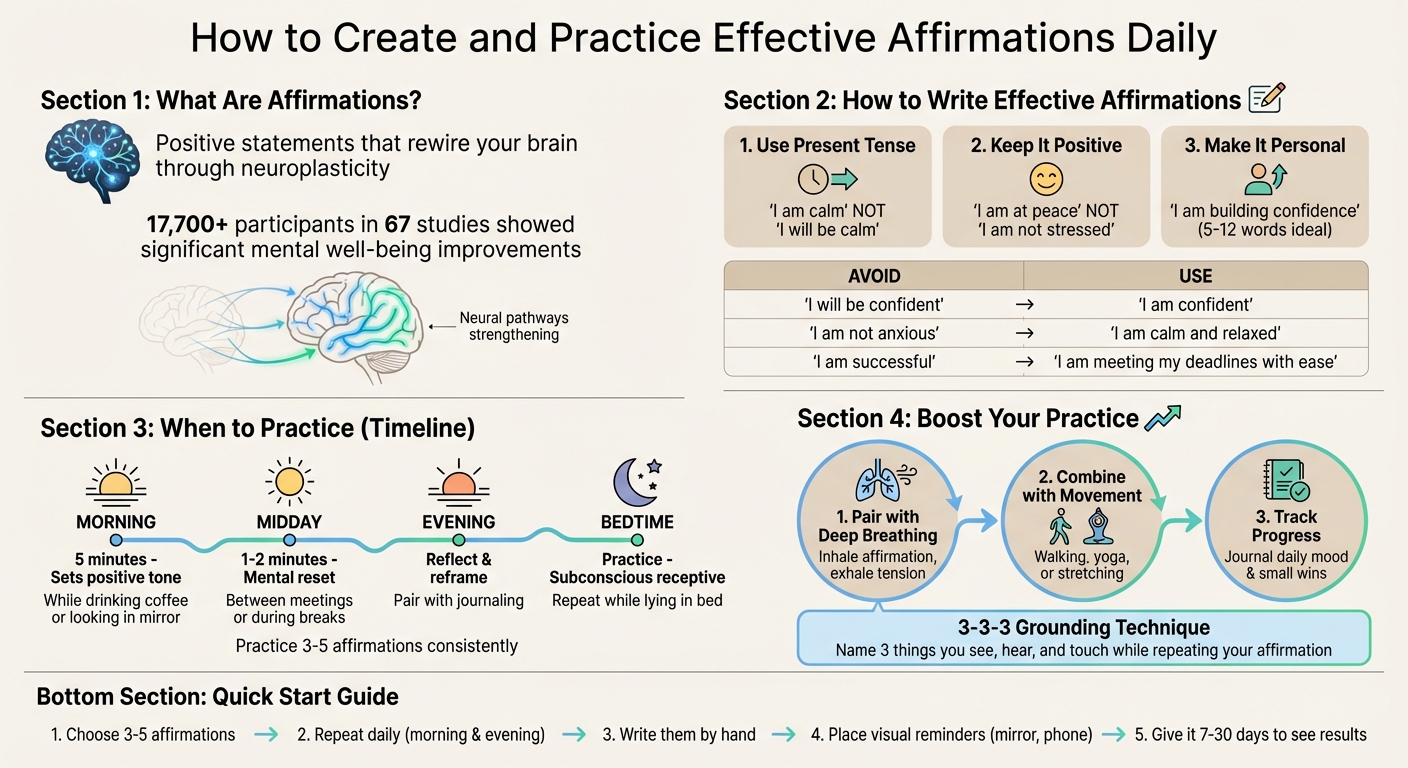
How to Create and Practice Effective Affirmations Daily
What Affirmations Are and How They Support Present-Moment Awareness
Defining Affirmations
Affirmations are positive, purposeful statements designed to shift your mindset and challenge negative beliefs. For instance, saying, "I am grounded in this moment," helps direct your attention to the present, allowing other distracting or negative thoughts to fade into the background.
This practice taps into the brain’s neuroplasticity – its ability to adapt and rewire itself. As Hebbian theory explains, "neurons that fire together, wire together". Regularly repeating affirmations strengthens positive neural pathways, gradually changing your default thought patterns. MRI studies even show that affirmations activate areas of the brain linked to self-reflection and reward, helping replace negative loops with more constructive thinking.
"Affirmations are statements intended to build and maintain healthy self-esteem and to help foster a positive outlook on life." – Psychology Today Staff
By reframing your thoughts in this way, affirmations naturally encourage mindfulness, pulling your attention away from dwelling on the past or worrying about the future.
How Affirmations Connect to Mindfulness
Mindfulness is all about being fully present in the moment, observing your thoughts and surroundings without judgment. Affirmations serve as mental anchors, guiding your focus back to the here and now. They also stimulate the brain’s reward centers, increasing dopamine and serotonin while reducing cortisol levels. This biochemical shift can enhance feelings of well-being and calm.
A meta-analysis of 129 tests across 67 studies, involving over 17,700 participants, found that self-affirmation significantly improves mental well-being and helps reduce barriers like anxiety.
Unlike mantras, which aim to quiet the mind, affirmations are more active – they work to reshape your thought patterns intentionally. By doing so, they not only promote mindfulness but also foster a healthier, more positive outlook.
sbb-itb-ee19e1f
POSITIVE MINDFULNESS AFFIRMATIONS ✨ Being Present ✨ Living here and now
Key Benefits of Affirmations for Present-Moment Focus
Affirmations can act as a mental anchor, helping to reduce stress, encourage self-compassion, and quiet negative thoughts. They’re not just motivational phrases – they engage your brain in ways that promote emotional balance and mindfulness.
Lowering Stress and Anxiety
Affirmations can interrupt the spiral of worry or self-doubt, redirecting your focus to the present moment. This isn’t just about feeling better; affirmations activate key areas of the brain, like the ventral striatum and ventromedial prefrontal cortex, which are tied to reframing stress and maintaining emotional equilibrium.
Studies show that practicing affirmations regularly can lower cortisol levels, reducing the physical toll of stress. For example, research involving over 17,700 participants revealed that self-affirmation significantly improves mental well-being and helps reduce anxiety. What’s even more promising? The benefits often grow over time, showing that consistency pays off.
"If we want to make less room for the negative thoughts, we have to practice positive thoughts intentionally." – Lauren Alexander, PhD, Psychologist, Cleveland Clinic
For managing anxiety, it’s helpful to keep affirmations realistic. Instead of saying, "I am fearless", try something like, "I have anxious thoughts, but I have the power to challenge them". Pairing affirmations with movement, such as walking or breathwork, can make them even more effective.
By reducing stress, affirmations create a foundation for improved self-esteem and emotional resilience.
Building Self-Esteem and Self-Compassion
Affirmations are a powerful antidote to harsh self-criticism, helping to train your mind to favor kindness over judgment. It’s like rewiring your brain to default to self-compassion.
Neuroimaging studies reveal that affirmations engage your brain’s reward centers, reinforcing a positive self-image. This aligns with Self-Affirmation Theory, which suggests that affirmations help restore a sense of self-integrity when it’s threatened by negative experiences.
"Positive affirmations are a form of self-talk where you consciously stop to notice, appreciate and give credit to yourself." – Tabitha Kirkland, Associate Teaching Professor, University of Washington
The trick is to make affirmations personal and grounded in the present. For example, “I am worthy of care and respect” resonates more deeply than a generic statement. Consistency is key – just a few minutes a day can help establish new, positive thought patterns. Placing visual reminders, like sticky notes or phone notifications, can prompt you to practice affirmations throughout the day. Over time, this habit nurtures a more balanced and positive mindset.
Stopping Negative Thought Patterns
Negative thoughts often pull you out of the present moment, but affirmations can help break this cycle. They act as a mental reset, interrupting automatic negative thoughts and replacing them with intentional, constructive ones.
This process taps into your brain’s ability to rewire itself. Each time you repeat an affirmation, you strengthen a positive neural pathway while weakening the old, negative one. Research also shows that repetition increases believability – a phenomenon called the "illusion of truthfulness" that you can use to your advantage.
When a negative thought arises, try to label it without owning it. For instance, instead of saying, "I am worried", reframe it as, "There is a worry." Then, use an affirmation like, "I am present and capable in this moment." This approach allows you to acknowledge the thought without becoming stuck in it. Pairing affirmations with mindfulness practices, such as meditation, can deepen their impact, helping you align your conscious intentions with your automatic thought patterns. This keeps you grounded in the present.
How to Write Affirmations That Work
The key to crafting affirmations that resonate lies in how you phrase them. Your mind responds best to statements that feel real, immediate, and specific. The goal isn’t to convince yourself of something unrealistic but to gently shift your mindset in a way that aligns with your personal truth. Let’s dive into some practical tips to create affirmations that truly connect.
Write in Positive, Present-Tense Language
Affirmations work best when written in the present tense, as if they reflect your current reality. Phrases like "I am" or "I choose" signal to your subconscious that this is happening now, not sometime in the future. For example, instead of saying, "I will be calm", opt for "I am calm and centered".
It’s also important to avoid negative words like "not", "don’t", or "stop." These can inadvertently focus your mind on the very thing you’re trying to avoid. For instance, instead of saying, "I am not stressed", reframe it as, "I am calm and at peace". Adding sensory details, like "I feel my breath steady", can make the affirmation more vivid and impactful.
"Your brain can’t process ‘I will be’ as reality. Say ‘I am’ or ‘I choose’ instead." – Irena Rakić, Mindfulness & Meditation Coach
Keep your affirmations short and easy to remember – around 5 to 12 words is ideal. This makes them easier to repeat throughout the day. For quick grounding, even single words like "Bold", "Flow", or "Enough" can work wonders when paired with a deep breath.
Once you’ve nailed the structure, it’s time to make your affirmations personal.
Make Affirmations Personal
Generic affirmations often fall flat because they don’t feel relevant. The most effective affirmations are ones that use language you naturally connect with. For example, instead of the broad "I am worthy", you might say, "I am remarkable and cherished" if that feels more aligned with your experiences.
Start by identifying recurring negative thoughts. If you often think, "I’m not smart enough", reframe it into something empowering like, "I am capable and experienced". Focus on one area of your life at a time – whether it’s career, self-confidence, or relationships – to avoid feeling overwhelmed.
Here’s a tip: Rate your belief in an affirmation on a scale of 1 to 10. If it scores below a 7, your mind might resist it. In such cases, use "bridge" phrases like "I am building…" or "I am learning to…" to make the statement feel more achievable. For instance, instead of saying, "I am a great speaker", try, "I am building my confidence in speaking" or "I am learning to express myself clearly".
"Saying to yourself, ‘I am brave,’ when you feel terrified, scared, and anxious on the inside feels like you are lying to yourself and can activate a lot of what I like to call resistant thinking, which can actually make things worse." – Jennice Vilhauer, Ph.D., Cognitive Psychologist
To reinforce your belief, write down two or three pieces of evidence from your life that support the affirmation. This helps ground the statement in reality.
While personalizing affirmations is essential, there are some common traps to avoid.
Mistakes to Avoid
Even with the best intentions, affirmations can lose their effectiveness if they’re vague, unrealistic, or overly focused on specific outcomes. For example, "I am successful" doesn’t provide a clear picture of what success means to you. A more focused version, like "I am meeting my project deadlines with ease", offers clarity and direction.
Avoid obsessing over the "how." Statements like "My boss will give me a raise" tie you to one outcome. Instead, try something broader, such as "I am fairly compensated for my work", which opens the door to multiple possibilities. Similarly, avoid starting affirmations with "I want" or "I need", as these phrases emphasize lack rather than abundance.
| Mistake Type | Avoid | Use Instead |
|---|---|---|
| Future Tense | "I will be confident." | "I am confident." |
| Negative Focus | "I am not anxious." | "I am calm and relaxed." |
| Vague Language | "I am successful." | "I am meeting my project deadlines with ease." |
| Too Many at Once | 10+ affirmations daily | 3–5 focused affirmations |
Writing affirmations by hand instead of typing them can deepen your connection to their meaning. The slower, deliberate process helps your mind absorb the message more fully. Stick to three to five affirmations at a time – this keeps your focus sharp and prevents dilution of their impact.
How to Use Affirmations in Your Daily Routine
Affirmations are most effective when practiced regularly, no matter how long or short each session is. The key is to make them a natural part of your day rather than a forced activity. Even brief, consistent sessions are more impactful than occasional, lengthy ones.
When and How Often to Practice Affirmations
The best time to practice affirmations is whenever you can stick to it consistently. Different times of day offer unique benefits:
- Morning: Starting your day with affirmations can set a positive tone before the stresses of the day creep in. Right after waking, your mind is fresh and open, making it an ideal time. Spend 5 minutes repeating 3–5 affirmations while looking in the mirror, brushing your teeth, or sipping your coffee.
- Midday: Use affirmations as a mental reset during an afternoon slump or between meetings. Even 1–2 minutes can help you refocus.
- Evening: Reflect on the day and reframe challenges into lessons. Pair affirmations with gratitude practices or journaling to wind down before bed.
- Bedtime: Just before sleep, your subconscious is highly receptive. Repeating calming affirmations at this time can ease anxiety and improve sleep quality.
You don’t need to stick to rigid schedules – affirmations can be practiced during "micro-moments" like waiting in line, commuting, or preparing for a big event. To make affirmations a habit, try "habit stacking" by attaching them to daily routines like showering, driving, or cooking.
| Time of Day | Benefit | Best Practice |
|---|---|---|
| Morning | Sets a positive tone for the day | Use affirmations while waking up or drinking coffee |
| Midday | Helps refocus and re-energize | Practice during a break or between tasks |
| Evening | Reflects on the day and calms the mind | Pair with gratitude or journaling |
| Bedtime | Eases anxiety and aids sleep | Repeat affirmations while lying in bed |
| On-Demand | Reduces stress in the moment | Use during high-pressure situations |
Integrating affirmations into other mindfulness techniques can amplify their impact.
Combine Affirmations With Mindfulness Practices
Pairing affirmations with activities like yoga, walking, or stretching can enhance their effectiveness. Movement helps reinforce the affirmations, making the practice more engaging. For example, repeat affirmations silently during each inhale and exhale while meditating or doing breathwork – it creates a calming rhythm.
Journaling is another great way to deepen your connection to affirmations. Writing them by hand slows down the process, allowing your brain to absorb their meaning more fully. Pay attention to how the words make you feel as you write. If you notice tension or resistance, it might mean the affirmation needs tweaking. Listening to guided affirmation meditations during your commute is another option, transforming a 10–15 minute drive into a mindful practice.
"Positive affirmations can be a wonderful part of one’s behavioral change regimen… [they] work even better when accompanied by some honest internal reflection and some deeper internal work that gets to the subconscious or unconscious level." – Anna Yusim, M.D., Psychiatrist and Author
Keep your affirmations visible to remind yourself throughout the day. Place them on your bathroom mirror, refrigerator, or computer screen. If they start to blend into the background, rotate them weekly or move them to new spots like your car visor or coffee maker.
Tracking your progress is essential to ensure your affirmations remain effective and aligned with your goals.
Monitor Progress and Adjust Your Affirmations
Regularly tracking your affirmation practice helps you identify what’s working and when adjustments are needed. Each day, jot down your mood, a small win, and an action you took. A quick note on your phone is enough.
Pay attention to how the affirmation feels when you say it. If it feels uncomfortable or far from your reality, try the Ladder Method. Start with a more realistic "bridge" statement, like "I am open to the possibility of…", and gradually build toward your desired belief. For instance, instead of "I am financially secure", begin with "I am learning to manage my money wisely" until the affirmation resonates.
"If resistance arises, roll things back and rephrase to something believable." – Dr. Ada, Happy Mindset
Signs of progress might include unexpected positive messages, helpful opportunities, or shifts in how you feel. Give yourself at least a week of consistent practice before evaluating results, though some changes might take up to 30 days. If no progress is noticeable after a month, consider rephrasing your affirmations or shifting your focus.
Reflecting on your practice keeps you grounded. If affirmations consistently make you feel worse, it could indicate deeper self-esteem challenges. In such cases, pause and address those underlying issues first. Affirmations should help you process emotions with optimism, not suppress genuine feelings like grief or sadness.
Affirmation Examples for Common Situations
The right affirmation can help shift your mindset and ground you in the present. Here are some examples tailored to specific situations where you might need a mental reset.
Affirmations for Stress and Anxiety
When stress takes over, it’s important to remind your nervous system that you’re safe in the moment. These affirmations can help calm your mind and bring you back to the present:
- "I am safe and in control."
- "I inhale peace and exhale worry."
- "I acknowledge that this feeling is temporary."
- "I release tension and embrace relaxation."
- "I am calm and centered in this moment."
To amplify their calming effect, pair these affirmations with deep breaths – inhale strength, exhale tension. Speaking them aloud can be more impactful than simply reading them silently.
Affirmations for Healing After a Breakup
Breakups can trigger emotional spirals and overthinking, but affirmations can help you process emotions and stay grounded. These phrases are most effective when they acknowledge emotions rather than suppress them:
- "I release the pain that I am holding in my heart."
- "I am letting go of that which no longer serves me."
- "I am safe, I am present, I am grounded."
- "My breath is my anchor, guiding me back to the present."
- "I am gentle with myself in transition."
"I release the pain that I am holding in my heart … I feel what needs to come up and be present with what is. As I feel, I heal."
Author Shannon Kaiser emphasizes combining affirmations with emotional processing. Repeating affirmations three to five times, twice daily – such as during breakfast and before bed – can be particularly effective. For additional support, tools like the Stumble app (https://joinstumble.com) offer 24/7 grounding exercises, private journaling, and guided healing content tailored for breakup recovery.
Affirmations for Building Resilience
Once you’ve addressed emotional healing, affirmations can also help build resilience. They focus on your inner strength, encouraging you to face challenges with confidence. Repetition of these affirmations can reshape thought patterns over time, thanks to the brain’s ability to create new neural pathways:
- "I am resilient in the face of challenges."
- "I grow through every experience in my life."
- "I draw strength from my experiences and grow stronger each day."
- "I am fully present and engaged in this moment."
- "My breath anchors me in the now."
Research from 2016 shows that replacing negative thoughts with positive affirmations can significantly reduce worry in individuals with generalized anxiety disorder. To keep these affirmations top of mind, consider placing sticky notes with them on your bathroom mirror or computer screen.
Using Grounding Tools to Support Your Affirmation Practice
Affirmations are most effective when your nervous system feels calm and secure. When you’re caught in a wave of anxiety or intense emotions, your brain tends to shift into fight-or-flight mode, which can make it harder for positive statements to stick. Grounding tools can help by activating the parasympathetic nervous system – the part of your body that promotes relaxation – creating the mental space needed for affirmations to truly take root.
Dr. Melissa Young, a Functional Medicine Specialist at Cleveland Clinic, explains:
"Grounding resets your mindset. It’s a form of distraction from those difficult emotions".
This approach is especially helpful during emotionally challenging times, such as recovering from a breakup. For example, 53% of women report experiencing heightened stress during such transitions. Grounding techniques work like an anchor, keeping your thoughts from spiraling into panic and helping you regain control.
Platforms like Stumble (https://joinstumble.com) offer tools specifically designed to support this process. Their 24/7 grounding exercises provide immediate relief during emotional storms, while features like private journaling allow you to reflect on your affirmations and track which ones resonate the most. Writing down affirmations and monitoring your emotional progress creates the repetition needed to support neuroplasticity – the brain’s ability to form new connections. This kind of intentional tracking also makes it easier to incorporate additional grounding techniques into your routine.
Consistency is key when it comes to creating lasting change. Daily check-ins help you establish intentional habits, such as a morning routine that sets a positive tone for the day. Journaling, in particular, reinforces affirmations by transforming negative thoughts into empowering statements. For instance, turning "I’ll never feel better" into "I am healing more each day" can shift your mindset over time.
To deepen the impact of your affirmations, consider pairing them with the 3-3-3 grounding technique: identify three things you see, three things you hear, and three things you can touch while repeating your affirmation. This sensory approach helps ground you in the present moment, making your affirmations feel more genuine and impactful. As the Mind Tools Content Team puts it:
"Affirmations are like exercises for our mind and outlook. These positive mental repetitions can reprogram our thinking patterns so that, over time, we begin to think – and act – differently".
Conclusion
Affirmations work by rewiring your brain through neuroplasticity. When you consistently engage in positive self-talk, you form new neural pathways that encourage compassionate thinking, while gradually weakening old habits of self-criticism. As Tabitha Kirkland, Associate Teaching Professor at the University of Washington Department of Psychology, puts it:
"On a biological level, the familiar roads you travel tend to be the ones you will travel in the future".
In short, the thoughts you repeat today lay the groundwork for the mindset you’ll carry tomorrow.
Beyond reshaping thought patterns, affirmations also play a role in cultivating mindfulness. When your mind starts to spiral into worries about the future or regrets about the past, affirmations can anchor you to the present moment. They support mindfulness by fostering awareness of your current experience and encouraging acceptance of your thoughts without judgment. In fact, research indicates that self-affirmation activates specific brain regions tied to self-processing and even helps buffer stress responses.
Making affirmations a part of your daily routine can turn them into a powerful habit. Try incorporating them into simple moments – while brushing your teeth, sipping your morning coffee, or during your commute.
If you’re working through emotional challenges, tools like Stumble (https://joinstumble.com) offer valuable support. Features such as private journaling, daily check-ins, and 24/7 grounding exercises can create the mental space needed for affirmations to take hold.
Shifting your inner dialogue begins with one intentional thought. Choose an affirmation that resonates with where you are right now, repeat it each day, and observe how it transforms your mindset. This practice isn’t about avoiding tough emotions – it’s about meeting them with kindness and building the strength to move forward.
FAQs
How long until affirmations start working?
The effectiveness of affirmations varies based on factors such as how consistently they are practiced, individual belief systems, and the complexity of the desired change. For smaller adjustments, you might notice progress within 20–30 days. However, achieving deeper, more significant changes often requires 1–3 months or even longer. Sticking with it and being patient are crucial – regular repetition over time lays the foundation for meaningful and lasting results.
What if affirmations feel fake or make me feel worse?
If affirmations feel forced or even make you feel worse, you’re not alone – this happens to many people and is not a reflection of failure. Affirmations can sometimes have the opposite effect if they conflict with your current beliefs or self-perceptions. A helpful alternative is to acknowledge your thoughts without judgment or tweak affirmations to better align with how you genuinely feel right now. Over time, as your mindset shifts, you can gradually refine them. But if affirmations continue to feel unhelpful, consider exploring other approaches like cognitive restructuring or seeking guidance from a professional.
Can I use affirmations during a panic or anxiety spike?
Yes, affirmations can be a useful tool during moments of panic or heightened anxiety. Simple phrases like "I am safe and in control" or "This too shall pass" can help break the cycle of panic and bring a sense of calm. When combined with deep breathing or grounding techniques, affirmations become even more effective, addressing both the emotional and physical symptoms of anxiety in those intense moments.
Related Blog Posts
- How to Journal Your Feelings After a Breakup
- Breakup Recovery Checklist: 15 Steps to Heal
- How to Stop Overthinking After a Breakup
- 10 Self-Care Activities for Breakup Recovery
STUMBLE APP
Ready to start healing?
Stumble gives you the community, tools, and support to move forward — free on iOS.
Download the app free →
Tagged with :