
When recovering from a breakup, choosing between No Contact and Low Contact can significantly impact your healing process. Here’s the key difference:
- No Contact: Completely cutting off communication – no calls, texts, or social media. Ideal for toxic relationships or when you need emotional space to heal faster.
- Low Contact: Limited, task-focused communication. Necessary when shared responsibilities like co-parenting, work, or finances make total avoidance impossible.
Both approaches aim to help you regain emotional stability, but the right choice depends on your situation. No Contact offers quicker emotional relief, while Low Contact balances healing with unavoidable interactions.
Quick Comparison
| Feature | No Contact | Low Contact |
|---|---|---|
| Goal | Full emotional detachment | Manage shared tasks while healing |
| Communication | None | Minimal and task-focused |
| Healing Speed | Faster (30–90 days for progress) | Slower due to ongoing interactions |
| Best For | Toxic relationships, emotional reset | Co-parenting, shared work, or finances |
Your choice isn’t fixed – adjust as needed based on your progress, boundaries, and emotional state.
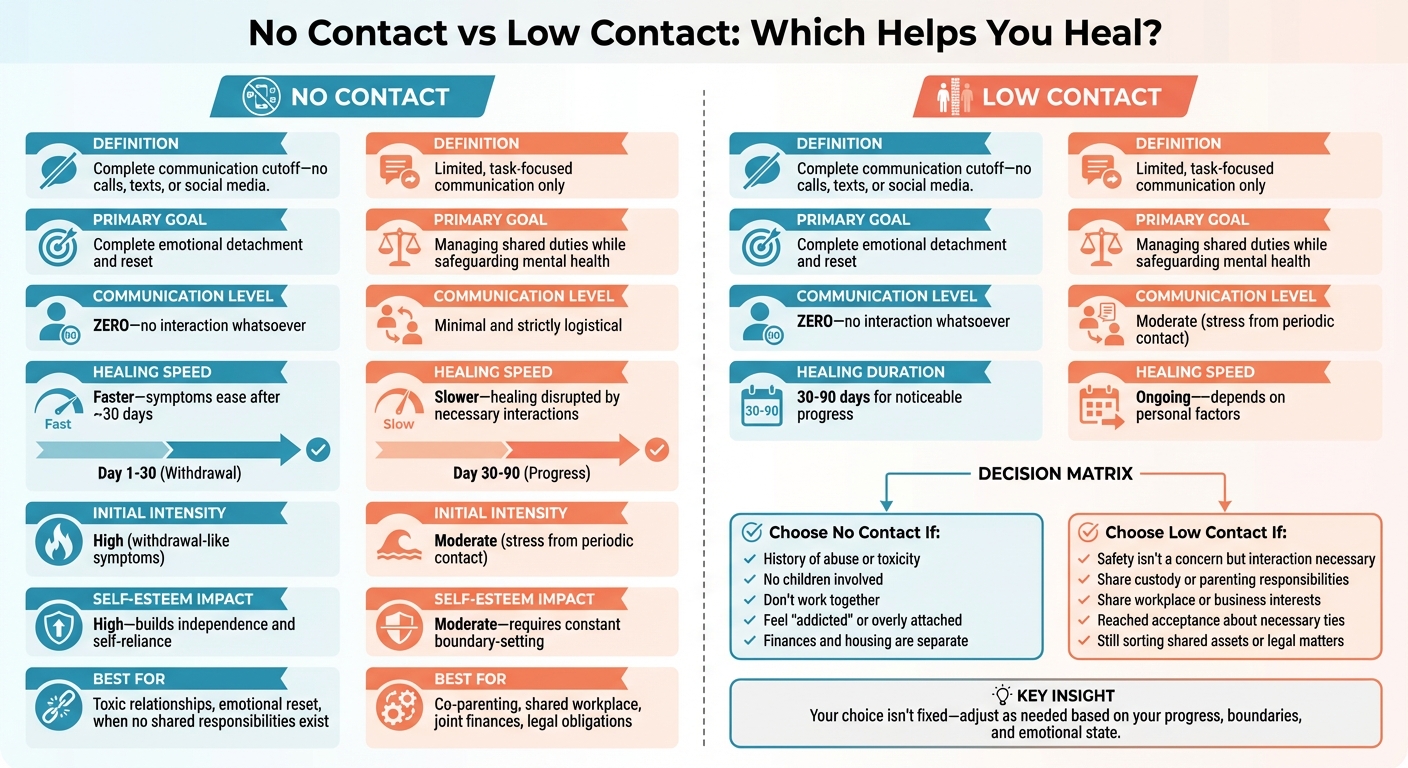
No Contact vs Low Contact: Complete Comparison Guide for Breakup Recovery
What is No Contact?
Definition and Purpose
No Contact is the deliberate choice to cut off all communication with an ex-partner. It also means resisting the temptation to check up on them online or seek indirect updates about their life.
Think of it as a way to protect yourself emotionally and begin breaking the "addiction" to your ex. Dr. Sharie Stines, LPCC, describes it well:
Going no contact is a self protective measure… It facilitates grief and breaks emotional dependency.
This approach gives you the time and space to let your mind recover from the emotional turmoil of the breakup. It allows wounds to heal without the constant reopening that comes with lingering contact.
To successfully implement No Contact, you need to set boundaries. This includes external measures like blocking phone numbers and avoiding places you associate with your ex, as well as internal efforts to stop dwelling on thoughts about them. By stepping away from the past, you create the mental clarity needed to move forward.
Main Goals and Emotional Benefits
The main purpose of No Contact is to detox emotionally. Cutting off interactions with your ex helps you process your grief rather than seeking temporary relief by reaching out. Grief coach Breeshia Wade explains it this way:
The no contact rule forces you to sit with and actually process the end of a relationship, instead of trying to distract and soothe yourself by reaching out to your ex.
This distance also gives you a new perspective. Without constant communication, you can see the relationship – and your ex – with greater objectivity. This clarity is essential for understanding what went wrong and avoiding the trap of returning to a relationship that isn’t healthy for you.
Another key benefit is rediscovering yourself. Breakup coach Paige Wilhide puts it beautifully:
No-contact is a gift you give yourself so you can reconnect with your desires, your dreams, your passion, your light.
By shifting your attention back to your own life, you can rekindle your passions, set fresh goals, and regain your independence. Experts often suggest committing to a specific timeframe for No Contact, typically between 30 and 90 days. Research shows it takes about 21 days to break a habit, which is why starting with at least 30 days is often encouraged.
Challenges of No Contact
While No Contact has clear benefits, it’s not without its difficulties. The first few weeks are often the hardest, as the process can feel like an emotional detox. You may experience strong cravings to reach out or feel overwhelmed by the emotional void left behind.
This emptiness can be especially tough during milestones like holidays, personal struggles, or when mutual friends mention your ex. Relationship coach Matthew Hussey highlights an important aspect:
If someone is continuously in contact with us, they never feel the effects of the breakup that they instigated.
To navigate these challenges, it’s helpful to have a plan. Lean on a trusted friend, dive into a hobby you love, or use journaling to channel your feelings instead of contacting your ex. Reminding yourself that your absence is part of their growth can also strengthen your resolve.
Another hurdle is dealing with boundary violations. Your ex might attempt to reconnect through manipulative tactics like "love-bombing" or subtle guilt trips. These moments can reopen old wounds, making it crucial to stick to your boundaries. Blocking them on all platforms, if necessary, can help maintain the distance you need to heal.
sbb-itb-ee19e1f
What is Low Contact?
Definition and Purpose
Low Contact is a mindful approach to maintaining limited communication with an ex-partner when cutting off all interaction isn’t practical. Unlike No Contact, which involves a complete break, Low Contact helps you preserve a connection while prioritizing your emotional health.
Therapist Sarah Epstein, LMFT, explains:
Low contact is a deliberate strategy to redefine how you engage in a relationship that’s become hurtful, depleting, or simply unsustainable in its current form.
This isn’t about being passive-aggressive or quietly disappearing. It’s about managing your energy and time intentionally. The aim is to create enough emotional distance to heal, even if a total break isn’t possible.
When Low Contact is Necessary
Low Contact becomes crucial when shared responsibilities or circumstances make complete avoidance impossible. One of the most common situations is co-parenting. Even after a breakup, you’ll need to coordinate schedules, discuss your children’s needs, and make joint decisions. Many parents rely on apps specifically designed for co-parenting to keep conversations focused on the kids and maintain a clear record of communication.
Another scenario is the workplace. If you and your ex share an office or work in the same industry, avoiding all interaction simply isn’t realistic. Similarly, shared social circles can complicate things – whether it’s mutual friends or attending the same events, complete avoidance isn’t always an option. Legal or business obligations, such as selling a shared property or closing a joint business, also require some level of contact.
Relationship coach Matthew Hussey offers this perspective:
I’m only containing the amount I have to think about them to the moments that I need to deal with them.
Challenges of Low Contact
While Low Contact offers a practical middle ground, it comes with its own set of challenges. One major hurdle is balancing necessary communication with maintaining emotional boundaries. Each interaction risks stirring up old wounds or triggering unresolved feelings. To avoid this, it’s crucial to keep conversations strictly task-focused – no small talk, no reminiscing, and definitely no emotional deep dives.
Another challenge is enforcing boundaries consistently. Your ex might resist your reduced availability, especially if they’re used to having unrestricted access to your time and attention. They could misinterpret your distance as hostility or try to engage you in unnecessary conversations. Sticking to your boundaries requires constant effort and the ability to redirect or end discussions that veer off-topic.
Lastly, the emotional strain can be significant. Unlike No Contact, which provides a clean slate to process your feelings, Low Contact means regular reminders of the relationship. Even brief interactions can stir up lingering emotions, making it harder to fully heal.
Comparing Healing Outcomes: No Contact vs Low Contact
Healing Benefits of No Contact
No Contact acts like an emotional reset button, giving your brain a chance to break free from constant dopamine spikes and stress hormones like cortisol. This break allows your mind to start building healthier patterns. Without the constant emotional triggers, your nervous system can shift into a calmer "rest-and-digest" mode, which promotes healing.
Grief coach Breeshia Wade puts it this way:
"Going no contact is one of the best things you can do… it can actually help you properly acknowledge a loss and mourn it, eventually creating space for something new."
Studies show that the toughest phase – marked by symptoms like insomnia, cravings, and anxiety – usually begins to ease after about a month of No Contact. A survey of 155 participants found that most people start noticing significant emotional improvement around the three-month mark. Experts generally suggest sticking with No Contact for 30 to 90 days to give your mind the time it needs to recover and reset.
While No Contact focuses on a clean break and rapid recovery, Low Contact provides a way to manage shared responsibilities without compromising your emotional well-being.
Healing Benefits of Low Contact
Low Contact is a practical approach for situations where a complete break isn’t possible. By keeping communication strictly task-oriented – whether it’s co-parenting, handling shared finances, or work-related matters – you can maintain your mental health while meeting necessary obligations.
This method, however, requires a certain level of acceptance. Balancing shared responsibilities while working on emotional independence can be tricky, as even brief interactions might reopen old emotional wounds. This can make the healing process feel slower and more challenging.
Comparison Table: No Contact vs Low Contact
The table below highlights the unique ways each approach supports emotional recovery, focusing on their goals, timelines, and challenges.
| Feature | No Contact | Low Contact |
|---|---|---|
| Primary Goal | Complete emotional detachment and reset | Managing shared duties while safeguarding mental health |
| Healing Speed | Faster; symptoms often ease after about 30 days | Slower; healing can be disrupted by necessary interactions |
| Initial Intensity | High (withdrawal-like symptoms) | Moderate (stress from periodic contact) |
| Healing Duration | 30–90 days for noticeable progress | Ongoing; depends on personal and situational factors |
| Communication | None – no calls, texts, or social media | Minimal and strictly logistical |
| Self-Esteem Impact | High; builds independence and self-reliance | Moderate; requires constant boundary-setting |
| Best For | Toxic relationships or breakups needing complete detachment | Scenarios like co-parenting, shared businesses, or collaborative work |
Choosing the Right Strategy for Your Healing
Factors to Consider
When deciding between No Contact and Low Contact, think about safety, shared responsibilities, and your emotional well-being. If the relationship involved abuse or toxicity, permanent No Contact is often the best choice to break trauma bonds and avoid falling back into harmful patterns. Leanna Stockard, LMFT at LifeStance Health, advises:
If the relationship in any way was abusive, toxic and the ‘no contact’ rule was established for safety reasons, I highly recommend never re-connecting with this partner.
However, shared responsibilities – like co-parenting, workplace collaboration, or joint financial management – may require Low Contact. In these cases, keep communication strictly factual, brief, and focused on logistics.
Your emotional readiness is another key factor. If you’re still emotionally attached or feel the urge to "fix" the relationship, No Contact can help you break free from emotional dependency. Assess whether lingering romantic feelings are holding you back. Additionally, your attachment style matters – those with an anxious attachment style might find No Contact more helpful, while others may benefit from limited interaction to gain clarity.
| Factor | Choose No Contact If… | Choose Low Contact If… |
|---|---|---|
| Safety | There’s a history of abuse or toxicity. | Safety isn’t a concern, but interaction is necessary. |
| Children | No children are involved. | You share custody or parenting responsibilities. |
| Work/Career | You don’t work together. | You share a workplace or business interests. |
| Emotional State | You feel "addicted" or overly attached. | You’ve reached acceptance about necessary ties. |
| Logistics | Finances and housing are separate. | You’re still sorting out shared assets or legal matters. |
Your approach isn’t fixed – adjustments may be needed as your situation evolves.
Adjusting Your Approach Over Time
Healing isn’t a one-size-fits-all process, and your strategy may need to change as you grow. For instance, you might start with No Contact to create emotional distance, then shift to Low Contact once you feel more detached. On the flip side, even minimal interaction might hinder your recovery, prompting a switch back to No Contact.
Signs that you’re ready to move from No Contact to Low Contact include no longer experiencing strong emotional reactions toward your ex and being able to confidently say you no longer have romantic feelings. This change often reflects steady emotional progress, which can take weeks or months.
If you notice ongoing boundary violations, feel drained after interactions, or find that Low Contact is slowing your healing, it may be time to transition to No Contact. A trial period – such as 30 days of No Contact – can help you evaluate your emotional state and decide on the next steps. Additionally, keeping a journal of your emotional responses during Low Contact can reveal whether stricter boundaries are necessary.
Getting Professional Support
Therapy can be an incredibly helpful tool as you navigate these strategies and work through the healing process. Research shows that a 12-week internet-delivered cognitive behavioral therapy (iCBT) program significantly reduces symptoms of depression and post-traumatic stress in bereaved adults. Many participants report noticeable improvements, which can be crucial when refining your approach.
Online therapy platforms make professional support more accessible and budget-friendly, offering options like CBT and individual sessions at competitive weekly rates. A therapist can also guide you in conducting a "readiness audit" to determine when it’s safe to adjust your contact strategy.
The No Contact Rule After A Breakup
How to Implement Your Chosen Strategy
Putting a No Contact or Low Contact strategy into action can protect your emotional well-being and speed up your healing process.
Setting and Maintaining Boundaries
Start by setting a clear No Contact period, typically 30–90 days. Research suggests it takes about 21 days to break a habit. If there’s no immediate safety risk, let the other person know you need space and won’t be in touch for a while.
Establish firm digital boundaries. Block or unfollow your ex on all social media, delete their contact information, and filter emails to avoid accidental communication. Amy Chan, author of Breakup Bootcamp, emphasizes:
Communicating with the ex only strengthens old neural pathways instead of allowing them to prune away. Even rereading old text messages, stalking their social media will reinforce those old neural pathways.
Let mutual friends know not to share updates about your ex to help you maintain your distance.
For situations requiring Low Contact, like co-parenting, use tools designed to keep communication strictly task-focused. Create a "Reasons Why" list to remind yourself why the relationship ended and why limited contact is necessary. Review this list during moments of doubt. Also, prepare for accidental encounters by deciding ahead of time to keep them brief and emotionally neutral.
Once your external boundaries are in place, turn your attention to building inner strength.
Emotional Self-Care
Be prepared for a detox phase during the first month. Withdrawal symptoms usually ease after about 30 days. Dr. Sharie Stines, LPCC, explains:
Going no contact is an excellent approach to take the focus off the other person and only focusing on yourself and your own well-being.
Instead of reaching out to your ex, write down your feelings to process them privately.
Make daily exercise a priority – activities like yoga or running for at least 30 minutes can lift your mood and replace the dopamine boost your relationship once provided. Tools like the Stumble app offer private journaling, daily check-ins, and 24/7 grounding support to help you manage your emotions and track your healing safely. To resist the urge to reconnect, have a plan in place – whether it’s calling a friend, diving into a hobby, or engaging in a new activity.
Tracking Your Healing Progress
As you maintain boundaries and focus on self-care, regularly check in with yourself to assess your emotional progress. Ask questions like, "Do I still have feelings for them?" or "What would I gain by re-establishing contact?" Leanna Stockard, LMFT, advises:
If the answer is yes [to having feelings], it may be too soon to contact them.
Research involving 155 participants found that most people start to feel noticeably better about three months after a breakup.
Take note of milestones, such as when your ex becomes a "non-issue" – when you no longer feel the need to fix the relationship or check their social media. Journaling can help you track these shifts, allowing you to reflect on what you’ve learned and accomplished during No Contact. Celebrate small victories, like sticking to your boundaries for a week, as these moments represent meaningful steps in reclaiming your personal power.
Conclusion
Deciding between No Contact and Low Contact depends on your situation. If you’re dealing with a toxic or abusive relationship, No Contact offers the clean break you need. On the other hand, Low Contact works better when shared responsibilities, like co-parenting or workplace interactions, require limited but necessary communication. Whichever path you choose, its success hinges on your commitment to personal healing and growth.
As breakup coach Paige Wilhide puts it:
No-contact is a gift you give yourself so you can reconnect with your desires, your dreams, your passion, your light.
The ultimate goal, whether you’re setting firm boundaries or managing minimal interactions, is to reclaim your sense of self. Healing isn’t a race – it unfolds at its own pace. What feels overwhelming today might feel manageable tomorrow, and your strategy can shift as your circumstances evolve.
No matter which approach you take, the boundaries you establish now lay the groundwork for a healthier future. Focus on what truly matters: prioritizing your well-being, creating new habits, and strengthening your emotional resilience. These efforts will continue to support you long after this challenging chapter has passed, helping you build a stronger, more fulfilling life.
FAQs
How can I decide if No Contact is the best choice after a breakup?
Choosing whether No Contact is the right approach for you boils down to how interactions with your ex impact your emotional health. If every text, call, or social media post stirs up pain, keeps you dwelling on the past, or makes moving forward feel impossible, No Contact could provide the breathing room you need to heal. However, if you’re able to stay composed during communication or have shared responsibilities like co-parenting or joint finances, a limited-contact approach might work better.
To figure out what’s best for you, consider these questions:
- Do I feel anxious, upset, or hurt after seeing their social media or hearing from them?
- Is the relationship toxic, or do they frequently violate my boundaries?
- Can I handle necessary interactions without needing constant communication?
If your answers reveal emotional discomfort or ongoing boundary issues, No Contact may be the healthier path. Whatever you decide, the key is to set boundaries that protect your well-being and support your personal growth.
How can I effectively manage Low Contact after a breakup?
Maintaining Low Contact after a breakup requires setting clear boundaries and being intentional about how you communicate. Start by figuring out what Low Contact looks like for you. Maybe it means only talking about specific topics or agreeing to occasional check-ins. Whatever you decide, communicate your boundaries clearly and stick to them to avoid misunderstandings or emotional setbacks.
It’s also important to focus on managing your emotions during this time. Take care of yourself – whether that’s through self-care routines, leaning on friends, or speaking with a therapist. Keep your healing goals in mind. If direct communication feels too difficult, consider using text or email to keep things polite but distant. The goal of Low Contact is to create a balance: giving yourself the space you need to heal while maintaining a minimal level of connection that works for you.
Can I move from No Contact to Low Contact if my circumstances change?
Absolutely, shifting from No Contact to Low Contact can be a healthy step if your circumstances change and it feels right for your progress. Low Contact offers a middle ground – allowing for limited interaction while still upholding necessary boundaries.
What’s crucial here is to regularly evaluate your emotional needs and ensure this adjustment supports your path to healing. Take the time to define clear boundaries and pay attention to how these interactions impact your mental and emotional well-being. Remember, this journey is deeply personal, and it’s all about finding what supports your growth and peace the most.
Related Blog Posts
- What to Do When You Miss Your Ex: 8 Healthy Steps
- Breakup Recovery Checklist: 15 Steps to Heal
- The Complete Guide to Healing After a Breakup
- 10 Self-Care Activities for Breakup Recovery
STUMBLE APP
Ready to start healing?
Stumble gives you the community, tools, and support to move forward — free on iOS.
Download the app free →
Tagged with :