
Breakups hurt because your brain and body process emotional pain similarly to physical injury. When a relationship ends, the same neural pathways that handle physical pain are activated, making heartbreak feel overwhelming and even physically painful. Here’s why this happens:
- Brain Overlap: Emotional pain activates areas like the anterior cingulate cortex, which also processes physical pain.
- Dopamine Withdrawal: Losing a partner disrupts your brain’s reward system, much like addiction withdrawal.
- Stress Hormones: Breakups spike cortisol levels, leading to physical symptoms like chest pain, loss of appetite, and fatigue.
- Rumination Trap: Obsessive thoughts keep stress high and delay recovery.
Understanding these biological responses can help you navigate the healing process with patience and self-care. Simple practices like exercise, avoiding contact with your ex, and focusing on new routines can support recovery over time.
How the Brain Processes Emotional Pain
The Connection Between Emotional and Physical Pain
Heartbreak activates the same neural pathways as physical injuries, like a cut or burn. Specifically, the anterior cingulate cortex (ACC) and the insula (AI) share circuits that process both types of pain.
The dorsal anterior cingulate cortex (dACC) focuses on the "distress" aspect of pain – the part that makes it feel unbearable. This overlap explains why emotional pain, like heartbreak, can manifest as physical sensations such as chest tightness or a knotted stomach.
"The brain does not differentiate much between physical and emotional pain, which is why the loss of a romantic relationship can feel physically painful." – Neurohealth Alliance
Interestingly, people who are more sensitive to physical pain often report heightened sensitivity to social rejection as well. From an evolutionary angle, this makes sense. Early humans depended on social bonds for survival, so the brain perceives social disconnection as a real threat.
This shared neural circuitry lays the groundwork for understanding how heartbreak deeply involves other brain structures, like the amygdala and prefrontal cortex.
The Amygdala and Prefrontal Cortex in Heartbreak
Beyond shared pain pathways, heartbreak is intensified by the brain’s emotional alarm system, particularly the amygdala, and the impaired functioning of the prefrontal cortex. The amygdala, a small almond-shaped structure, interprets the loss of a relationship as a survival threat. This triggers overwhelming emotions like fear, sadness, and anxiety. When the amygdala is hyperactive, it can lead to emotional flooding.
At the same time, the prefrontal cortex – the part of the brain responsible for rational thinking and self-control – loses its ability to regulate emotions effectively. The heightened activity in the amygdala disrupts its communication with the prefrontal cortex, making it harder to manage impulses and emotions. This breakdown often leads to behaviors like obsessively checking an ex’s social media or sending regrettable late-night messages.
"The amygdala triggers heightened emotional responses… amplifying the hypothalamic-pituitary-adrenal (HPA) axis and increasing cortisol release and stress." – Neurohealth Alliance
A 2025 fMRI study involving 94 young adults (ages 18–25) revealed that viewing photos of an ex-partner activated the amygdala and hippocampus in ways similar to what is observed in victims of physical assault. The study also found that the amygdala’s activity was most intense in participants who felt betrayed or had not initiated the breakup. This disruption in brain function underscores why it’s risky to make major life decisions during intense heartbreak – your ability to think clearly is compromised.
How Breakups Affect Your Hormones-Hormone Crash! #Heartbreak #Hormones #BrainScience #MentalHealth
Hormonal and Neurochemical Changes After a Breakup
Breaking up doesn’t just hurt emotionally – it triggers a storm of hormonal and neurochemical changes that can leave you feeling completely off balance.
Dopamine and Withdrawal Symptoms
In a relationship, your partner becomes a key source of dopamine, the chemical that fuels pleasure and motivation. Your brain associates them with rewards, much like it does with food or safety. After a breakup, that dopamine flow is suddenly cut off, but your brain still craves it, creating a state similar to withdrawal.
The brain’s reward centers, like the caudate nucleus and ventral tegmental area (VTA), often stay active after rejection, as though waiting for another "hit" of the lost partner. Neuroimaging has shown that romantic love activates these dopamine pathways in ways that resemble addiction.
"As far as brain wiring is concerned, when you’re in love, it’s not as if you’re an addict. You are an addict." – Meghan Laslocky, Author
Even small reminders of an ex – like a photo, a social media post, or a song – can cause dopamine spikes, reinforcing behaviors like checking their messages or hoping for reconciliation. While your logical brain knows the relationship is over, your reward system keeps sending signals to chase that connection. To break the cycle, it’s often best to adopt a strict "No Contact" rule – mute, unfollow, or block if necessary – to help interrupt these dopamine-driven urges.
But dopamine isn’t the only chemical at play. The loss of bonding hormones adds another layer to the heartbreak.
Oxytocin and Vasopressin: Losing the Bond
Oxytocin and vasopressin are the so-called "bonding hormones" released during physical intimacy and emotional closeness. They help create and maintain deep attachments. After a breakup, the drop in these hormones can intensify feelings of loneliness and even fuel jealousy. Early on, elevated oxytocin levels might paradoxically increase the desire to reconnect with your ex. Over time, without those reciprocal interactions, the system can become unbalanced. Vasopressin, in particular, has been linked to the jealousy and possessiveness that often surface after a relationship ends.
"Oxytocin and vasopressin, often referred to as ‘bonding hormones,’ play complex roles in heartbreak. These neuropeptides are released during positive social interactions and physical intimacy, contributing to the formation and maintenance of pair bonds. The disruption of oxytocin and vasopressin systems during relationship dissolution may contribute to the intense longing and separation distress experienced during heartbreak." – Arnab Roy, Assistant Professor, Sai Nath University
Interestingly, genetic differences in oxytocin receptors may explain why some people seem more resilient to heartbreak than others. When bonding hormones and dopamine levels plummet together, the result can feel like a neurochemical withdrawal, eerily similar to substance addiction.
Cortisol and the Stress Response
As your brain struggles with these imbalances, your stress system kicks into overdrive. A breakup activates the hypothalamic-pituitary-adrenal (HPA) axis, flooding your body with cortisol – the stress hormone. Your brain perceives the loss of a romantic bond as a threat, triggering a constant fight-or-flight response. This is intensified by an overactive amygdala, which further amplifies cortisol production.
Elevated cortisol levels can interfere with your prefrontal cortex, the part of the brain responsible for decision-making and memory. A 2021 study found that people who had gone through a breakup within the last six months showed noticeable impairments in working memory. This explains why making big decisions during the immediate aftermath of a breakup can be so challenging.
"Relationship loss triggers chronic cortisol elevation, keeping your nervous system in perpetual ‘fight or flight’ mode." – Aaron, Researcher at Forget – Breakup Recovery
Prolonged cortisol elevation can weaken your immune system, increase inflammation, disrupt digestion, and even raise your risk of heart problems. Research suggests that it can take anywhere from 6 to 18 months for dopamine systems to stabilize after a major breakup, and stress hormones like cortisol may remain elevated during this time. To help manage these effects, consider incorporating deep breathing exercises, sticking to a daily routine, and making time for physical activity. Exercise, in particular, can boost Brain-Derived Neurotrophic Factor (BDNF), which supports brain health and helps lower cortisol levels naturally.
sbb-itb-ee19e1f
How Rumination Prolongs Pain
After a breakup, it’s easy to get stuck in a mental loop – replaying old conversations, analyzing each detail, and wondering what went wrong. This repetitive focus on distressing thoughts is called rumination, and it plays a major role in slowing down emotional recovery.
Rumination’s Effect on Emotional Recovery
Rumination doesn’t just keep you emotionally stuck – it affects your body too. It lowers serotonin levels and keeps the amygdala, the brain’s stress center, overactive. While it might not change how you initially react to stress, research shows rumination significantly delays your heart rate recovery, leaving your body in a prolonged state of tension. Over time, this heightened stress can push you toward avoidance strategies like withdrawal or denial, which only make it harder to process emotions and move forward.
One of the most harmful aspects of rumination is how it disrupts self-concept recovery – the process of rediscovering who you are outside of the relationship. Studies link prolonged rumination to poorer outcomes across emotional, academic, and even physical recovery. Alarmingly, 12% of young adults report ruminating for over six months after a breakup.
But there’s hope. Many people start to feel better within three months when they focus on reducing rumination and rebuilding their routines. For instance, the 24-Hour Delay rule can help: instead of acting on the impulse to contact your ex, give yourself 24 hours. During that time, tackle one productive task (like organizing your space) and one enjoyable activity (like listening to your favorite playlist). Be mindful of social media too – it often amplifies these thought loops and adds to the emotional strain.
These insights on rumination also help explain some of the differences in how men and women process breakups.
Gender Differences in Rumination
Research shows that women tend to ruminate more than men after a breakup. On average, women scored 3.5 on rumination scales compared to men’s 3.0, reflecting greater emotional reactivity and higher cortisol levels.
"Women generally have higher levels of chronic strain and rumination with breakups than men do." – American Journal of Psychiatry
Men, on the other hand, often lean toward distraction and action-focused strategies, which can delay their emotional processing. However, when it comes to avoidance behaviors or seeking social support, studies found no major differences between genders.
Understanding these patterns can shed light on why breakups feel so different for everyone, and why tackling rumination is key to moving forward.
Physical Symptoms and the Recovery Process
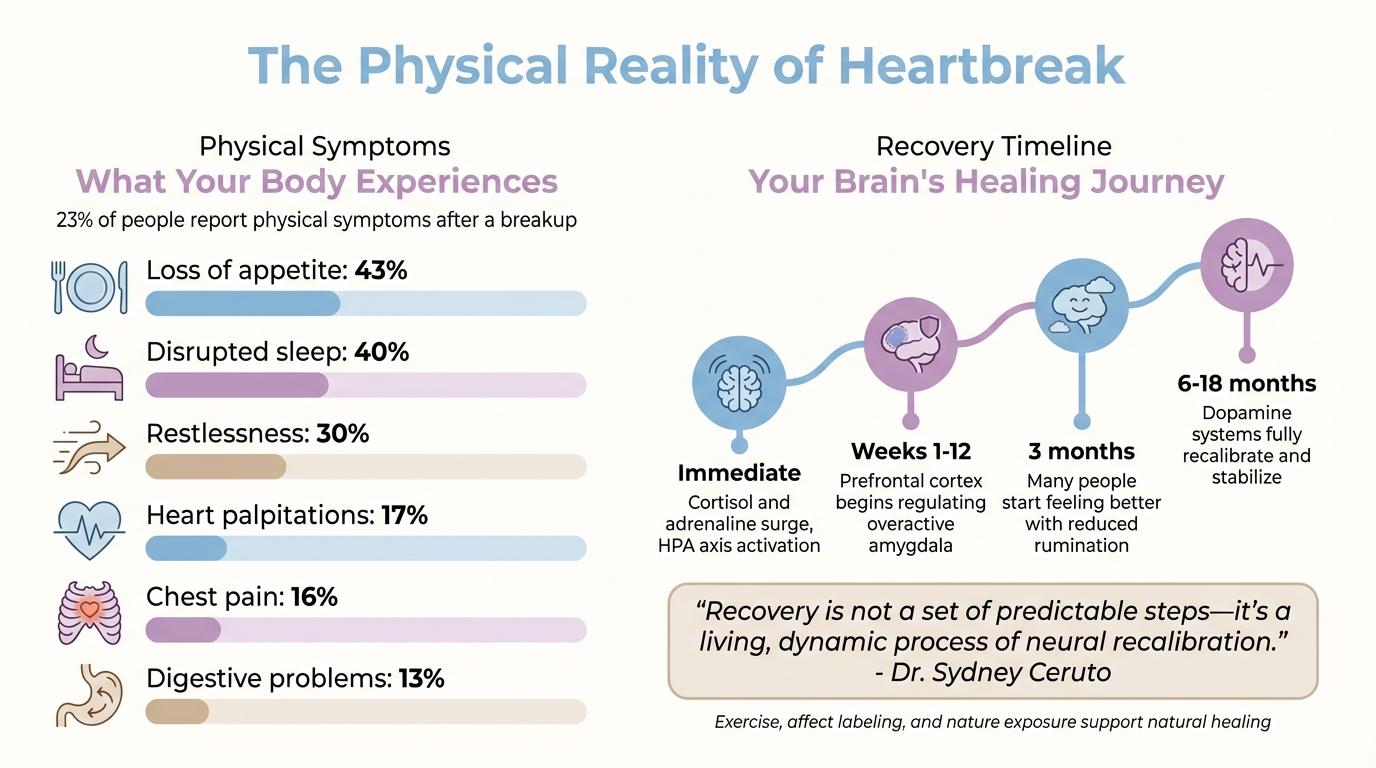
Physical and Neurological Effects of Breakups: Statistics and Symptoms
Physical Signs of Heartbreak
Heartbreak isn’t just an emotional struggle – it takes a toll on your body too. Around 23% of people report physical symptoms after a breakup, with common issues including loss of appetite (43%), disrupted sleep (40%), restlessness (30%), heart palpitations (17%), chest pain (16%), and digestive problems (13%).
When heartbreak strikes, your body’s stress response kicks into high gear. The HPA axis releases cortisol and adrenaline, which redirects blood flow away from digestion. This often leads to nausea, stomach cramps, and other gut-related discomforts. On top of that, constant muscle tension can cause headaches, neck stiffness, and a feeling of tightness in your chest.
"Emotional heartache can often manifest into physical symptoms such as chest pain and heart palpitations due to a surge of stress hormones following an emotionally difficult event."
– Dr. Katie Tryon, Director of Health and Strategy, Vitality
Lower levels of neurotransmitters like serotonin and dopamine also play a role, fueling physical restlessness and obsessive thoughts.
Brain Recovery and Emotional Regulation
While the physical effects of heartbreak are immediate, your brain begins its recovery process almost simultaneously. It’s a natural system of healing where neural pathways are restructured to restore balance. This involves the prefrontal cortex and orbitofrontal cortex gradually regaining control over an overactive amygdala – the part of the brain responsible for processing intense emotions. The orbitofrontal cortex, in particular, learns from emotional experiences, helping to suppress impulsive reactions and reduce the intensity of pain over time.
A key part of this recovery is something called "extinction learning." During this process, your brain rewires its reward circuits, teaching itself to stop expecting dopamine boosts tied to your ex-partner. Over time, this helps stabilize disrupted sleep patterns and appetite. Studies suggest that dopamine systems can take anywhere from 6 to 18 months to fully recalibrate after a major breakup. Meanwhile, engaging in new activities helps create fresh neural pathways, encouraging neuroplasticity and offering new sources of pleasure and motivation.
"Recovery is not a set of predictable steps – it’s a living, dynamic process of neural recalibration."
– Dr. Sydney Ceruto, Founder & CEO, MindLAB Neuroscience
Simple strategies can support this healing process. For instance, affect labeling – just identifying and naming your emotions – can calm the amygdala while activating the prefrontal cortex. Physical activity also helps, as exercise releases endorphins and promotes the production of BDNF (a protein that supports neural growth). Spending time in nature can further reduce cortisol levels, often more effectively than urban environments.
Conclusion: Healing and Moving Forward
Why Understanding Heartbreak Matters
Understanding the way heartbreak affects your brain can validate what you’re going through. Learning that romantic rejection activates the same brain regions as physical pain – like burns or fractures – shows that your suffering isn’t "all in your head." It’s a full-body response, rooted in biology.
Love operates like a dopamine-driven addiction, which explains why you might obsess over your ex or feel the urge to check their social media. These behaviors aren’t personal failings – they’re withdrawal symptoms. The concept of neuroplasticity, or your brain’s ability to rewire itself, offers hope. Healing doesn’t mean erasing memories; it’s about creating new neural pathways. Research suggests this process typically takes between six and 18 months.
"Your brain is not broken – it’s responding exactly as it should to a significant loss."
– Aaron, Forget – Breakup Recovery
By understanding these biological responses, you can approach healing with a clearer sense of purpose.
Using Supportive Tools for Recovery
External resources like Stumble can play a critical role in recovery by helping to stabilize your prefrontal cortex, which may feel overwhelmed during this time. The app offers features tailored to support your healing, including private journaling to help you process emotions, guided content to provide structure, and an anonymous community to foster a sense of connection and safety. These tools are designed to work in harmony with your brain’s natural healing processes.
Daily check-ins and 24/7 grounding support act as external aids when your internal emotional regulation feels off balance. These strategies align with your biology, helping you move from a state of rumination to one of clarity and growth. Since recovery is a gradual process of rewiring your brain, having consistent, science-backed support can make a meaningful difference in how you navigate the journey forward.
FAQs
How does understanding the brain’s reaction to a breakup help you heal?
Understanding how your brain reacts to a breakup can make the healing process feel less overwhelming. Studies reveal that breakups spark brain activity similar to what happens during trauma or withdrawal. Key areas of the brain, like the amygdala and hippocampus – both tied to emotions and stress – light up, which explains why the pain can feel so intense. It’s not just emotional; it’s physical too.
Realizing that this response is your brain’s natural way of processing can help you show yourself more compassion. It also highlights the value of strategies that align with these brain functions, like mindfulness practices, grounding techniques, or tools such as Stumble, which offers resources for emotional recovery. Understanding that your feelings are rooted in biology can make the path to healing feel more manageable and affirming.
How do hormones like oxytocin and vasopressin affect heartbreak?
Hormones like oxytocin and vasopressin are central to forming emotional bonds and attachments. Often called the "love hormones", they foster feelings of intimacy and connection in relationships, making them key players in building and maintaining close ties.
When a breakup happens, the abrupt decrease in these hormones can lead to emotional turmoil, almost like withdrawal symptoms. This is why heartbreak can feel so intense – it’s not just an emotional experience but also a physical reaction caused by shifts in your brain’s chemistry.
Why is it important to avoid contact with your ex after a breakup?
Avoiding contact with your ex plays a key role in the recovery process because breakups can stir up powerful emotional and physical reactions in the brain. Studies reveal that regions like the hippocampus and amygdala – responsible for handling emotions and stress – respond to breakups in ways comparable to trauma or even withdrawal from addictive substances. Keeping in touch can intensify these reactions, making it tougher to heal and move on.
By maintaining distance, you allow your brain and body the chance to recalibrate, lower stress levels, and prioritize your emotional health.
Related Blog Posts
- What to Do When You Miss Your Ex: 8 Healthy Steps
- 10 Self-Care Activities for Breakup Recovery
- How Long Does It Take to Get Over a Breakup?
- Breakup Recovery Timeline Calculator
STUMBLE APP
Ready to start healing?
Stumble gives you the community, tools, and support to move forward — free on iOS.
Download the app free →
Tagged with :