
Breakups lead to personal growth — and that’s not just a comforting thing people say. The pain is real (research from Columbia University found that social rejection activates the same brain regions as physical pain), but so is the opportunity sitting inside it. When a relationship ends, you’re forced to look inward in a way that everyday life rarely demands. You start questioning what you actually want, who you’ve become, and what you’re no longer willing to settle for. That’s not nothing. That’s the beginning of something.
Key Insights:
- Emotional Impact: Breakups trigger a wide range of emotions — from sadness to relief — that mirror the grieving process.
- Growth Opportunities: Pain can spark self-reflection, helping you spot patterns, build emotional resilience, and set firmer boundaries.
- Rediscovery: Being single lets you reconnect with hobbies, values, and personal goals you’d quietly shelved for the relationship.
- Healing Tools: Journaling, mindfulness practices like RAIN, and connecting with supportive communities can speed up recovery and sharpen self-awareness.
Breakups are hard — genuinely hard. But with the right mindset and a few solid tools, they can spark real change, setting you up for healthier relationships and a stronger sense of who you are.
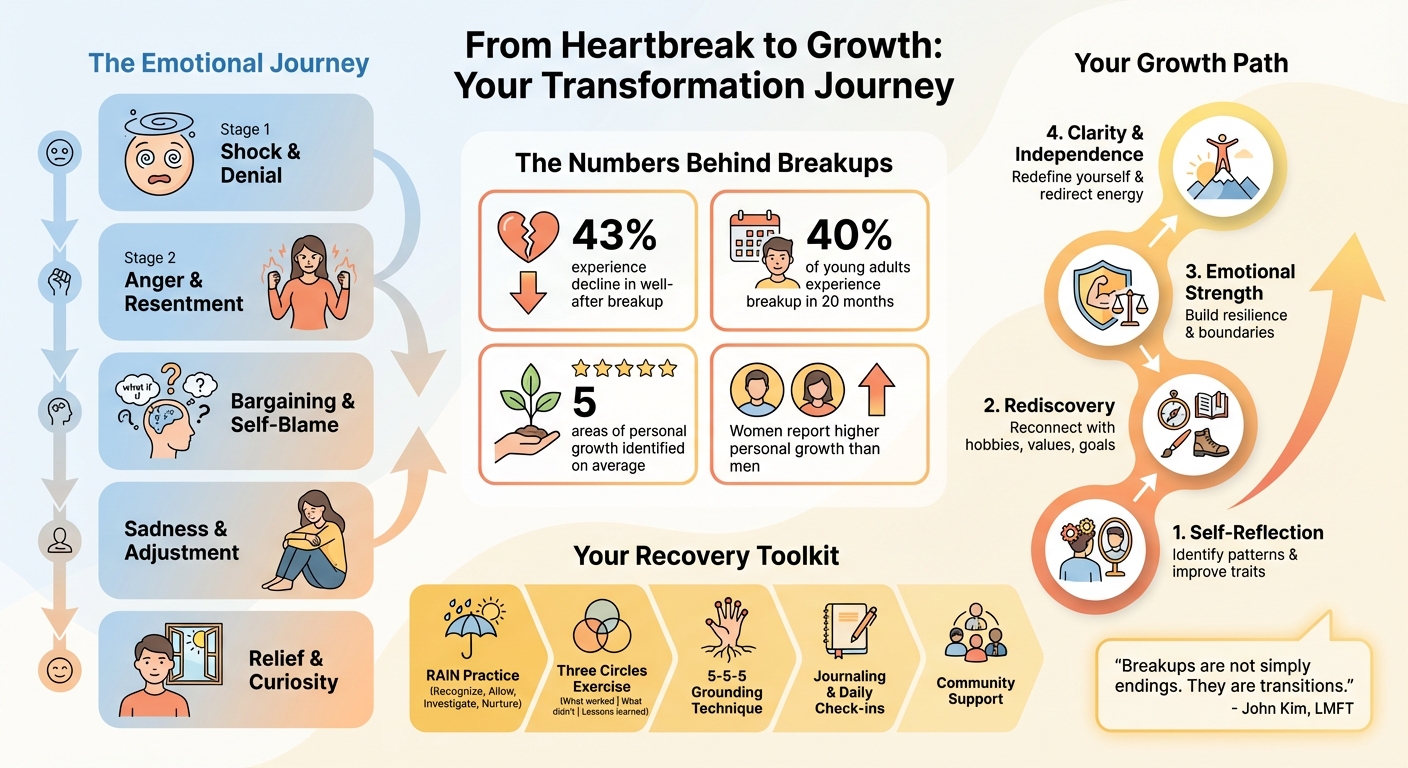
The Journey from Breakup to Personal Growth: Key Stages and Outcomes
Understanding the Emotional Impact of Breakups
Common Emotions After a Breakup
Breakups bring a whirlwind of emotions that can feel completely overwhelming. At first, you might land in shock or denial — that strange, numb state where the reality of it all hasn’t fully landed yet. You’re waiting for a call or message that isn’t coming.
As the shock fades, anger and resentment often take over. Intense as they are, those feelings sometimes carry a strange kind of energy — a signal that you’re starting to reclaim your sense of self. Then comes the bargaining phase, where your mind loops through endless “what-if” scenarios. This stage tends to bring self-blame, even when the breakup wasn’t your fault. Sadness usually follows, deepening as you adjust to life without the shared routines that once felt so normal.
Here’s the thing: not all post-breakup emotions are painful. Some people feel genuine relief, or even curiosity about what’s next. That sense of freedom can spark real motivation to rebuild an independent life. Others feel torn — grieving the loss while also knowing, somewhere deep down, that the breakup was the right call.
Why does this emotional rollercoaster happen? Your brain processes a breakup much like it processes losing someone you love. Research confirms that rejection activates the same brain regions associated with physical pain and addiction-like craving. Studies also show that over 43% of breakups lead to a noticeable drop in personal well-being, and divorce is linked to a higher risk of a first-time depression diagnosis.
Painful as these emotions are, they often open the door to self-discovery. This is — genuinely — a chance to redefine yourself.
The Power of Self-Reflection
Amid the emotional chaos, self-reflection becomes one of the most useful things you can do. Your brain’s neuroplasticity — its ability to rewire and form new connections — goes into overdrive during emotional upheaval. That heightened state can actually help you uncover things about yourself and your relationships that you’d never noticed before. Intense anger might reveal a deep need for loyalty. A wave of relief might tell you the relationship had quietly become a source of chronic stress.
"The natural tendency is to reflect on the many facets of the relationship and try to understand why it ultimately didn’t work. This self-understanding can often make meaning out of an emotionally draining experience and turn it into a positive for the future."
– Erin Engle, PsyD, NewYork-Presbyterian/Columbia University Irving Medical Center
Reflection also helps you spot patterns that may have quietly undermined your past relationships. A study involving 92 young adults found that focusing on personal growth — improving personal traits and core beliefs — was the most commonly reported positive outcome after a breakup. Interestingly, women were more likely to report that growth, and people who didn’t initiate the breakup often gained the deepest insights over time. Those with higher self-compassion also tend to cope better, experiencing less distress than people who are hard on themselves.
The goal of self-reflection isn’t to assign blame. It’s to gain clarity — so you can build stronger, healthier relationships going forward.
sbb-itb-ee19e1f
How Breakups Lead to Personal Growth
Rediscovering Who You Are
Breakups create a kind of space that’s genuinely hard to find inside a relationship. Without the constant need to compromise or reshape your goals around someone else, you can finally turn the spotlight on yourself. Relationships involve real sacrifice — but singlehood lets you reconnect with your own interests, your own rhythm, your own priorities.
A lot of people realise they’d quietly pushed aside hobbies, friendships, or passions just to keep the peace. Think about it this way: someone who rediscovers their love of music after a long-term breakup isn’t just picking up a hobby. They’re reclaiming a part of who they are. That’s not a small thing.
Shifting from seeking validation from a partner to building genuine inner confidence changes everything. Studies suggest that picking up new activities — learning a skill, hiking, exploring creative work — can meaningfully improve well-being after a breakup and help you rebuild a sense of identity. It’s both empowering and, slowly, healing.
"Being single isn’t a state to escape from; it’s a unique phase to be embraced and cherished."
– Reid Horn, Mental Health Therapist
A good place to start: identify your “non-negotiables” — the traits and values you need in future relationships — then honestly ask whether you embody them yourself. Set small, achievable goals (try a new recipe, finish a book chapter) to rebuild self-trust. As you reconnect with your identity, you’ll also strengthen your emotional foundation.
Building Emotional Strength
Let me be honest: breakups are a crash course in emotional resilience. Learning to sit with uncomfortable feelings instead of running from them builds your capacity to handle future challenges. It’s not about ignoring what you feel — it’s about facing it with intention rather than panic.
A big part of this shift involves moving from an external to an internal locus of control. Instead of feeling like life is just happening to you, you start to feel like you’re the one steering it. Take Alex, who reframed his breakup as a “plot twist” in his own story — he realised he needed an emotionally available partner, joined therapy groups, and started volunteering to develop those qualities in himself.
"I am the author of my story."
– Amelia Kelley, Ph.D., Psychologist
Breakups also give you a real chance to tighten up your boundaries and communication. Understanding what went wrong in a previous relationship can reduce distress and open the door to healthier dynamics later. Research shows that clarity about why a breakup happened is linked to greater satisfaction in future relationships — and on average, people identify five distinct areas of personal growth after a breakup.
Journaling is one of the most effective tools here. A study in Frontiers in Psychology found that journaling about emotional experiences reduces distress by up to 40% in acute grief — and it’s a lot cheaper than you’d think to start. Personal mantras like “my happiness comes from within” can also quietly reinforce your inner strength. Reaching out to people you’ve lost touch with, or building new social networks, helps you find your footing again. The research is pretty clear on this: women tend to report higher levels of personal growth post-breakup than men, partly because they’re more likely to lean into emotional support. That resilience lays the groundwork for the clarity and independence that comes next.
Gaining Clarity and Independence
After a breakup, clarity and independence aren’t just nice outcomes — they’re the whole point. Independence reshapes how you see yourself, untangling your sense of worth from one person. That opens the door to finding genuine fulfilment in your career, your friendships, your creative life.
Distance from a former partner often illuminates parts of your life that quietly need attention — whether that’s family relationships you’ve neglected or professional goals you’ve been putting off. Nearly 40% of young adults experience at least one breakup over a 20-month period, and many find that this newfound independence leads to real progress across different areas of life.
"When you leave a relationship that no longer serves you, you create the opportunity to redefine yourself and redirect your energy toward self-improvement."
– Mariya Yakymchuk, Mental Health Author
This clarity comes from actually working through the thoughts and emotions — not around them. A long-term study found that understanding the reasons behind a breakup leads to greater satisfaction and intimacy in future relationships. That’s not a coincidence.
One of the best ways to lean into this phase? “Date yourself.” Visit a museum solo. Try photography. Take up painting. Let journaling help you reconnect with your own voice and define what you actually need going forward. When you shift your perspective from “I lost something” to “I learned something,” everything changes.
Practical Tools for Healing After a Breakup
The Benefits of Guided Healing
Guided healing techniques can turn emotional chaos into a sense of direction — by giving your feelings somewhere structured to go. The RAIN mindfulness practice (Recognize, Allow, Investigate, and Nurture) offers a clear method for working through intense emotions without being swallowed by them. The Three Circles Exercise lets you evaluate what worked in the relationship, what didn’t, and what you’re taking with you as lessons.
Daily journaling and self-check-ins are genuinely powerful here. Breakups can trigger stress-induced neuroplasticity — your brain actually becomes more open to forming new habits during this time. Guided healing content takes advantage of that window, helping you shift your focus from couple-based routines toward a more independent sense of self.
"Each relationship pattern you identify becomes valuable data for your personal growth."
– Sarah Thompson, Ahead App Blog
Simple grounding techniques can also keep you steady when emotions start to spiral. Try the 5-5-5 technique: name five things you can see, five you can hear, and five sensations you can feel right now. It sounds almost too simple, but it genuinely pulls you back into the present when anxiety hits. The Self-Acknowledgment Practice — reflecting on three things you handled well each evening — quietly builds a sense of self-worth that doesn’t depend on anyone else’s approval.
While these structured approaches support internal healing, connecting with other people adds something those tools can’t fully replicate.
Connecting with Supportive Communities
Feeling isolated after a breakup makes the pain harder to carry. Reaching out to people who actually get what you’re going through — not just in theory, but from experience — can provide real stability and speed up healing more than most people expect.
Anonymous, judgment-free spaces let you share your story without performing okayness. According to the American Psychological Association, social support is the single strongest predictor of resilience after a major loss — stronger than any individual coping strategy. And the research is specific about what kind of support matters: emotional support (listening, validating, encouraging) makes a real difference. Practical help, like someone doing your chores, doesn’t carry the same weight. Being honest about what you actually need — someone to listen, a distraction, reassurance that you’re not alone — makes asking for it a lot easier.
"Social support is a key ingredient in almost every healing recipe."
– Attachment Project
Research published in the Journal of Social and Personal Relationships found that 71% of people said their most important support during a breakup came from peer relationships — not professional help. That doesn’t mean therapy isn’t worth it (it often is), but it does mean the people around you matter more than you might think. Women tend to lean on social networks more readily during difficult times, which may partly explain why they often report higher personal growth after a breakup.
Using these strategies doesn’t just ease the immediate pain — it sets you up for long-term growth and genuine self-discovery.
How Stumble Can Help

Stumble pulls all of these healing tools into one platform built specifically for breakup recovery. The app includes private journaling to help you process emotions and get clearer on what you want in future relationships. It also offers guided healing exercises — including RAIN and the Three Circles Exercise — to help you turn emotional chaos into self-awareness. For moments when emotions feel like too much, 24/7 grounding tools are there to help you regain your footing.
The anonymous community feature creates a judgment-free space where you can connect with others on similar journeys. Daily check-ins keep you consistent, and a range of healing paths means you can choose what actually works for you. Stumble’s entire focus is helping you recover emotionally and find clarity during this in-between time.
| Feature | How It Supports Your Recovery |
|---|---|
| Private Journaling | Helps you organise your thoughts, spot patterns, and define what you need in future relationships. |
| Guided Healing Content | Offers structured exercises like RAIN and the Three Circles Exercise to turn pain into insight. |
| Anonymous Community | Provides a safe space to share your experiences and gain perspective without judgment. |
| 24/7 Grounding Support | Delivers tools to manage emotional surges and stay present. |
| Daily Check-Ins | Encourages consistency and tracks your progress through the healing process. |
Can Heartbreak REALLY Lead to Personal Growth?
Moving Forward After a Breakup
Breakups hurt, but they don’t define you. As overwhelming as the pain feels right now, it’s actually clearing space for something unexpected: a more resilient, more honest version of yourself. Your experiences, your emotions, the lessons you’re pulling from all of this — they’re shaping a future with more self-assurance in it than you might be able to see right now.
"Breakups are not simply endings. They are transitions. They are the crossroads where your past meets the opportunity to redefine your future."
– John Kim, LMFT
The healing practices covered here can help you lean into that. A study from the University of Virginia followed 160 people aged 20 to 25 and found that gaining clarity about why a relationship ended led to real improvements in future relationship satisfaction and interpersonal skills. This isn’t about pretending the pain isn’t there — it’s about finding meaning inside it. When you shift from “why did this happen to me?” to “what can I learn from this?”, you stop being a passenger in your own story.
The tools you’ve explored — journaling, grounding exercises, connecting with real community — aren’t short-term fixes. They’re helping you uncover your core values, recognise your patterns, and set the kind of boundaries that will quietly guide you for years. Growth after a breakup is far more common than most people realise. You’re not alone in this. And the work you’re doing now is building the foundation for relationships — and a life — that actually fit who you’re becoming.
FAQs
How long does breakup healing usually take?
Healing after a breakup is deeply personal — there’s no one-size-fits-all timeline. The length of the relationship, how it ended, and how you tend to cope all play a role. A 2017 study in the Journal of Positive Psychology found that most people actually overestimate how long their pain will last — the real recovery window is typically around 11 weeks. That said, for people coming out of long-term or difficult relationships, it can take a year or longer. You’ll sometimes hear the idea that recovery takes about half the length of the relationship — that’s more of a rough guide than a rule, but it’s not entirely off base either.
How do I stop replaying the breakup in my head?
Reliving a breakup on loop is a completely normal — if exhausting — part of how your brain processes emotional pain. The problem is it can spiral quickly. To interrupt the cycle, try mindfulness: focus on your senses (what you can see, hear, feel right now) to pull yourself back into the present moment. It works better than it sounds. Activities like self-care, journaling, or working through guided healing exercises can also help redirect that mental energy somewhere more useful. The replaying doesn’t last forever — and while it’s happening, it’s actually doing some of the processing work for you.
When should I consider therapy after a breakup?
If you’re stuck in grief, feeling overwhelmed, or struggling to get through your days, it’s worth talking to someone. Signs that professional support could help include persistent sadness, anxiety, or emotional distress that isn’t letting up. A therapist can give you tools to work through those feelings, find some clarity, and start moving forward. There’s no threshold you have to hit before it “counts” — if the pain is interfering with your daily life, that’s reason enough to reach out.
Related Blog Posts
- How to Journal Your Feelings After a Breakup
- 10 Self-Care Activities for Breakup Recovery
- How Long Does It Take to Get Over a Breakup?
- Ultimate Guide to Career Growth Post-Breakup
STUMBLE APP
Ready to start healing?
Stumble gives you the community, tools, and support to move forward — free on iOS.
Download the app free →
Tagged with :