
When you’re trying to set boundaries after a breakup, here’s what actually matters: doing it clearly, doing it early, and doing it for yourself — not to punish your ex or send a message. Boundaries are how you stop the emotional bleeding. They give your nervous system permission to stop bracing for the next hit. The five steps below cover everything from cutting contact to handling mutual friends — practical, specific, and in the order that tends to work best for most people.
- Understand Your Emotional Needs: Reflect on what caused pain in the relationship and identify triggers to avoid.
- Set Contact Rules: Use a “no-contact” period to create space and stop communication with your ex.
- Define Friendship Boundaries: Don’t jump into a friendship too soon — if you do reconnect, communicate your limits clearly.
- Talk to Friends and Family: Ask mutual friends and loved ones to respect your boundaries and avoid discussing your ex.
- Focus on Personal Healing: Stop checking your ex’s social media, build self-care routines, and break the habit of replaying the past.
These steps help you move forward with clarity and self-respect — creating the space you need to heal and rediscover who you are outside of that relationship.
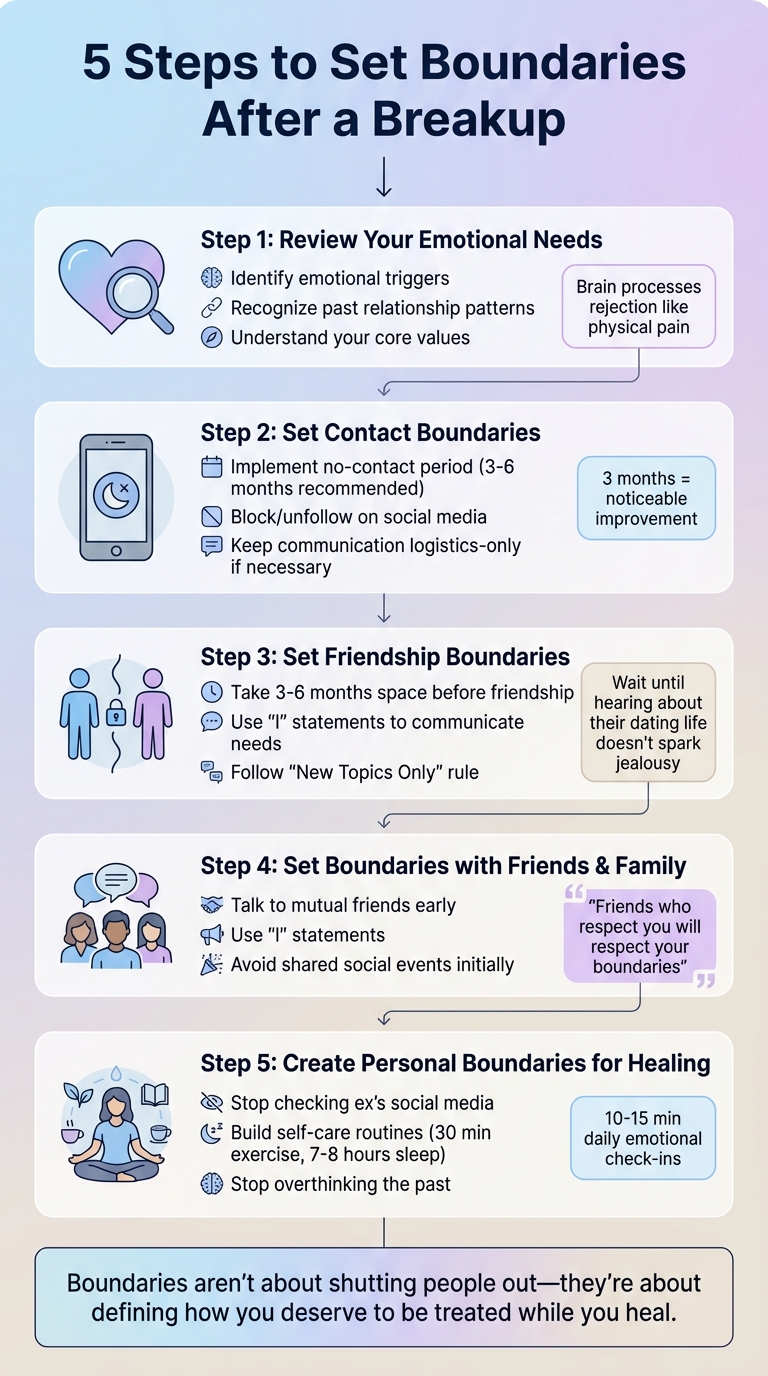
5 Steps to Set Boundaries After a Breakup
Boundaries After Breakups | Why you’re scared to set them & how to know what boundaries you need!
Step 1: Review Your Emotional Needs and Past Relationship
Take a moment to understand your emotional triggers and past relationship patterns — not to place blame, but to figure out what you need to protect your emotional well-being. Reflect on what specifically caused pain and identify behaviors or dynamics that need to change.
Think about your core values. These are the principles that make you feel secure and respected in a relationship. By reflecting on these, you can pinpoint where boundaries were crossed and where they need reinforcing. For instance, if honesty matters deeply to you and your ex often withheld information, you might decide that transparency will be non-negotiable moving forward.
Recognize Your Emotional Triggers
Triggers are those moments or reminders that send you into an emotional tailspin. Rereading old messages. Checking your ex’s social media. Walking past places you used to go together. When you feel overwhelmed, pause and try to identify the source of your distress.
Here’s the thing: research from Columbia University found that social rejection activates the same brain regions as physical pain. That’s not weakness — that’s just how your brain processes emotional hurt. If you catch yourself stuck in “what if” scenarios, try setting a limit on how much time you spend reflecting each day. Grounding statements, like “No reply does not mean rejection; it does not mean I am unlovable,” can also ease the emotional sting.
Spot Patterns from Past Relationships
Look for recurring behaviors in your past relationships that left you feeling undervalued or drained. Did you often say “yes” when you wanted to say “no”? Did you feel pressured to constantly justify yourself or check in? A 2020 study in the Journal of Social and Personal Relationships highlighted that people with high attachment anxiety tend to absorb their partner’s traits into their own identity. After a breakup, this can create “self-concept confusion” — a strong pull to reconnect just to feel whole again.
Go back through old messages and interactions. Were you seeking validation? Were your boundaries consistently ignored? Did your ex use guilt-tripping, gaslighting, or coercion? A 2022 study found that nearly everyone in relationships with emotionally manipulative partners experienced higher rates of PTSD and depression than those who’d experienced physical violence. As psychologist Mark Travers, Ph.D., puts it:
"Love does not excuse cruelty. The two cannot co-exist."
Recognizing these patterns is a foundational part of figuring out where to set boundaries in your future relationships. It’s about protecting your emotional health and creating space for genuine mutual respect.
Step 2: Set Contact Boundaries
Managing communication with your ex is a major part of creating the space you need to heal. This isn’t about being harsh or playing games — it’s about prioritizing your emotional recovery and breaking free from lingering attachments.
Choose a "No Contact" Period
A “no contact” period means cutting off all communication — no calls, texts, social media interactions (including likes and DMs), and no seeking updates through mutual friends. Think of it as a healing timeout for your mind and emotions.
How long should it last? Research published in the Journal of Positive Psychology found that most people actually overestimate how long their breakup pain will last — the real recovery window is typically around 11 weeks, with noticeable improvement often beginning after about three months. Dr. Ernesto Lira de la Rosa, a psychologist with the Hope for Depression Research Foundation, suggests three to six months for deep healing after a long-term relationship. For shorter relationships or a quick emotional reset, 21 to 30 days might be enough. If the relationship was toxic or abusive, permanent no contact may be the healthiest choice — full stop.
Before you start, consider having one final conversation or sending a clear message explaining your need for space. Use “I” statements to reduce defensiveness — something like, “I need some space right now to focus on healing. Please don’t reach out to me for the next few months.” If you share responsibilities like children, work, or finances, keep communication strictly about logistics. Let friends and family know about your no-contact plan and ask them not to relay updates about your ex. And have a plan ready for moments when you’re tempted to reach out — try journaling, calling a trusted friend, or going for a walk instead. Breakup coach Paige Wilhide puts it well:
"No-contact is a gift you give yourself so you can reconnect with your desires, your dreams, your passion, your light."
Control Social Media and Digital Connections
Social media acts as a constant reminder of the past — and it makes moving forward harder. Block or unfollow your ex on all platforms. You might even delete their phone number or change their display name to discourage late-night impulse texts.
Go further by adjusting your privacy settings to reduce reminders. Unfollow any accounts or content that might trigger memories tied to the relationship. A 2021 study in PLOS ONE found that limiting social media use to 30 minutes daily reduced loneliness scores by 25% — so even a broader social media detox can help you heal faster.
If blocking feels too drastic right now, start by limiting how often you check your ex’s profiles and work toward eliminating the habit entirely. Therapist John Kim, LMFT, explains the reasoning:
"Blocking is for your mental health, not for looking like a bad guy. You’re protecting yourself from unnecessary temptation."
Handle Unexpected Encounters
Sometimes running into your ex is unavoidable. If you share spaces or social circles, keep interactions brief and focused on logistics. Use “I” statements, and have an exit strategy ready if things get uncomfortable — something like, “I’m not comfortable talking right now. I need some space.”
If an encounter leaves you unsettled, take immediate steps to reset. Go for a walk, dive into a hobby, call a friend — anything that breaks the emotional loop.
Leanna Stockard, LMFT at LifeStance Health, offers a useful gut-check:
"A good question to ask yourself is, ‘Do I still have feelings for them?’ If the answer is yes, it may be too soon to contact them."
If managing these emotional triggers feels overwhelming, tools like Stumble offer 24/7 grounding support and daily check-ins to help you stay committed during your no-contact period.
Once you’ve set these boundaries, you can start establishing healthy friendship boundaries in the next step.
Step 3: Set Friendship Boundaries
Why Taking Space Matters
Jumping into a friendship with your ex too soon can seriously stall your healing. Experts suggest 3 to 6 months of no contact to give your brain the chance to break old emotional patterns and form new ones. Your brain processes the pain of a breakup in the same regions it processes physical hurt — which means rushing back into contact isn’t just emotionally risky, it’s neurologically counterproductive. As Sarah Thompson explains:
Research on attachment and emotional processing shows that attempting friendship too soon prevents the psychological detachment necessary for moving forward.
That space lets you reflect on the relationship, rebuild your sense of self, and release any lingering hopes of getting back together.
Express Friendship Boundaries Clearly
If you choose to explore a friendship eventually, set clear boundaries from the start. Use direct “I” statements to communicate your needs — something like, “I’d like for us to be friends eventually, but I need time to heal first. Let’s revisit this in two months.”
When you do reconnect, establish rules for communication — how often you’ll talk, which platforms you’ll use, which topics are off-limits. A helpful approach is the “New Topics Only” rule: focus on current interests, future plans, or mutual hobbies, and steer clear of rehashing the relationship. Meeting in group settings with mutual friends can also make the shift from romantic to platonic feel more natural.
Decide If Friendship Is Right for You
Before pursuing a friendship, ask yourself honestly: are you genuinely seeking a platonic connection, or are you secretly hoping for reconciliation? Marissa Moore warns:
It’s hard to get to a healthy place where friendship is possible if you feel hurt or have unresolved feelings about your relationship.
After spending time together, pay attention to how you feel. Do you leave the interaction feeling okay, or does it drain you? You’re probably ready for friendship when hearing about their dating life doesn’t spark jealousy and you can talk about the past without feeling overwhelmed. But if you’re still relying on your ex for emotional support — or obsessively checking their social media — that’s a sign you need more time.
If working through these emotions feels like too much, Stumble’s private journaling feature can help you sort through your feelings and track your progress. Once you’ve set boundaries with your ex, the next step is establishing clear limits with mutual friends and family.
Step 4: Set Boundaries with Friends and Family
Talk to Mutual Friends
Breakups don’t just affect you — they put mutual friends in an uncomfortable position too. They shouldn’t feel like they’re stuck in the middle. The best way to avoid that? Communicate your needs clearly, and do it early. “I” statements keep the focus on your feelings without putting anyone on the spot. For example: “I care about our friendship, but for my own healing, I’d prefer not to talk about [Ex’s Name] or the breakup.”
Katie Reseburg, Head of Content at Hello Divorce, suggests another option: “I’m okay with you staying friends with [Name], but I’d appreciate it if you avoid discussing our matters with her.” This sets the tone for healthy communication and cuts off the gossip loop before it starts. Karen Salerno, MSSA, LISW-S at Cleveland Clinic, adds:
"Setting boundaries really lets you get rid of toxic relationships that maybe you didn’t even know you had. If people don’t respect your boundaries, you learn very quickly that maybe some of your friends aren’t respectful of you."
If a friend slips up, gently but firmly remind them of your needs. Consistency matters here — it shows you’re serious, and friends who genuinely care about you will adjust. Once you’ve had those conversations, handling shared social situations gets a lot easier.
Handle Shared Social Spaces
Shared social settings can be tricky after a breakup. To minimize stress, try to avoid group events where your ex might show up — or ask for a heads-up if they’re planning to attend. If you share a friend group, alternating attendance at events is a completely reasonable option.
What if you run into your ex unexpectedly? Have a line ready. Something like: “It’s nice to see you, but I’m not comfortable talking right now. I’m going to grab a drink.” If they push your limits or make you uncomfortable, calmly restate your needs and leave. Walking away from a situation that feels overwhelming is always valid — don’t let anyone make you feel otherwise.
At larger gatherings, consider asking a trusted friend to act as a “boundary guardian” — someone who can help you hold your limits and provide backup if things get uncomfortable.
sbb-itb-ee19e1f
Step 5: Create Personal Boundaries for Healing
Stop Checking Your Ex’s Social Media
Scrolling through your ex’s profiles keeps you stuck in a cycle of longing and sadness. Research is pretty clear on this — social media use after a breakup is linked to heightened feelings of loneliness and depression. Katherine Ibis, a Licensed Mental Health Counselor, puts it plainly:
"Social media creates an environment for stalking and unhealthy fixation, along with opportunities for passive-aggressive bullying."
If cutting ties completely feels overwhelming, start by muting their posts. But if their content causes immediate distress, blocking is the better call. To resist the urge to check their profile, create a short reminder — something like “I need space to focus on myself” — and read it whenever the temptation hits. If you find yourself spiraling into obsessive checking, break the pattern: step outside for fresh air, call a friend, or tackle a productive task like tidying up.
Alongside managing these digital habits, building a self-care routine can help you regain emotional balance.
Build Self-Care Routines
Personal boundaries extend to how you treat yourself. Daily routines provide much-needed stability during a turbulent time. Aim for at least 30 minutes of physical activity, 7–8 hours of sleep, and a few minutes of mindfulness each day — these all help stabilize your mood and release endorphins that naturally fight anxiety and depression.
Dedicate 10–15 minutes daily to check in with your emotions through journaling, sketching, or meditation. A study in Frontiers in Psychology found that journaling about emotional experiences reduces distress by up to 40% in acute grief — so this isn’t just feel-good advice, it works. Immersing yourself in hobbies that require focus — gardening, painting, learning something new — offers a healthy distraction too. Stumble (https://joinstumble.com) provides a private space for journaling and daily emotional check-ins, making it easier to stay consistent with your self-care and track your progress.
Stop Overthinking the Past
Once you’ve built a foundation of physical self-care, it’s time to address the mental loop — that exhausting habit of replaying memories and rehearsing conversations that never happened. When you feel the urge to send a heartfelt text or reach out impulsively, write your thoughts down instead, or talk them through with a trusted friend. Only act when you feel calm and centered. Psychologist Mark Travers, Ph.D., offers a grounding perspective:
"If I feel abandoned, I’ll sit with the pain, not chase relief from the person who caused it."
Grounding mantras like “That was then, this is now” can help separate old wounds from your current reality. Swap out sad movies and love songs for uplifting music, comedies, or lighthearted books. And if you shared a living space with your ex, consider rearranging or redecorating — even small changes help reclaim your space as a sanctuary rather than a museum of the relationship.
Why Boundaries Help You Heal
Boundaries aren’t just about keeping your ex at a distance — they’re about reclaiming your sense of self and emotional stability. After a breakup, it’s common to experience what researchers call “self-concept confusion,” where your identity feels tangled up with your former partner’s. A 2020 study published in the Journal of Social and Personal Relationships found that people with high attachment anxiety often face intense identity disruption — which can fuel a strong urge to reconnect, even when the relationship was harmful. Setting boundaries creates space to rediscover your autonomy and who you actually are.
Think about it this way: your brain is already working hard to process the pain of loss. Clear boundaries act as a stabilizing force — they help you get through heartbreak with self-compassion rather than seeking fleeting comfort from your ex. As Licensed Marriage and Family Therapist John Kim puts it:
Creating boundaries helps you gain clarity and perspective and grow as a person.
Without boundaries, you risk falling into patterns that erode your self-worth. Research from 2022 in the International Journal of Offender Therapy and Comparative Criminology found that emotional manipulation — gaslighting, coercion, psychological control — can lead to higher rates of PTSD and depression than physical violence. Setting firm boundaries sends a clear message that mistreatment has consequences. Psychologist Mark Travers, Ph.D., says it well:
Love should not require the erosion of your dignity.
The benefits extend far beyond the immediate aftermath of a breakup, too. Boundaries build assertiveness and self-confidence — laying the groundwork for healthier relationships later. Karen Salerno, MSSA, LISW-S, from Cleveland Clinic, explains:
Setting boundaries really lets you get rid of toxic relationships that maybe you didn’t even know you had.
Over time, you get sharper at distinguishing supportive people from harmful ones — and you develop a personal standard for how you deserve to be treated. That’s not a small thing. Stumble’s daily check-ins and 24/7 grounding support can help you stay on track while you build that foundation, with a private journaling feature that reinforces the boundaries you’ve worked hard to establish.
How to Communicate Your Boundaries
Clear communication is where boundaries either hold or fall apart. “I” statements are your best tool here — they let you express your feelings without placing blame. As Hello Divorce explains:
I statements are a form of assertive communication that focuses on the speaker’s feelings, beliefs, and needs rather than the listener’s behaviors or thoughts.
Don’t be vague. “I need more space” means nothing to most people. Instead, be specific: “I need some space right now. Let’s take a break from all communication for a week.” If you’re co-parenting, try: “I’d appreciate it if, for the next two months, you only contact me regarding situations involving the kids.” Keeping communication factual and logistical helps keep things calm.
Don’t apologize for needing space. Your boundaries are part of your healing process — full stop. Karen Salerno from Cleveland Clinic is direct about this:
If you don’t act on [boundaries], it may make it harder for other people to trust your boundary setting.
If someone crosses a boundary you’ve clearly stated, address it right away. If it keeps happening, follow through with the consequences you’ve outlined — end the conversation, limit contact, or block them entirely. Consistency is what makes boundaries real.
Use Clear and Direct Language
Keep your statements brief, specific, and focused on your own needs — not on criticizing the other person. If someone touches you unexpectedly, you could say: “It’s nice to see you, but I don’t feel comfortable with you touching me. If we can’t just stand and talk, then I’d like to leave.” With mutual friends: “I’m okay with you staying friends with [Name], but I’d appreciate it if you avoid discussing our matters with them.” At work: “We decided to stop seeing each other, but we’re committed to maintaining a good working relationship.” Direct language eliminates confusion and sets clear expectations from the start.
Set Timeframes for Your Boundaries
Timeframes make boundaries easier to understand and enforce. By specifying a duration, you set clear expectations — and give yourself a natural checkpoint to reassess. You might say: “Let’s pause communication for one week.” Or, if you’re open to reconnecting eventually: “I’d eventually like it if we could be friends, but I need time to heal right now. Maybe we can check in with each other in a couple of months.” This reinforces that boundaries are tools for healing, not permanent punishments.
If expressing yourself in emotional moments is hard, Stumble’s private journaling and guided healing content can help you sort through your thoughts and prepare for these conversations before they happen.
Conclusion: Move Forward with Healthy Boundaries
Setting boundaries after a breakup isn’t about shutting people out — it’s about defining how you deserve to be treated while you heal. The five steps here offer a clear path: assess your emotional needs, establish contact boundaries, define friendship boundaries, set limits with friends and family, and protect your personal healing. Each step reinforces the next, helping you rebuild self-respect and clarity.
Boundaries aren’t set in stone, either. As Karen Salerno from Cleveland Clinic explains:
As your life changes, your relationships will change and evolve over time. If you ever feel like something is off, it’s never too late to get back on track and re-establish boundaries that make sense at the time.
Check in with your boundaries regularly to make sure they still reflect where you are in your healing process.
Start firm, then adjust as needed. Katie Reseburg from Hello Divorce makes the case clearly:
It’s far easier to adjust boundaries as you grow more comfortable than to inflict harsh boundaries when you realize you’ve been too lax.
If you need to, maintain a strict no-contact period and loosen things up as you regain your footing.
Let me be honest: your healing journey is personal and yours alone. John Kim, LMFT, says it plainly:
Setting boundaries is an act of self-care and self-respect essential for your healing and well-being.
Don’t feel guilty for protecting your peace. Whether you’re journaling, leaning on supportive friends, or using tools like Stumble’s guided healing content, focus on what helps you rebuild and move forward. Every boundary you set is a step toward reclaiming yourself — and toward a healthier future.
FAQs
How long should you follow the no-contact rule after a breakup?
The no-contact rule is a boundary you set for yourself — to aid your healing and find emotional clarity after a breakup. Generally, it’s suggested to avoid contact for 3 weeks to 6 months, depending on how serious the relationship was and where you are emotionally.
This time gives you space to work through your feelings, rebuild your confidence, and create healthy distance. Focus on your own well-being during this period, and remember — there’s no universal timeline for healing. Your journey is entirely your own.
How can I stop myself from checking my ex’s social media after a breakup?
Resisting the urge to check your ex’s social media is genuinely hard — but there are steps that make it easier. Start by unfollowing, muting, or blocking them across your platforms. That simple move removes the temptation before it starts.
From there, shift your focus to offline activities. Hang out with friends, pick up a new hobby, get moving — these keep your hands and mind occupied. You can also set limits on your overall social media use, like capping screen time or turning off notifications. The goal isn’t perfection; it’s building a habit of redirecting your attention toward yourself.
How do I set boundaries with mutual friends after a breakup?
Setting boundaries with mutual friends after a breakup can feel awkward — but it’s really about clear, kind communication. Let your friends know what you need to feel supported. You might ask them to avoid bringing up your ex in conversation, or to understand if you skip certain social events for a while. Be honest, but gentle — these boundaries are about taking care of yourself, not a judgment on the friendship.
Consistency matters too. If a friend forgets or crosses a line, politely remind them of your needs or steer the conversation somewhere else. Over time, this builds mutual understanding — and you’ll quickly learn which friends genuinely have your back.
Related Blog Posts
- What to Do When You Miss Your Ex: 8 Healthy Steps
- No Contact vs Low Contact: Which Helps You Heal?
- The Complete Guide to Healing After a Breakup
- How Long Does It Take to Get Over a Breakup?
STUMBLE APP
Ready to start healing?
Stumble gives you the community, tools, and support to move forward — free on iOS.